
How Much Does It Cost for Google Ads?
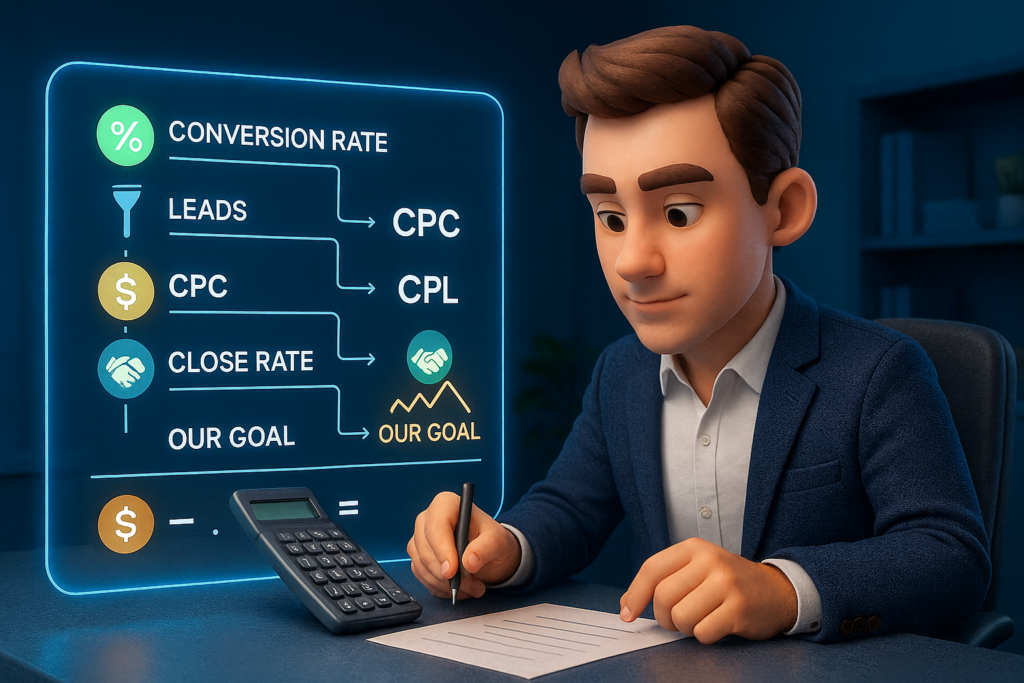
If you are planning your marketing budget for the year ahead, the first question on your mind is almost always the same: how much does it cost for Google Ads?
It is the question every business owner asks, and the honest answer—”it depends”—is rarely helpful. Because Google Ads operates on a live auction system, there is no fixed price tag. Your costs are influenced by your industry, your location, and how aggressively your competitors are bidding.
However, „it depends” doesn’t help you write a check. In this guide, we break down the latest benchmarks, providing the data and formulas you need to understand how much does it cost for Google Ads in 2026 so you can set a budget that actually delivers ROI.
TL;DR: Google Ads Cost Summary (2026 Outlook)
If you need the numbers fast, here are the key stats based on the latest data: * Average Cost Per Click (CPC): Typically ranges between $4.51 and $8.34 on Search. * Average Cost Per Lead (CPL): Approximately $70.11 across all industries.
* Typical Small Business Budget: Most small businesses invest $1000 – $5,000 per month.
* Minimum Starting Budget: While there is no official minimum, the recommendation starts with at least $10 – $30 per day to gather meaningful data.
What You Will Learn in This Guide: We have moved past generic advice to give you
a concrete pricing blueprint. Below, you will find updated industry-specific cost tables,
a step-by-step formula to calculate your exact monthly budget, and proven strategies to lower your Cost Per Click without sacrificing lead quality.
How Much Does It Cost for Google Ads in 2026? (Industry Benchmarks)
To get a realistic answer to how much does it cost for Google Ads, you need to look at the latest market data. We have broken down the 2026 benchmarks to show you exactly what to expect.
Average CPC (Cost Per Click) & CPL Data (Source: WordStream)
According to the latest benchmarks from WordStream, the baseline costs for advertisers have shifted.
- Average Cost Per Click (CPC): The average cost across all industries is now $5.26.
- Average Cost Per Lead (CPL): The average amount you pay to acquire a lead is $70.11.
This data serves as a crucial baseline. If your campaigns are achieving a CPC lower than $5.26, you are performing better than the global average for small-to-medium businesses.
How Much Does It Cost for Google Ads by Industry? (Comparison Table: Dental vs. Insurance)
The „average” cost can be misleading because pricing varies wildly by sector. To illustrate this, let’s compare a Dental Clinic (a high-trust local service) against an Insurance Company (a high-competition national service).
The difference demonstrates why industry context is vital.
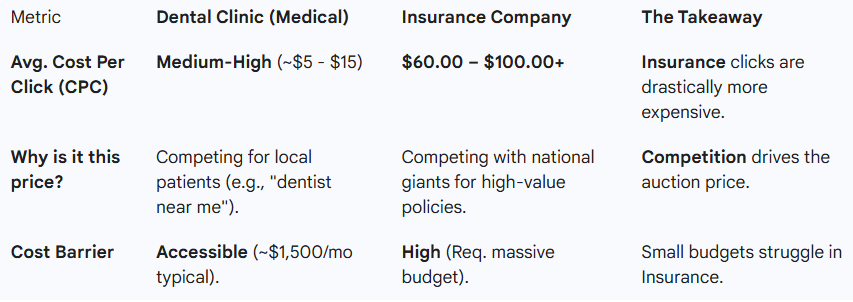
Source: WebFX & WordStream Industry Benchmarks
Why the difference? Data from WebFX shows that high-competition verticals like insurance consistently incur CPCs exceeding $60 and occasionally over $100 per click. This is due to the massive lifetime value of a new policyholder. In contrast, local medical services generally face lower costs compared to these national giants.
How Much Does It Cost for Google Ads for Small Businesses? (Budgeting)
One of the most common questions from local business owners is: „Is my budget enough?”
While large corporations spend millions, you do not need an enterprise budget to see results. For small businesses, how much it costs for Google Ads is largely determined by your specific lead goals and how much revenue you reinvest into marketing.
Typical Monthly Budgets ($500 – $5,000 range)
For most small businesses, the „sweet spot” for a monthly ad spend falls between $500 and $5,000.
- The Starter Tier: Many businesses start with a budget of $1,000 – $2,500 per month to cover basic Google Ads costs and gather initial data.
- The Growth Tier: Established mid-size companies often scale up to $5,000 – $50,000 monthly once they have proven their return on investment (ROI).
- The Revenue Rule: A common rule of thumb for small businesses is to reinvest 5-15% of revenue back into advertising to fuel consistent growth.
Determining Your Daily Budget (Starting at $10-$20/day)
Google Ads operates on a daily budget, not a monthly one. To calculate this, you divide your total monthly limit by 30.4 (the average number of days in a month).
- Minimum Viable Budget: Google’s help community suggests that new advertisers can start with as little as $10 per day (approximately $300 per month) to test the platform.
- Recommended Range: For faster results, data suggests most effective small business campaigns run on $20 – $50 per day.
Note: If you set a budget of $10/day, you might spend $15 on Tuesday and $5 on Wednesday. Google optimizes this automatically but will never exceed your daily budget × 30.4 over the course of a month.
The Budget Formula: (Leads Needed / Conv. Rate) * CPC
Don’t guess your numbers. You can calculate exactly how much it costs for Google Ads to hit your specific goals using this reverse-engineering formula:
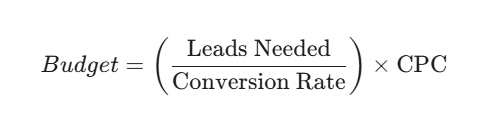
Here is how it works in practice:
Let’s say you are a local HVAC company wanting 20 new leads per month. Your website converts visitors at 5%, and the average CPC for your industry is roughly $5.0010.
- Calculate Clicks Needed: 20 Leads ÷ 0.05 (5%) = 400 Clicks.
- Calculate Budget: 400 Clicks × $5.00 CPC = $2,000/Month.
By using this formula, you stop asking „how much does it cost” and start asking „how many customers can I afford to buy?”
Taking it One Step Further: Cost Per Lead vs. Paying Clients
Calculating the budget is only half the battle. You also need to know if that spending is profitable. This requires understanding two more numbers: your Cost Per Lead (CPL) and your Close Rate.
- Your Cost Per Lead (CPL) Based on the math above, if you spend $2,000 to get 20 leads, your Cost Per Lead is $100.
- Is $100 expensive? It depends. If you sell $20 socks, yes. If you sell $5,000 HVAC installs, $100 is a bargain.
- From Leads to Paying Clients (The „Close Rate”) Getting the phone to ring is marketing; answering it is sales. Not every lead will hire you. Let’s assume your sales team closes 20% of the leads (1 in 5 callers becomes a paying customer).
- Total Leads: 20
- Close Rate: 20%
- New Paying Clients: 4 Clients (20 × 0.20)
- Cost Per Acquisition (CPA): $500 ($2,000 Budget ÷ 4 Clients)
The Final Verdict: In this scenario, you are paying $500 to „buy” a new customer. If an average HVAC job is worth $5,000, you are trading $500 for $5,000—a 10x return on investment. This is how smart businesses determine if how much it costs for Google Ads is „worth it.”

Let's Talk!
I’m here to help you grow your business with the power of Google Ads. If you’re ready to take your campaigns to the next level – Schedule My Free Consultation
How Google Determines Your Costs (The Auction Model)
Many advertisers assume that Google Ads works like a traditional store: you see a price tag, you pay it, and you get the traffic. However, the reality is far more complex. The answer to „how much does it cost for google ads” changes in real-time, every single millisecond, because the platform operates on a live auction system.
Every time a user types a query into Google, an auction runs instantly to determine which ads show up and in what order. This means you aren’t just paying a fee; you are competing against other businesses for that specific moment of user attention. Understanding how this „black box” works is the single most important step in lowering your costs while maintaining your position.
Ad Rank Explained (Max Bid x Quality Score)
The biggest misconception in paid search is that the advertiser with the deepest pockets always wins. If that were true, small businesses could never compete against Amazon or Walmart. Fortunately, Google uses a metric called Ad Rank to level the playing field.
Google’s priority is to show users the most relevant information, not just the most expensive ad. If users keep clicking irrelevant ads, they will stop using Google. To balance revenue with user experience, Google calculates your position using this formula:

Max CPC Bid: This is the maximum amount you have told Google you are willing to pay for a click.
Quality Score: This is a rating from 1 to 10 that judges how relevant your ad copy, keywords, and landing page are to the user’s search.
Why this matters for your wallet: This system means that a high-quality ad can actually beat a high-paying ad. For example, if your competitor bids $10.00 but has a terrible Quality Score of 1/10, their Ad Rank is 10. If you have a perfect Quality Score of 10/10, you might only need to bid $1.01 to beat them. Improving your ad relevance is the only way to lower your cost per click without sacrificing traffic.
Why You Rarely Pay Your Full Bid (Second-price auction)
One of the distinct advantages of the Google Ads platform is that it uses a „Second-Price Auction” model. This is designed to encourage advertisers to bid their true value without fear of overpaying.
In a second-price auction, you do not pay what you bid. You only pay $0.01 more than the amount required to beat the advertiser directly below you in the auction results.
The formula for your Actual CPC is roughly:

A Practical Example:
Imagine you bid $5.00 on the keyword „emergency plumber.”
- Your main competitor bids $4.00.
- Because of your Quality Score, Google determines that you only need to pay $4.01 to maintain your position above them.
- Even though you were willing to pay $5.00, Google only charges you $4.01.
This mechanism ensures that how much it costs for Google Ads is fair relative to the competition, rather than arbitrarily expensive.
Search vs. Display vs. Video Pricing
Finally, „how much does it cost” depends entirely on where your ad appears. Different networks have different intent levels, which dictates the price.
- Search Network (Google Search Results):
This is the premium inventory. Users are actively typing in problems they need to solve (e.g., „buy running shoes”). Because the intent to purchase is high, the competition is fierce. As noted in our benchmarks, Search ads typically cost between $1.00 and $8.00+ per click depending on the industry. - Display Network (Banner Ads):
Display ads appear on third-party websites, news blogs, and apps. These are „interruption” ads—the user is reading an article, not looking for your product. Because the intent is lower, the cost is significantly cheaper. Display clicks often cost under $1.00, making them excellent for brand awareness but less effective for immediate lead generation. - Video (YouTube):
Video ads often use a different pricing model entirely, such as Cost Per View (CPV). You might only pay if a user watches at least 30 seconds of your video. This can be incredibly cost-effective, often ranging from $0.10 to $0.30 per view, offering a cheap way to build familiarity before a user ever searches for your brand.
Top 5 Factors Influencing How Much Does It Cost for Google Ads
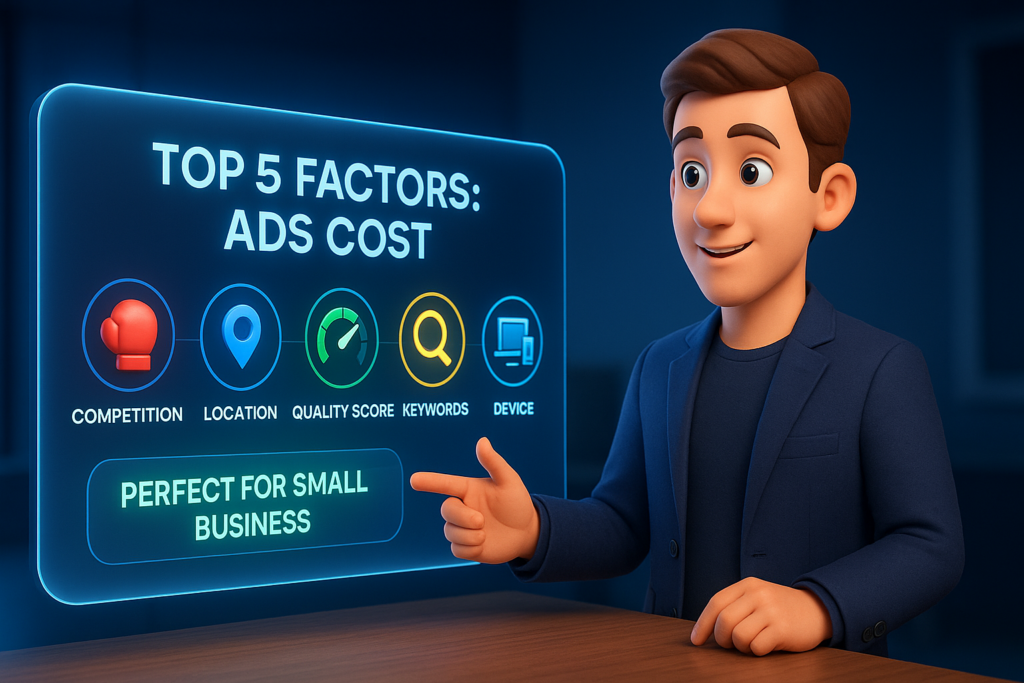
You now know the benchmarks, but why does one business pay pennies while another pays a premium? The answer to „how much does it cost for google ads” is rarely static. It fluctuates based on five critical variables. Understanding these allows you to stop guessing and start optimizing.
Industry Competition (Why Insurance costs more than Socks)
The single biggest driver of cost is your industry. This pricing disparity comes down to Customer Lifetime Value (CLV).
- High Cost (Insurance): A new car insurance customer might stay for 10 years, paying thousands in premiums. Because the lead is so valuable, companies bid aggressively. This is why insurance keywords consistently incur CPCs of $60+ and occasionally over $100 per click.
- Low Cost (Retail/Socks): If you sell a pair of socks for $15, you cannot afford to pay $5 for a click. The market self-corrects, keeping CPCs in apparel and entertainment often below $1.00.
The Rule: The more money you make from a single customer, the more your competition is willing to pay to acquire them.
Geographic Location & Seasonality
Where and when you advertise changes the price tag.
- Location: Costs vary significantly by city. A plumber in a dense, competitive market like New York City will pay a much higher CPC than one in a rural town, simply because there are more competitors bidding for the same screen space.
- Seasonality: Timing matters. Tax preparation services see CPC spikes in Q1, while retail sees spikes in Q4. Additionally, data shows that overall CPCs have risen roughly 12.9% year-over-year, meaning standing still is actually getting more expensive.
Quality Score (The biggest cost variable you control)
If you want to lower your costs, this is your most powerful lever. Quality Score is Google’s rating (1-10) of your ad’s relevance.
Google rewards high-quality ads with lower costs. If your ad text matches the user’s search and your landing page is helpful, Google will charge you less per click than a competitor with a lower score.
- Action: improving your landing page experience is often more profitable than simply increasing your budget.
Keywords & Match Types
The specific keywords you choose directly dictate your price.
- Broad Match: These keywords capture a wide audience but often bring in lower-intent traffic (e.g., someone searching „free dentist advice”). They might be cheaper, but they waste budget.
- Long-Tail Keywords: Specific phrases (e.g., „dentist near me miami”) often have less competition and higher intent. Using these „long-tail” keywords is a key strategy to reduce wasted spend.
Device Targeting (Mobile vs. Desktop)
How users find you affects what you pay.
- Mobile Dominance: With mobile devices now driving nearly 70% of clicks, mobile traffic is often high-volume but competitive for „near me” local searches.
Strategy: Depending on your industry, you might find that desktop clicks (often B2B) cost more but convert better, or vice versa. You can adjust your bids by device to control how much it cost for google ads on phones versus computers.
Strategies to Lower Your Google Ads Costs
The benchmarks might say the average click costs $5.26, but that does not mean you have to pay that. Smart advertisers do not just accept the market price; they optimize to beat it.
If you are asking „how much does it cost for google ads” because you are worried about overspending, applying these four strategies can significantly reduce your wasted spend and improve your return on investment (ROI).
Improving Ad Relevance & Quality Score
The fastest way to discount your clicks is to improve your Quality Score. As we explained in the auction model, Google rewards relevance.
- The Strategy: Tightly group your keywords. Do not have one ad group for „Shoes” containing keywords for „hiking boots,” „sneakers,” and „sandals.”
- The Action: Create specific ad groups where the keyword, the ad copy, and the landing page headline all match perfectly.
- The Result: Higher relevance leads to a higher Quality Score, which directly lowers your actual CPC. Steps like improving landing page speed and relevance are critical to raising this score.
Using Negative Keywords to Stop Waste
One of the biggest budget drains is paying for clicks from people who will never buy from you.
- The Strategy: Use Negative Keywords to tell Google which searches to exclude.
- The Action: Regularly review your „Search Terms Report.” If you sell high-end consulting, add words like „free,” „cheap,” „internship,” or „jobs” as negatives.
- The Result: You stop paying for „junk clicks,” ensuring your budget only goes toward high-intent users.
Geotargeting & Ad Scheduling
Why pay for ads when your business is closed or in cities you don’t service?
- Geotargeting: CPCs vary widely by location—for example, a plumber’s CPC can fluctuate from $15 to $60 depending on the city. Use geofencing to target only your most profitable zip codes or radius.
- Ad Scheduling (Dayparting): If your sales team is only available 9-to-5, consider turning your ads off at night. Scheduling ensures you don’t pay for leads that go cold before you can call them back.
Leveraging AI & Performance Max
In 2026, manual bidding is becoming less efficient compared to AI-driven strategies.
- Performance Max (PMax): This campaign type uses Google’s AI to find customers across YouTube, Display, Search, and Maps simultaneously. It is designed to maximize conversions rather than just clicks.
- AI Bidding: Strategies like Target CPA (Cost Per Action) or Target ROAS (Return On Ad Spend) let Google’s algorithms adjust your bids in real-time for every single auction, aiming to get you the most conversions for your specific budget.
The Benefit: Automation helps navigate complex factors like device trends and changing search behaviors (like AI Overviews) that are hard to manage manually.
Comparison: How Much Does It Cost for Google Ads vs. Facebook Ads?
Contents
- 1. How Much Does It Cost for Google Ads?
- 1.1. How Much Does It Cost for Google Ads?
- 1.2. How Much Does It Cost for Google Ads in 2026? (Industry Benchmarks)
- 1.3. How Much Does It Cost for Google Ads for Small Businesses? (Budgeting)
- 1.4. Let's Talk!
- 1.5. How Google Determines Your Costs (The Auction Model)
- 1.6. Top 5 Factors Influencing How Much Does It Cost for Google Ads
- 1.7. Strategies to Lower Your Google Ads Costs
- 1.8. Comparison: How Much Does It Cost for Google Ads vs. Facebook Ads?
- 1.9. So, How Much Does It Cost for Google Ads?
- 1.10. FAQ: How Much Does It Cost for Google Ads
- 1.10.1. What is the average monthly spend when asking "How much does it cost for Google Ads"?
- 1.10.2. How much does it cost for Google Ads per click in 2026?
- 1.10.3. Is there a minimum budget for how much does it cost for Google Ads?
- 1.10.4. How much does it cost for Google Ads for a small local business?
- 1.10.5. Does the industry affect how much does it cost for Google Ads?
- 1.10.6. Are there hidden fees in how much does it cost for Google Ads?
- 1.10.7. How can I lower Google Ads cost without losing leads?
- 1.10.8. How much does it cost for Google Ads compared to Facebook Ads?
- 1.10.9. Is it worth paying for Google Ads?
- 1.10.10. How do daily limits control how much does it cost for Google Ads?
- 1.10.11. Daniel Ostrzyzek
- 1.11. Let's Talk!
When managing a budget, you inevitably face the choice between Google and Meta (Facebook/Instagram). While Google Ads captures users who are looking for you, Facebook Ads interrupts users to show them something they might like.
This fundamental difference in „Intent” drives the massive price gap between the two platforms.
CPC and Intent differences between the two platforms
If you strictly look at the price tag, Facebook is cheaper. However, „cheap” does not always mean „profitable.”
- Cost Per Click (CPC) Comparison:
- Google Ads: The average CPC for Search is typically $2.69 – $5.26. It is more expensive because you are paying for high-intent users (e.g., someone searching „buy leather boots”).
- Facebook Ads: The average CPC is significantly lower, often ranging from $0.70 – $1.92.
- The „Intent” Factor:
- Google = Demand Capture: Google Ads are „pull” marketing. The user has a problem and is actively searching for a solution. Because the intent to buy is high, conversion rates are typically strong (averaging ~7.5% for search ads).
- Facebook = Demand Generation: Facebook Ads are „push” marketing. Users are passively scrolling through their feed to see photos of friends, not to buy your product. You have to interrupt them. While the clicks are cheap, the conversion rate is often lower (~2.5% – 3%) because the user wasn’t planning to shop.
Verdict: Use Google Ads when you need immediate sales (e.g., „Emergency Plumber”). Use Facebook Ads for brand awareness, retargeting, or visually appealing products that people didn’t know they needed.
When to use SEO vs. PPC
Should you pay for clicks (PPC) or earn them organically (SEO)? The answer depends on your timeline.
- PPC (Pay-Per-Click):
- Speed: Immediate. You can generate traffic and leads within hours of launching a campaign.
- Cost: You pay for every single visitor. The moment you stop spending, the traffic stops completely.
- Best For: New product launches, testing specific keywords, or generating immediate cash flow.
- Speed: Immediate. You can generate traffic and leads within hours of launching a campaign.
- SEO (Search Engine Optimization):
- Speed: Slow. It typically takes 3 to 12 months to see significant results and ROI.
- Cost: High upfront effort (content, technical fixes), but the traffic is effectively „free” once you rank.
- Best For: Long-term brand authority and sustainable growth. Data shows SEO often delivers a higher ROI (500%+) over the long haul because you aren’t paying a „rent” for every click.
- Speed: Slow. It typically takes 3 to 12 months to see significant results and ROI.
The Winning Strategy: Do not choose one. Smart businesses use PPC to get sales now while building their SEO foundation for later. A common mix is allocating 60-70% of the budget to PPC for immediate returns while investing the rest in content for long-term organic growth.
So, How Much Does It Cost for Google Ads?
We started this guide with a simple question, and now you have the data to answer it for your specific business.
So, how much does it cost for Google Ads in 2026? For most small businesses, a healthy starting budget is typically between $1,000 and $2,500 per month , with an average cost per click ranging from $4.50 to $8.34 depending on your industry.
Remember, the goal isn’t just to spend money—it’s to make money. By focusing on your Quality Score, rigorously using negative keywords, and calculating your budget based on your specific lead goals, you can turn Google Ads from a confusing expense into a profitable revenue engine.
Ready to maximize your budget? You don’t have to guess your numbers. At Danny Ads, we specialize in helping local businesses calculate and growth service businesses.
FAQ: How Much Does It Cost for Google Ads
What is the average monthly spend when asking "How much does it cost for Google Ads"?
While every campaign is different, most data suggests that how much does it cost for Google Ads for a typical mid-sized business averages between $1,000 and $10,000 per month. This budget allows for enough clicks to generate consistent data and leads.
How much does it cost for Google Ads per click in 2026?
When breaking down how much does it cost for Google Ads by individual clicks, the average Cost Per Click (CPC) on the Search Network ranges from $4.51 to $8.34 depending on your industry, while Display ads are often under $1.00.
Is there a minimum budget for how much does it cost for Google Ads?
There is no official minimum, but to evaluate how much does it cost for Google Ads effectively, experts recommend a starting budget of at least $10 to $20 per day. Spending less than this often means your ads won’t show enough to get results.
How much does it cost for Google Ads for a small local business?
For local service providers, how much does it cost for Google Ads typically falls in the $500 to $5,000 per month range. This is usually sufficient to cover a specific geographic area (like a single city) without overspending.
Does the industry affect how much does it cost for Google Ads?
Yes, your industry is the biggest factor in how much does it cost for Google Ads. For example, competitive insurance keywords can exceed $50 per click, while Retail and Fashion keywords often cost less than $1.00.
Are there hidden fees in how much does it cost for Google Ads?
No, there are no hidden fees in how much does it cost for Google Ads; you only pay when someone clicks your ad (PPC). However, if you hire an agency to manage the campaign for you, that management fee is separate from the ad spend paid to Google.
How can I lower Google Ads cost without losing leads?
You can significantly reduce cost by improving your Quality Score (making ads more relevant) and using Negative Keywords to prevent your ads from showing for irrelevant searches like „free” or „jobs”.
How much does it cost for Google Ads compared to Facebook Ads?
Generally, for Google Ads (Avg CPC ~$5.26) is higher than Facebook Ads (Avg CPC ~$1.92). This is because Google Ads targets users with „high intent” who are actively searching to buy, whereas Facebook is passive.
Is it worth paying for Google Ads?
For most businesses, the return on investment justifies how much does it cost for Google Ads. Since you capture customers at the exact moment they are searching for a solution, Google Ads often delivers a faster ROI than organic marketing (SEO).
How do daily limits control how much does it cost for Google Ads?
You set a daily budget cap to control spending. Google ensures that Google Ads cost never exceeds your daily budget multiplied by 30.4 (the average days in a month) over the course of your billing cycle.

Daniel Ostrzyzek
Hi, I’m Daniel Ostrzyzek, a passionate Google Ads specialist with over 8 years of experience. I work with small to medium-sized businesses to help them attract leads, achieve their growth goals, and maximize ROI through Google Ads campaigns. After discovering my passion for digital marketing, I dove deep into Google Ads. Over the years, I’ve gained valuable experience working with businesses across various industries. I specialize in Google Ads Search and lead generation campaigns, helping my clients maximize the results of their online advertising.
Let's Talk!
I’m here to help you grow your business with the power of Google Ads. If you’re ready to take your campaigns to the next level – Schedule My Free Consultation