
What Is a Good Conversion Rate for Google Ads?
- Published:2026-04-20
- Updated: 2026-05-07
What Is a Good Conversion Rate for Google Ads?

Key Takeaways (TL;DR) * Industry Average: WordStream’s 2025 report puts the average conversion rate at roughly 7.5% across all industries.
E-commerce vs. Services: E-commerce typically converts at 2–5% , while service businesses range from 5–10%.
Source: https://www.wordstream.com/blog/2025-google-ads-benchmarks
The Real Metric: Averages can mislead you. A „good” conversion rate is simply the one that hits your target Cost Per Lead (CPL).
Every advertiser wants to know: what is a good conversion rate for Google Ads? While benchmark reports show a 7.5% average across all industries, this number can be wildly misleading.
Recently, a service business owner came to me panicking over a 6% conversion rate. Yet, his cost per lead was perfectly on target and his calendar was full. The problem wasn’t his performance; it was comparison. In reality, I’ve seen highly profitable campaigns at 5% and completely unprofitable ones bleeding money at 12%.
This guide demystifies industry benchmarks , exposes common measurement traps that skew your data , and gives you the simple formula to calculate the exact conversion rate your business actually needs. Stop guessing, and let’s do the math.
Contents
- 1. What Is a Good Conversion Rate for Google Ads?
- 1.1. What Is a Good Conversion Rate for Google Ads?
- 1.2. Watch My Video I Created for You
- 1.3. Understanding Conversion Rate in Google Ads
- 1.4. How to Calculate Your Conversion Rate
- 1.5. Let's Talk!
- 1.6. Setting up conversion tracking correctly in Google Ads
- 1.7. Average and Benchmark Conversion Rates
- 1.8. Benchmarks by campaign type (Search, Display, Shopping, Performance Max)
- 1.9. Factors That Affect Your Google Ads Conversion Rate
- 1.10. Beyond Conversion Rate: Evaluating ROAS and Profitability
- 1.11. Tools to track revenue and measure profitability for Google Ads
- 1.12. FAQ: What Is a Good Conversion Rate For Google Ads
- 1.12.1. What is considered a good conversion rate for Google Ads overall?
- 1.12.2. Is a 10% conversion rate good for Google Ads lead generation?
- 1.12.3. How do I calculate if I have a good conversion rate for Google Ads?
- 1.12.4. Why is my average Google Ads conversion rate so low?
- 1.12.5. Does a typical good conversion rate for Google Ads differ between Search and Display campaigns?
- 1.12.6. How many conversions are needed to achieve a good Google Ads conversion rate with smart bidding?
- 1.12.7. What is a good cost per conversion compared to a good conversion rate in Google Ads?
- 1.12.8. How does keyword match type affect my ideal Google Ads conversion rate?
- 1.12.9. What is a good conversion rate for landing pages running Google Ads traffic?
- 1.12.10. Should I focus on getting a good conversion rate for Google Ads or a high return on ad spend (ROAS)?
- 1.12.11. Daniel Ostrzyzek
- 1.13. Let's Talk!
Watch My Video I Created for You
Understanding Conversion Rate in Google Ads
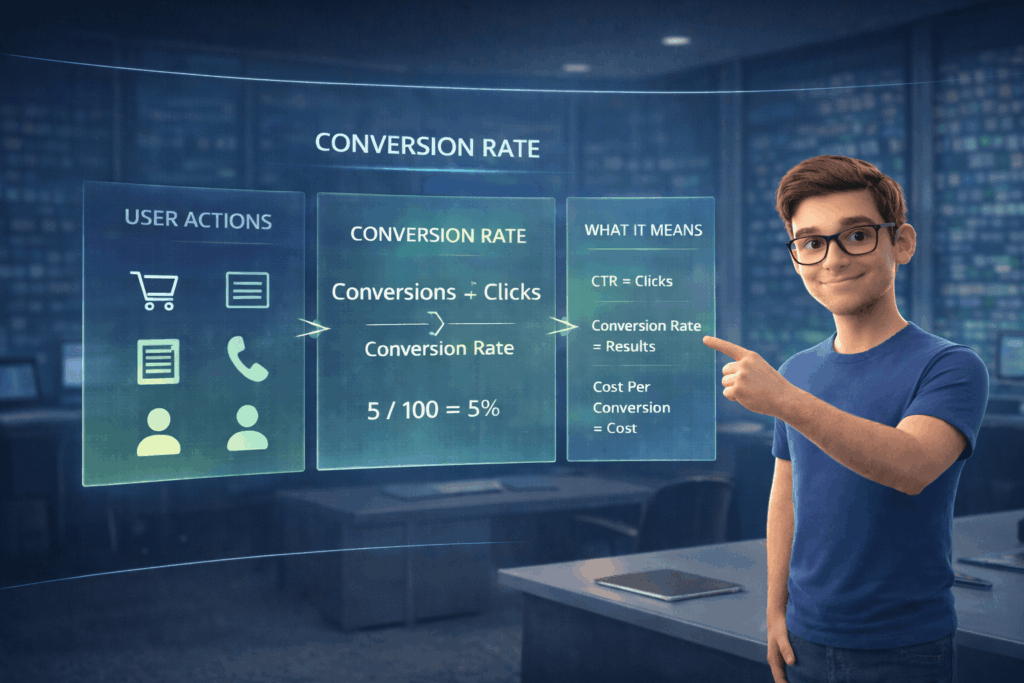
What counts as a conversion?
If you want to know what is a good conversion rate for Google Ads you need to know what we should count. A conversion isn’t always a direct sale. It is simply any valuable action you want a user to take after they click on your ad. Depending on your business model and campaign goals, a conversion could be:
- Purchases: The primary goal for e-commerce businesses.
- Leads/Form Submissions: A user filling out a contact form to request a quote (crucial for service businesses).
- Phone Calls: A prospect calling your business directly from the ad or landing page (highly valuable for local services like auto repair or medical clinics).
- Sign-ups: A user subscribing to a newsletter, downloading a whitepaper, or creating a software trial account.
A word of caution on what you count: As I often tell my clients, what you define as a conversion can create dangerous measurement traps. If you are using call tracking, sometimes any call over a certain length counts as a conversion—even if it wasn’t a qualified lead. This makes your conversion rate look high, but your revenue doesn’t move. Additionally, if you count „every” conversion, a single user who calls your business and also fills out a form might be double-counted. This inflates your numbers and can even push your conversion rate above 100% in poorly configured setups.
How Google calculates conversion rate
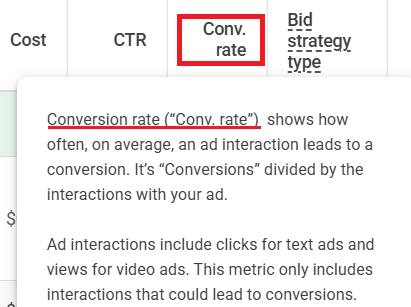
Google Ads calculates your conversion rate using simple math: it divides the total number of conversions by the total number of ad interactions (which are usually clicks).
For example, if your ad receives 100 clicks and results in 5 conversions (like 5 phone calls), Google divides 5 by 100 and multiplies by 100. Your conversion rate is 5%.
Conversion rate vs. click-through rate (CTR) and cost per conversion
It’s easy to get lost in the dashboard, but you must understand the difference between these three metrics to make smart optimization decisions:
- Click-Through Rate (CTR): This measures how many people clicked your ad after seeing it. It tells you if your ad copy is compelling and relevant to the searcher’s intent. However, a high CTR just means people are visiting your site; it doesn’t mean they are buying.
- Conversion Rate: This measures what happens after the click. It tells you how effective your landing page and offer are at turning that visitor into a customer.
- Cost Per Conversion (or Cost Per Lead): This is the actual dollar amount you pay to acquire one conversion.
Here is the critical distinction: A high conversion rate alone does not mean success. I’ve seen profitable service campaigns converting at 5%, and completely unprofitable ones bleeding money at 12%.
If your cost per click is incredibly high, even a stellar 12% conversion rate might result in a cost per conversion that destroys your profit margins. Conversely, a 6% conversion rate is fantastic if your clicks are cheap, your cost per lead is exactly on target, and your calendar is full. Always look at your conversion rate in the context of what it actually costs to acquire that customer.
How to Calculate Your Conversion Rate
If you’re asking what is a good conversion rate for google ads you need also to know how to calculate it. You can’t optimize what you don’t accurately measure. Calculating your conversion rate isn’t just about looking at the default column in your Google Ads dashboard; it’s about understanding the math behind your profitability and ensuring your tracking is actually telling the truth.
Basic formula with examples
As we covered earlier, the basic calculation for your actual conversion rate is straightforward: (Total Conversions ÷ Total Ad Interactions) × 100 = Conversion Rate %
But remember the golden rule: the only number that actually defines a “good” conversion rate is the one that hits your target Cost Per Lead (CPL).
To calculate the target conversion rate your business specifically needs to stay profitable, use this formula: Target Conversion Rate % = (Average CPC ÷ Target Cost Per Lead) × 100
- Example 1: If your average click costs $12 and you need leads at $60 to maintain your profit margins, you divide 12 by 60, which equals 0.20. Multiply by 100, and you see that you need a 20% conversion rate to succeed. If you are only hitting 8%, you are losing money.
- Example 2: Now let’s say your industry has cheaper clicks. Your average click costs $5, but your target CPL is still $60. In this scenario, you only need about an 8% conversion rate to hit your goal. Same conversion rate, different economics, completely different result.

Let's Talk!
I’m here to help you grow your business with the power of Google Ads. If you’re ready to take your campaigns to the next level – Schedule My Free Consultation
Setting up conversion tracking correctly in Google Ads
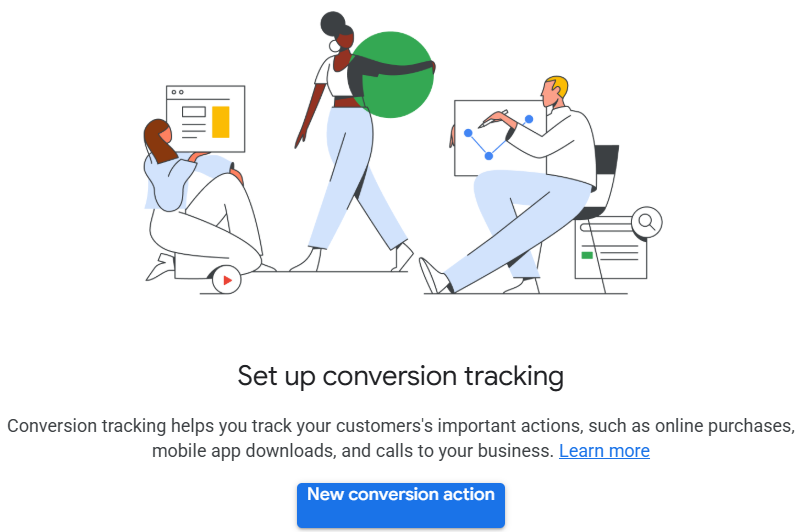
Your math is only as good as your data. If your tracking is broken, you will either change what is working or feel safe when you shouldn’t—and both mistakes cost money.
Google Ads relies on snippets of code (tags) placed on your website to track when an ad click results in a valuable action. Proper setup ensures you are feeding Google’s algorithm the right signals. A faulty setup can lead to wild inaccuracies, like data swings where 3 conversions one week and 6 the next makes it look like your conversion rate magically doubled.
To ensure your foundation is solid, follow Google’s official guide to setting up conversion tracking.
Micro vs. macro conversions; why tracking definitions matter
Not all conversions are created equal, which is why tracking definitions matter. We generally divide them into two categories:
- Macro Conversions: The primary goals of your business (e.g., a completed purchase, a booked consultation, a qualified lead submission).
- Micro Conversions: Smaller stepping stones that indicate interest but don’t immediately impact revenue (e.g., downloading a PDF, signing up for an email newsletter).
One of the biggest measurement traps advertisers fall into is counting micro conversions or unqualified actions as macro conversions.
For example, if you use call tracking, sometimes any call over a certain length (like 30 seconds) counts as a conversion. But that doesn’t always mean it was a qualified lead. It could be a vendor, a wrong number, or a customer service issue. Your conversion rate might look exceptionally high, but your revenue doesn’t move.
Another common trap is double counting. If a prospect calls your business and also fills out a contact form, and your tracking counts both, your conversion rate artificially inflates. It can even go above 100% in some broken setups—that’s a settings issue, not performance magic. Always be strict about what you define as a conversion.
Average and Benchmark Conversion Rates
Now that you know how to calculate your true conversion rate, it is time to see how you stack up against the rest of the market. According to WordStream’s 2025 Google Ads benchmark report, the average conversion rate across all industries is approximately 7.5%. This figure is based on solid data from more than 16,000 campaigns. While we know that your target Cost Per Lead is the most important metric, these industry benchmarks are incredibly helpful for setting realistic baseline goals.
Overall averages for search vs. display campaigns (3-5% vs. 0.5-1%)
The first thing to understand is that the type of campaign you run drastically changes your expected conversion rate.
- Search Campaigns: Because these capture users actively looking for a solution, average Google Ads conversion rates for search range between 3-5%.
- Display Campaigns: Because these ads are shown to people browsing other websites (lower intent), display campaigns average much lower, typically between 0.5-1%.
All-industry average (around 4.8% to 7.5%)
When you mix every single industry and campaign type together, some reports place the overall Google Ads conversion rate at 4.8%. However, as mentioned above, WordStream’s 2025 data places the average Google Ads conversion rate across all industries at roughly 7.52%.
Why the discrepancy? Because that number mixes everything together. It blends high-volume e-commerce stores with local emergency plumbers.
Benchmarks by industry
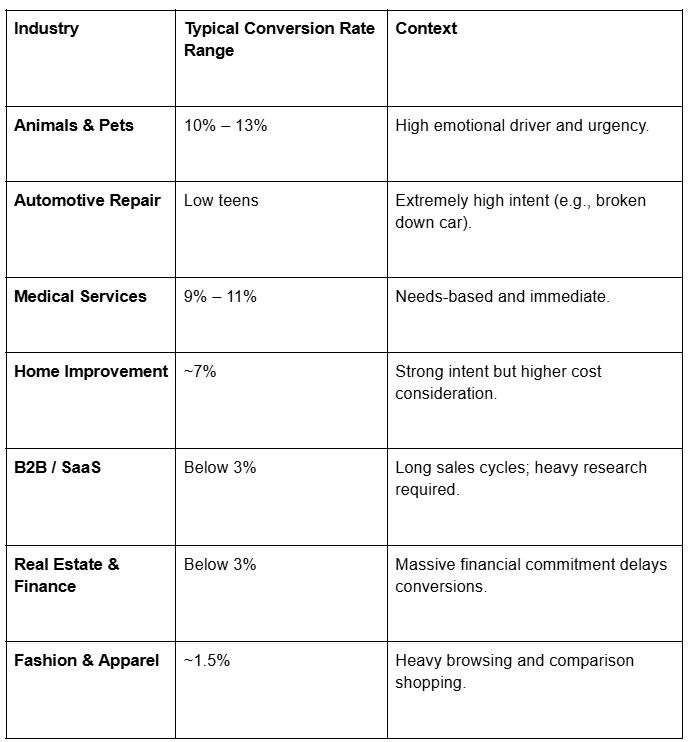
Your specific vertical dictates what a „good” rate looks like. High-performing sectors with extreme urgency (like automotive services or personal services) can exceed 10%. Meanwhile, slower, high-consideration sectors like finance, real estate, or B2B often average below 3%.
Here is a quick look at how conversion rates fluctuate by industry:
Benchmarks by campaign type (Search, Display, Shopping, Performance Max)
Beyond just Search and Display, you have to account for Google’s other campaign types.
- Shopping Campaigns: Highly visual and focused on product sales. Because they fall under the e-commerce umbrella, you are typically looking at conversion rates around 2% to 5%.
- Performance Max (PMax): PMax serves ads across Google’s entire network (Search, Display, YouTube, Gmail). Because it blends high-intent search with low-intent display and video, PMax conversion rates usually land somewhere in the middle, heavily influenced by whether the account is e-commerce or lead generation.
Beyond just Search and Display, you have to account for Google’s other campaign types.
- Shopping Campaigns: Highly visual and focused on product sales. Because they fall under the e-commerce umbrella, you are typically looking at conversion rates around 2% to 5%.
- Performance Max (PMax): PMax serves ads across Google’s entire network (Search, Display, YouTube, Gmail). Because it blends high-intent search with low-intent display and video, PMax conversion rates usually land somewhere in the middle, heavily influenced by whether the account is e-commerce or lead generation.
Benchmarks by device (desktop vs. mobile) and time of day
Finally, where and when people see your ads shifts your conversion rate. Mobile conversions differ significantly from desktop conversions. A user on a mobile device might convert at a much higher rate for a „call now” search for a local plumber, but abandon a complex B2B software sign-up form that is easier to complete on a desktop.
Similarly, time of day and scheduling impact performance. B2B campaigns might see conversion rates plummet outside of standard business hours, while an e-commerce brand might see a spike in late-night impulse buys.
Factors That Affect Your Google Ads Conversion Rate

Your conversion rate is not a random number generated by the Google algorithm; it is the direct result of several moving parts working together. If you want to improve your numbers, you need to understand the variables you can control.
Keyword match type and intent
The biggest driver of your conversion rate is the intent behind the user’s search. Someone searching „buy sunglasses” is just browsing, while someone searching „emergency roof repair near me” is ready to buy right now.
Your keyword match types dictate how tightly you control this intent. If you rely too heavily on Broad Match without a strong negative keyword list, your ads will show for loosely related, low-intent searches, driving your conversion rate down. Using Phrase and Exact match ensures your ads only show to users with high intent.
Ad relevance and copy (headline/description alignment)
Your ad copy sets an expectation. If a user searches for „affordable accounting software for startups” and your headline simply says „Accounting Software,” you are missing the mark.
High-converting ads have tight alignment between the search query, the headline, and the description. Relevancy builds trust. If your ad promises a specific solution or a specific price, but your landing page says something different, the user will immediately bounce, wasting your click budget.
Landing-page relevance and user experience
The ad only gets the click; the landing page is what actually secures the conversion. Even if you have the best ad copy in the world, a slow, confusing, or poorly designed landing page will kill your conversion rate.
Properly built landing pages that match the ad’s exact promise and provide a seamless user experience are what allow service businesses to push their conversion rates past 10%. Ensure your landing page loads quickly, is easy to navigate, and clearly presents the information the user clicked the ad to find.
Device and audience segmentation
Not all clicks are equal, and segmenting your audience can reveal massive differences in performance.
User behavior changes drastically depending on the device. A person frantically searching for a tow truck on their mobile phone is highly likely to click a „Call Now” button. However, a procurement manager researching B2B software on their mobile phone on the train home is unlikely to fill out a complex 10-field lead form. They might save it for when they are back at their desktop. Understanding how your specific audience uses different devices allows you to optimize your bids and layouts accordingly.
Scheduling and seasonality
Time of day and time of year directly influence outcomes.
Seasonal factors heavily dictate demand and conversion rates. For example, HVAC repair ads peak in the summer, while retail campaigns see massive surges during the Q4 holidays. Outside of macro-seasonality, daily ad scheduling matters just as much. If you run a B2B company, running ads at 2:00 AM on a Sunday will likely yield a terrible conversion rate compared to 10:00 AM on a Tuesday.
Offer strength and call-to-action
Finally, you must evaluate the strength of your actual offer and call-to-action (CTA).
You can have perfect keyword targeting, brilliant ad copy, and a lightning-fast landing page, but if your offer is weak, people won’t convert. „Get a Free Consultation Today” or „Save 20% on Your First Order” gives the user a compelling reason to act immediately. A generic „Submit” or „Learn More” button creates friction and lacks the urgency needed to turn a browser into a buyer.
Beyond Conversion Rate: Evaluating ROAS and Profitability
While a strong conversion rate is an excellent indicator that your targeting and landing pages are working, it is not the ultimate measure of success. The real goal of any Google Ads campaign is profitability.
Why ROAS matters more than a high conversion rate
A high conversion rate alone does not mean success. If you run an e-commerce brand, Return on Ad Spend (ROAS) is a far more critical metric than your conversion rate.
ROAS measures exactly how much revenue you earn for every dollar you spend on advertising. You could boast a massive 15% conversion rate, but if you are spending $10 in clicks to sell a $5 product, your campaign is a financial failure. Conversely, a seemingly low 2% conversion rate on a $5,000 piece of equipment can generate a massive ROAS and drive significant profit. Ultimately, ROAS matters more because it measures actual business impact and revenue, not just website behavior.
Balancing conversion rate and cost per conversion; lifetime value considerations
As we established earlier with our formula, your conversion rate must always be balanced against your cost per conversion. If your average click costs $5 and your target Cost Per Lead (CPL) is $60, an 8% conversion rate means you are hitting your goals. Same conversion rate, different economics, completely different result.
Furthermore, you must factor in Customer Lifetime Value (LTV). If a new client typically stays with your B2B software company for three years and spends $15,000, you can afford a much higher initial cost per conversion than a business selling a one-time $50 pair of shoes. When your LTV is high, you can accept a lower front-end conversion rate because the long-term profitability justifies the initial ad spend.
Tools to track revenue and measure profitability for Google Ads
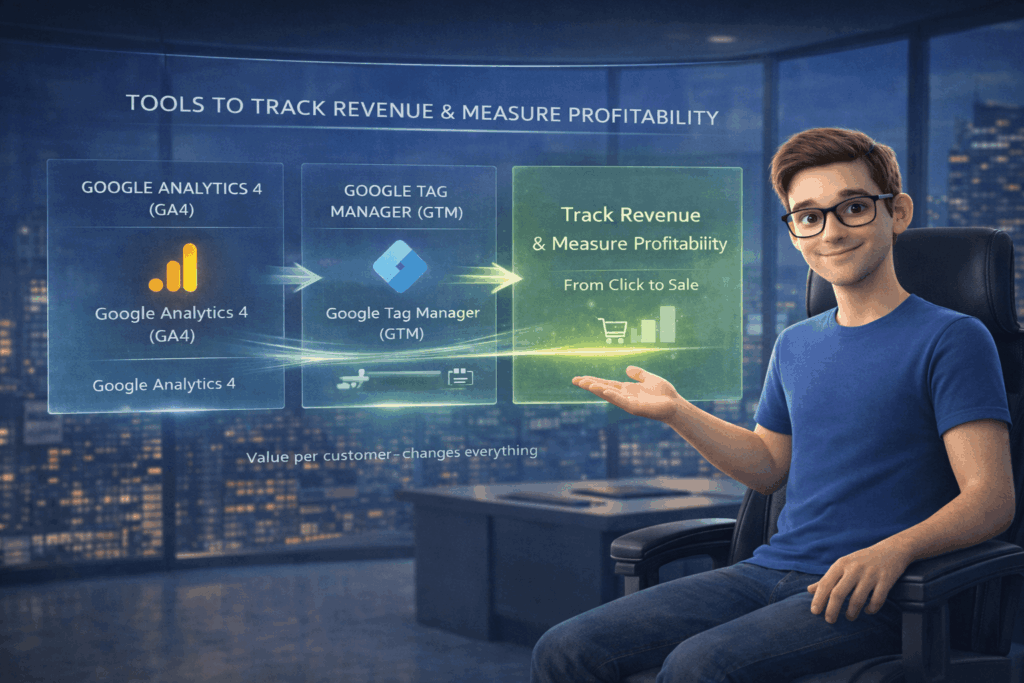
To properly evaluate ROAS and true profitability, you must use the right tools to track revenue. Looking solely at the basic „conversions” column in Google Ads is rarely enough.
- Google Analytics 4 (GA4): By linking your Google Ads account to Google Analytics, you can track deep post-click user behavior, attribute e-commerce revenue directly to specific campaigns, and measure overall site profitability.
- Google Tag Manager (GTM): This is the ultimate bridge for accurate measurement. Instead of relying on a web developer to hardcode tracking pixels into your website, GTM allows you to easily deploy and manage your Google Ads conversion tags and Analytics events from one centralized dashboard. It ensures your macro and micro conversions (like button clicks, form submissions, or purchases) fire exactly when they are supposed to.
- Offline Conversion Tracking: If you run a service business where the actual sale happens over the phone or in person days after the ad was clicked, offline conversion tracking is absolutely essential. By connecting your CRM (like Salesforce or HubSpot) back into Google Ads, you can tell the algorithm exactly which leads actually became paying customers, allowing you to optimize for closed revenue rather than just form submissions.
FAQ: What Is a Good Conversion Rate For Google Ads
What is considered a good conversion rate for Google Ads overall?
According to WordStream’s 2025 benchmark report, the average conversion rate across all industries is roughly 7.5%. However, a „good” rate is highly dependent on your specific business and industry. E-commerce typically ranges from 2% to 5% , while service-based lead generation usually sits between 5% and 10%.
Is a 10% conversion rate good for Google Ads lead generation?
Yes, 10% or higher is considered excellent and places advertisers in the top tier. In high-intent service industries like auto repair, animal care, and medical services, reaching 10% to 15% is a very realistic and profitable target.
How do I calculate if I have a good conversion rate for Google Ads?
Instead of relying on industry averages, calculate the exact percentage your specific business needs to remain profitable. Use this formula: Target Conversion Rate % = (CPC ÷ Target Cost Per Lead) × 100.
Why is my average Google Ads conversion rate so low?
A low conversion rate is usually caused by a disconnect between the ad and the user’s experience. Common culprits include using poor keyword match types that bring in low-intent traffic, having weak landing-page relevance, lacking a strong call-to-action, or having broken conversion tracking setups.
Does a typical good conversion rate for Google Ads differ between Search and Display campaigns?
Yes, drastically. Search campaigns capture users actively looking for a solution, resulting in average conversion rates around 3% to 5%. Display campaigns show ads to users browsing other sites, which is lower intent, making their average conversion rate much lower at around 0.5% to 1%.
How many conversions are needed to achieve a good Google Ads conversion rate with smart bidding?
To allow automated smart bidding algorithms to work effectively, you typically need at least 30 conversions in the past 30 days.
What is a good cost per conversion compared to a good conversion rate in Google Ads?
A good cost per conversion (or target Cost Per Lead) is simply one that allows your business to remain profitable. It is a far more important metric than your conversion rate. You could have a high conversion rate, but if your cost per conversion is too high, the campaign is failing.
How does keyword match type affect my ideal Google Ads conversion rate?
Keyword match types directly control the intent of the traffic you pay for. Refining your keyword targeting by using exact match and utilizing negative keywords ensures your ads only trigger for highly relevant searches, which naturally improves your conversion rate.
What is a good conversion rate for landing pages running Google Ads traffic?
The benchmark for your landing page is the same as your campaign: usually 2% to 5% for e-commerce and 5% to 10% for lead generation or higher with the right optimization. Designing a high-converting landing page that matches the ad’s promise, reduces friction, and includes trust signals is key to hitting these numbers.
Should I focus on getting a good conversion rate for Google Ads or a high return on ad spend (ROAS)?
You should always prioritize Return on Ad Spend (ROAS). ROAS measures actual revenue and profitability, which matters more than a high conversion rate percentage. Balancing your conversion rate with your cost per conversion and lifetime value considerations is the ultimate goal.

Daniel Ostrzyzek
Hi, I’m Daniel Ostrzyzek, a passionate Google Ads specialist with over 8 years of experience. I work with small to medium-sized businesses to help them attract leads, achieve their growth goals, and maximize ROI through Google Ads campaigns. After discovering my passion for digital marketing, I dove deep into Google Ads. Over the years, I’ve gained valuable experience working with businesses across various industries. I specialize in Google Ads Search and lead generation campaigns, helping my clients maximize the results of their online advertising.
Let's Talk!
I’m here to help you grow your business with the power of Google Ads. If you’re ready to take your campaigns to the next level – Schedule My Free Consultation