
How Does Google Paid Search Work? The Master Guide
- Published:2026-04-23
- Updated: 2026-04-23
How Does Google Paid Search Work?
The Reality of How Google Paid Search Works
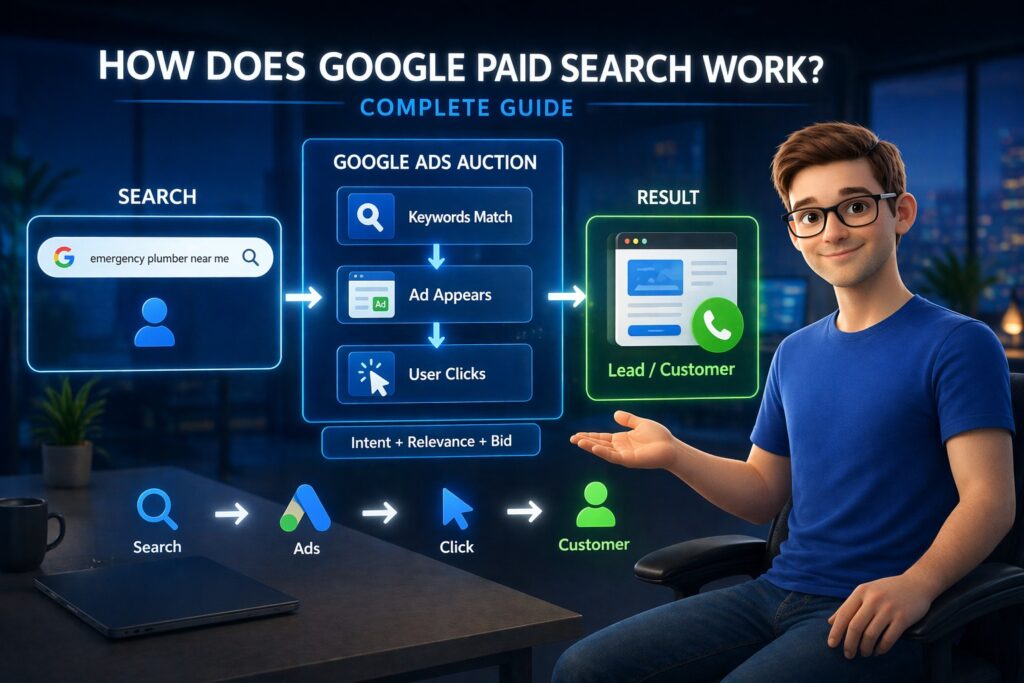
If you are wondering, how does Google paid search work, the reality might surprise you. Google Ads remains one of the most powerful ways to connect with customers exactly when they are looking for your services. However, many advertisers mistakenly follow Google’s suggestions to start immediately with Performance Max campaigns.
You should only open budget for Performance Max testing after your search campaigns are consistently producing leads at your target CPA. In this guide, we will explain how the paid search auction operates, how to control your budget, and why testing different ads to highlight your Unique Selling Proposition (USP) is vital to standing out from competitors.
Understanding Google Ads & How Does Google Paid Search Work
What is Google Ads?
Google Ads is Google’s overarching online advertising platform. It allows businesses to pay to display brief advertisements, service offerings, product listings, or video content to web users. Through this single platform, advertisers can run multiple different formats, including Search, Display, Video, and Shopping campaigns. It is the control center where businesses allocate their budgets and target specific audiences across Google’s massive network of search results, partner websites, and apps.
What is Google Paid Search?
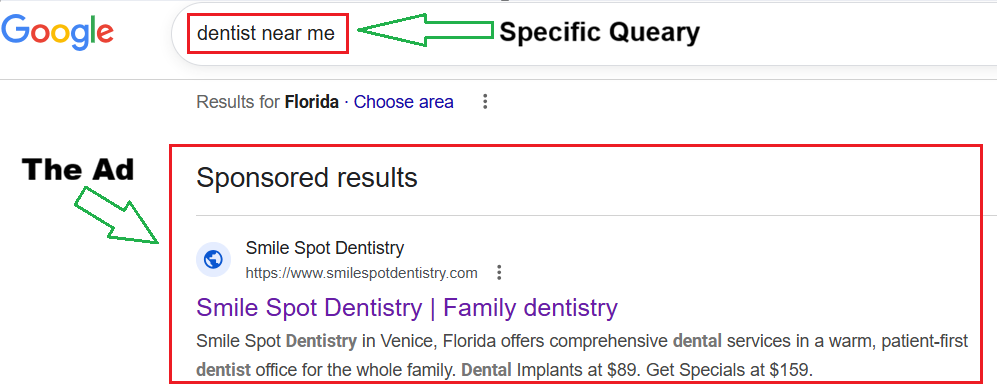
To fully grasp How Does Google Paid Search Work, you need to know that Google Paid Search refers specifically to the text-based advertisements that appear at the very top and bottom of Google’s search engine results pages (SERPs). When a user types a specific query into the search bar, Google’s algorithm instantly evaluates which ads are most relevant. In this system, advertisers bid on specific keywords related to their business.
In this system, advertisers bid on specific keywords related to their business. For example, if you run a landscape design-build company, you might bid on target phrases like „backyard landscape architect near me” or „custom patio builder.” When a homeowner in your service area searches for those exact terms, your ad has the opportunity to appear at the very top of the results. You don’t pay just to have your ad displayed; instead, you pay a fee only when that homeowner actually clicks on your ad and visits your website—which is why this model is commonly referred to as Pay-Per-Click (PPC).
How Google Ads Search Differs from PMax, Display & Video
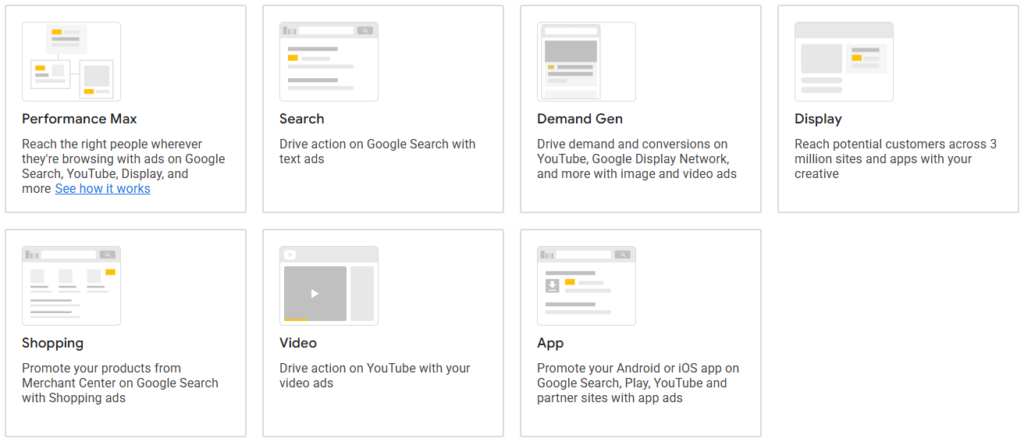
Understanding the difference between campaign types is crucial for budget allocation. They generally fall into two categories: „pull” marketing and „push” marketing.
- Search (Pull Marketing): Search campaigns are entirely intent-based. You are capturing users who are actively typing in a specific problem or need. Because the user is already looking for a solution, this is considered the ultimate „pull” marketing strategy.
- Shopping (Pull Marketing): Like search, Shopping campaigns are heavily intent-based but are tailored specifically for e-commerce. They display rich product information—like images, prices, and store names—directly to users who are actively searching to buy specific physical products, capturing shoppers at the moment of high purchase intent.
- Display, Video & Demand Gen (Push Marketing): These formats represent „push” marketing. You are showing image or video ads to people while they are reading blogs, browsing websites, or watching YouTube. The primary goal here is to build brand awareness and plant a seed before they are actively searching to buy.
- Performance Max (PMax): PMax is an automated, cross-channel campaign type. It uses Google’s AI to automatically serve your assets (text, images, and video) across the entire Google network—including Search, Display, Video, Maps, and Discover—optimizing for a specific conversion goal.
We have more options to do like PMAX campaign, demand gen, display or video youtube, but the search is still one of the best converting type of the campaign, when you know how to set up this and optimize. Controlling your search terms and whole campaign manually gives you the foundation needed before trusting an automated system.
Contents
- 1. How Does Google Paid Search Work? The Master Guide
- 1.1. How Does Google Paid Search Work?
- 1.2. The Reality of How Google Paid Search Works
- 1.3. Understanding Google Ads & How Does Google Paid Search Work
- 1.4. Google PPC vs. Organic SEO: What's the Difference?
- 1.5. High-Intent Traffic: Why Service Businesses Rely on Google Paid Search
- 1.6. How the Google Ads Auction Works
- 1.7. Let's Talk!
- 1.8. Factors That Determine Google Paid Search Success
- 1.9. The Right Google Search Ads Strategy for Service Businesses
- 1.10. Advanced Google PPC Strategies & Updates
- 1.11. Common Google Paid Search Mistakes & How to Avoid Them
- 1.12. FAQ: How does google paid search work
- 1.12.1. How does google paid search work?
- 1.12.2. How do Google search ads operate compared to organic SEO?
- 1.12.3. What is the process of Google PPC when a user makes a search?
- 1.12.4. How does the Google Ads search auction function to rank ads?
- 1.12.5. How does google paid search work for service businesses looking for leads?
- 1.12.6. How do Google text ads work when it comes to budgeting and costs?
- 1.12.7. How does google paid search work with automated Performance Max campaigns?
- 1.12.8. How does Google pay-per-click work with broad match keywords?
- 1.12.9. How do Google paid listings operate with artificial intelligence?
- 1.12.10. To ensure success, how does google paid search work with landing pages?
- 1.12.11. Daniel Ostrzyzek
- 1.13. Let's Talk!
Google PPC vs. Organic SEO: What's the Difference?
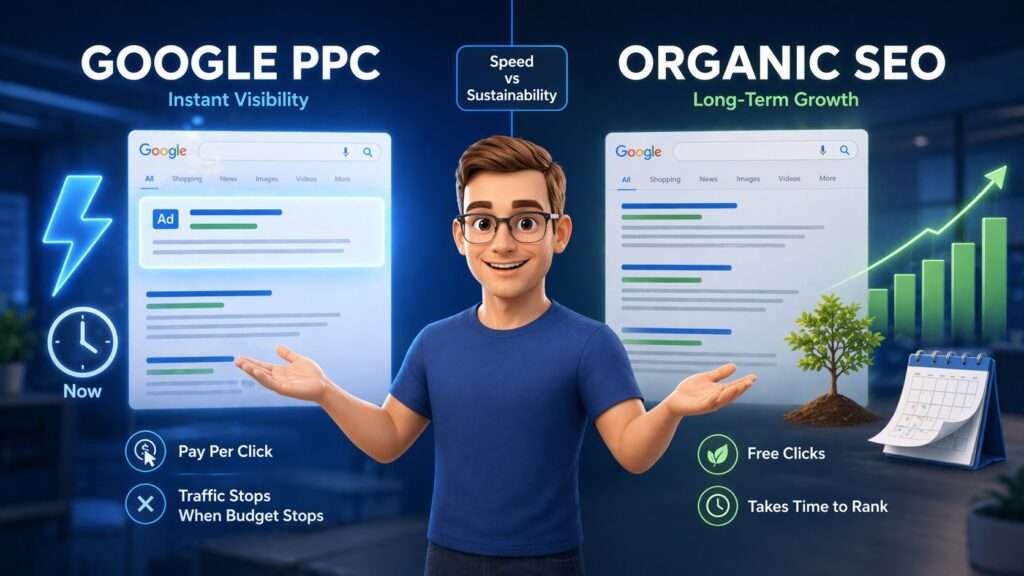
Both paid search and organic Search Engine Optimization (SEO) aim to get your business onto the first page of Google, but they have distinct advantages and limitations.
- Google PPC: Paid search guarantees immediate visibility. The moment your campaign goes live, you can appear at the very top of the SERPs. The advantage is complete control over your targeting and instant lead generation. The limitation is cost: you pay for every click, and your traffic stops immediately once you turn off your campaign or run out of budget.
- Organic SEO: SEO involves optimizing your website’s content, speed, and backlinks so Google naturally ranks it high in the organic results. The advantage is that organic clicks are „free” and provide sustainable, long-term traffic. The limitation is time: SEO requires significant upfront effort and can take months or years to yield page-one results for competitive keywords.
High-Intent Traffic: Why Service Businesses Rely on Google Paid Search
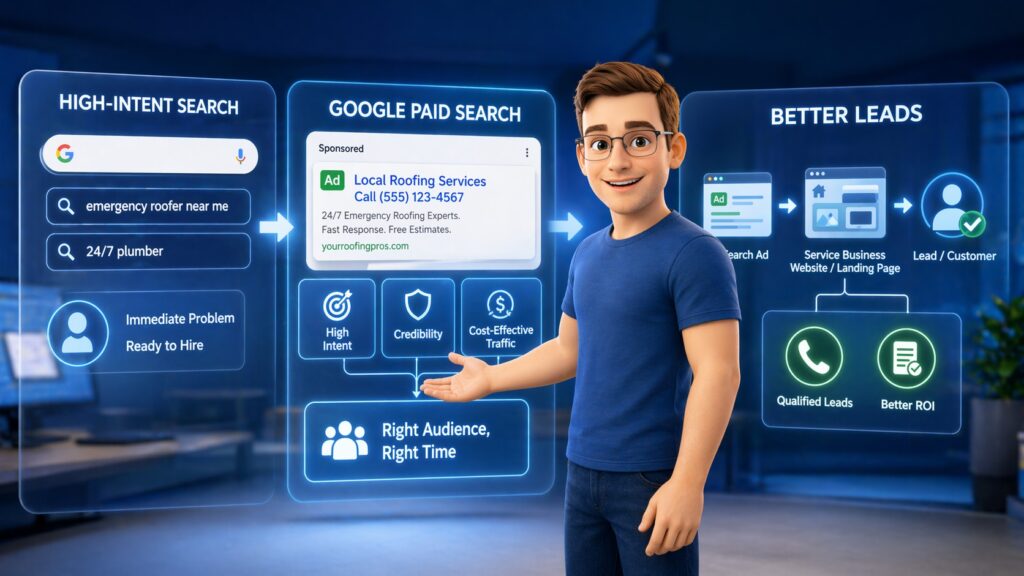
The true power of Google Ads lies in its ability to capture high-intent traffic. When someone types „emergency roofer near me” or „24/7 plumber,” they aren’t casually browsing—they have an immediate problem and a high intent to purchase a solution.
This is precisely why the search campaign is one of the best way to attract potential clients for service businesses. Capturing users at the exact moment of search provides a high level of cost-effectiveness and credibility. Because you are answering a direct demand rather than interrupting a user’s day, the Return on Investment (ROI) for a well-optimized paid search campaign often heavily outpaces other marketing channels.
How the Google Ads Auction Works
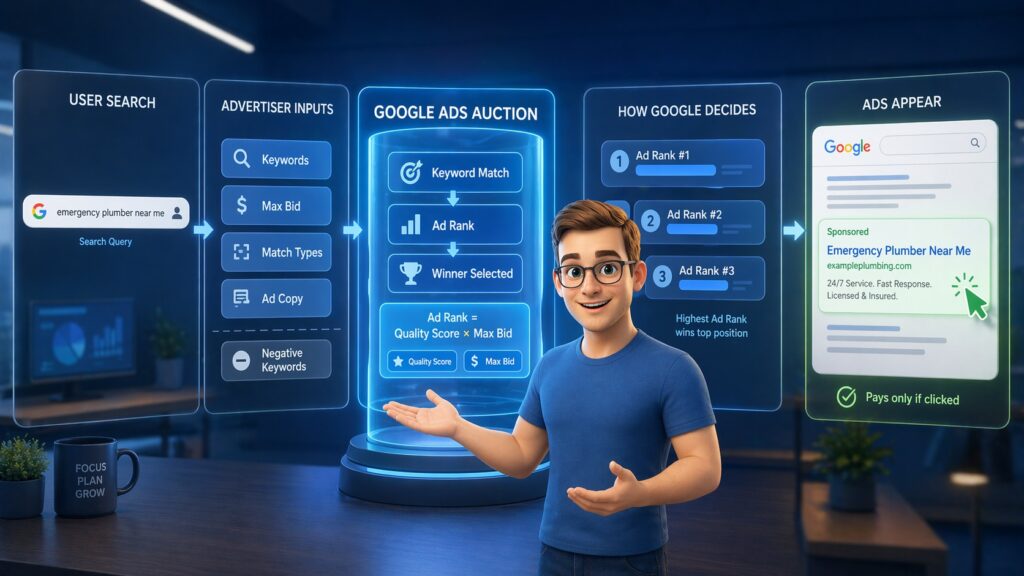
A core component of how does google paid search work is the invisible auction that takes place in milliseconds every single time a person searches for something on Google. It determines which ads will appear and in what order. Understanding this process is the key to running profitable campaigns, because Google doesn’t just for no reason reward the person who throws the most money at them.
Here is a deep, step-by-step breakdown of how the Google Ads auction works.
Step 1 – Advertisers Create Ads & Choose Keywords
Long before the auction even happens, the groundwork is laid by advertisers. First, advertisers do keyword research to pick the specific words or phrases (keywords) they want to trigger their ads.
Next, they tell Google the maximum amount of money they are willing to pay if someone clicks on their ad—this is known as their bid. Advertisers also choose their match types (how strictly Google should match their keyword to a user’s search) and set up negative keywords to ensure their ads do not show up for irrelevant searches. Finally, they write the actual text ads that users will see.
Step 2 – A User Searches on Google
The entire process is triggered the moment a user goes to Google and types a phrase into the search bar.
It is important to understand a slight terminology difference here: the exact string of words the person types into the search bar is called a search query, while the words the advertiser targets in their account are called keywords.
Step 3 – Google Matches Keywords to the Query
Instantly, Google’s system looks at the user’s search query and scans its massive database of advertisers. It checks to see whose targeted keywords match the user’s search.
This matching process depends heavily on the match types the advertiser selected (such as broad, phrase, or exact match). If an advertiser has a relevant keyword that matches the query, they are entered into the pool of potential competitors.
Step 4 – The Auction Begins
Now, the actual auction is triggered. Because there are often dozens or hundreds of advertisers who want to show up for the same search, Google has to decide who gets the limited ad slots available on the results page.
A critical rule of the auction is that only one keyword from your entire Google Ads account can enter this specific auction. Google will automatically select the most relevant keyword from your account to compete.
Step 5 – How Google Chooses Which Ad to Show (Ad Rank)
This is the most important step. Google does not simply give the top spot to the highest bidder. Instead, it uses a formula called Ad Rank to determine the winner.
Here is the basic equation Google uses to calculate who wins:
$Ad Rank = Quality Score \times Max Bid$
Let’s break down exactly what these two elements mean:
- Max Bid: This is the absolute maximum amount of money you told Google you are willing to pay for a single click.
- Quality Score: This is a grade Google gives your keyword, rated from 1 to 10. Google calculates your Quality Score based on three main components: how relevant your ad copy is to the search, your expected click-through rate (CTR), and the user experience of your landing page.
Beyond just your bid and Quality Score, Google also factors in Ad Extensions (extra features on your ad like phone numbers or sitelinks) and AI Signals (like the user’s device type, intent, and time of day) to calculate your final Ad Rank.
The takeaway? A smaller business with a highly relevant ad and a great landing page (high Quality Score) can beat a massive corporation with a huge budget (high Max Bid).
Step 6 – The Winning Ads Appear
Once Google calculates the Ad Rank for every competing advertiser, it ranks the results. The advertiser with the highest Ad Rank gets the #1 spot at the top of the page, the second highest gets the #2 spot, and so on.
The winning ads are then displayed to the user. The beauty of the Pay-Per-Click model is that the winning advertisers do not necessarily pay their absolute Max Bid. Because of how the CPC (Cost Per Click) formula works, they only pay a penny more than what is required to beat the Ad Rank of the competitor immediately below them—and they only pay if the user actually clicks on their ad.

Let's Talk!
I’m here to help you grow your business with the power of Google Ads. If you’re ready to take your campaigns to the next level – Schedule My Free Consultation
Factors That Determine Google Paid Search Success
Quality Score Components
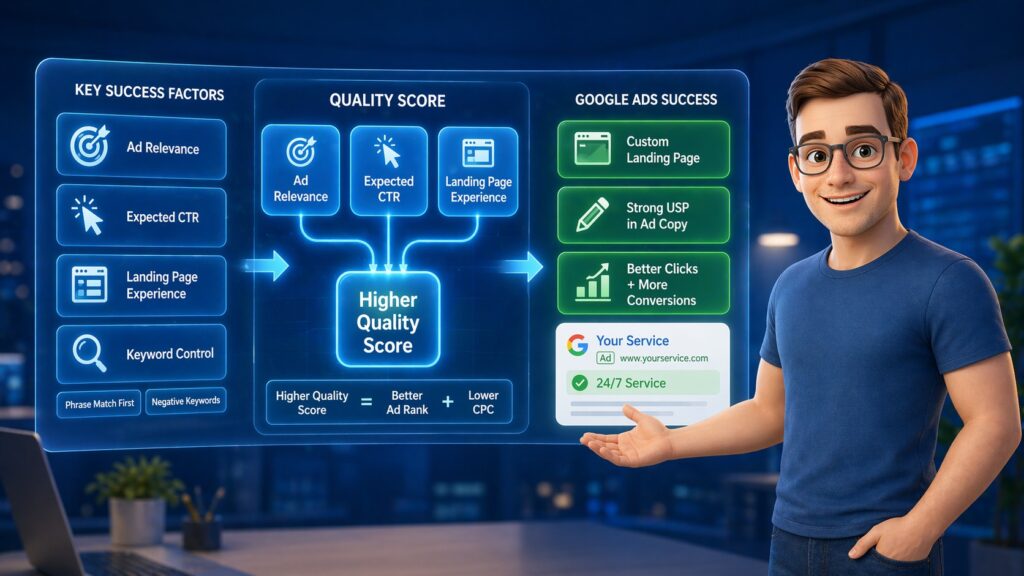
When mastering how does google paid search work, you must understand Quality Score, a crucial metric that dictates your Ad Rank and ultimately how much you pay per click. Google evaluates your keywords based on three main components:
- Ad Relevance: Does your ad copy actually match the user’s search query? If a user searches for „emergency plumbing repair,” your ad headline should directly address emergency plumbing, not just general bathroom remodeling.
- Expected Click-Through Rate (CTR): Google predicts the likelihood that someone will click your ad when it is shown to them. High historical engagement tells Google your ad is genuinely helpful and enticing to searchers.
- Landing Page Experience (User Experience): Once a user clicks, where do they go? Your landing page must be highly relevant to the ad they just clicked, load quickly, and provide a seamless, trustworthy user experience.
The Importance of a Custom Landing Page
One of the most common beginner mistakes is sending paid traffic to a generic homepage. To maximize your Google paid search success, you must use dedicated, custom landing pages that directly match the intent of your ad.
If your ad promotes a specific service, the user should land on a page completely dedicated to that service, rather than a homepage listing everything your business does. A highly relevant landing page accomplishes two critical things: it dramatically increases the likelihood that the user will actually convert (call you or fill out a form), and it directly improves the „Landing Page Experience” component of your Quality Score. By providing exactly what the user searched for, you improve your standing in the auction and ultimately lower your costs.
The Danger of Broad Match & The Power of Negative Keywords
In Google Ads, you choose how strictly Google matches your targeted keywords to a user’s actual search using different „match types.” Broad match is exactly what it sounds like—it gives Google broad permission to show your ad for loosely related searches. While this casts a wide net, broad match without the proper safeguards will quickly waste your budget on irrelevant clicks.
We need to be very careful with broad match, as it can bring in misleading search terms in the beginning of a campaign. A common and costly mistake is launching a brand-new campaign using only broad match keywords. Instead, it is important to start first with phrase match, which gives you much tighter control over the search terms triggering your ads.
Before you even consider testing broad match, you need to build a big negative keyword list. Negative keywords tell Google exactly what searches you do not want to show up for (for example, adding „cheap,” „free,” or „DIY” as negative keywords if you offer premium services). You must have this massive negative list in place first so you do not burn your budget when you eventually open up to broad match testing.
Search Ad Copy & Finding Your USP
One of the greatest advantages of paid search is that we can test the exact ads we want. You do not have to guess what messaging resonates with your audience; you can run multiple variations of headlines and descriptions simultaneously to see which combinations drive the highest click-through and conversion rates.
However, simply showing up at the top of the page isn’t enough to guarantee success. When a potential client searches for your service, they are likely looking at three or four other competing ads right next to yours. It is incredibly important to be different from competitors. To win the click, your ad copy must clearly highlight your Unique Selling Proposition (USP). Whether your USP is a specific warranty, decades of experience, or lightning-fast response times, you must give the searcher a compelling reason to choose your business over everyone else.
The Right Google Search Ads Strategy for Service Businesses
Why You Shouldn’t Start With Performance Max
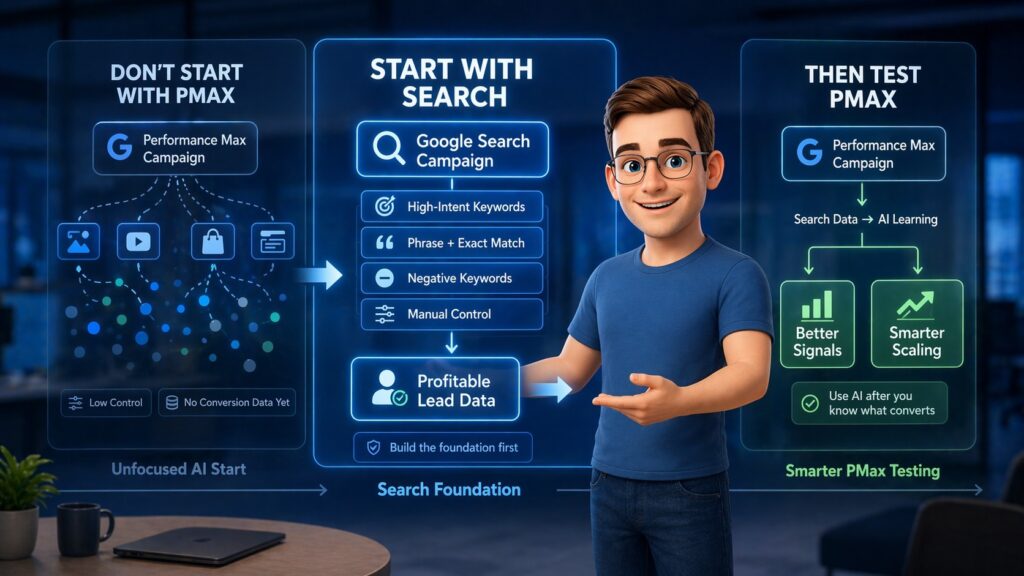
When you first set up a Google Ads account today, the platform heavily encourages you to launch a Performance Max (PMax) campaign. Because it uses Google’s AI to automatically distribute your budget across all of its networks, it sounds like the perfect „set it and forget it” solution for a busy business owner. However, this is one of the biggest pitfalls for new accounts.
A lot of advertisers believe in Google’s suggestions to start new campaigns with Performance Max. When you start with PMax on a brand-new account, the AI has no historical conversion data to learn from, resulting in your budget being wasted on low-quality display clicks or irrelevant video views while the algorithm „figures it out.”
The truth is that you must first start with a focused search campaign. By understanding how does google paid search work and manually controlling your keywords, match types, and bids, you build a foundation of high-intent, profitable data.
Once you know that you can consistently produce leads at your target CPA (Cost Per Acquisition), then you can safely open a part of your budget to test Performance Max. This ensures the AI has a clear blueprint of what a successful customer looks like.
Local Business Google Paid Search Case Study
To see how this strategy plays out in the real world, let’s look at a recent case study of a local landscape design-build company I helped achieve measurable results using a targeted Google Ads search strategy.
- The Challenge: When they came to me, this landscape design-build firm wanted to attract homeowners looking for high-budget, comprehensive backyard renovations. However, they were wasting their limited marketing budget on DIYers, people searching for cheap lawn mowing services, and broad terms like „garden ideas.” To make matters worse, they were sending all this traffic to a generic homepage that didn’t highlight their high-end portfolio.
- The Goal: Generate a consistent stream of qualified leads for custom hardscaping and landscape design projects at a profitable target CPA.
- The Strategy: First, I had them pause all of their automated, broad campaigns. I then launched a highly controlled Search campaign for them, using only exact and phrase match keywords to target high-intent phrases like „custom patio builder,” „landscape architect near me,” and „backyard design build firm.” Crucially, I built a massive negative keyword list right from the start to filter out searches containing words like „cheap,” „DIY,” „mowing,” „maintenance,” and „how to.” Finally, instead of the homepage, I routed all ad clicks to a dedicated custom landing page optimized specifically for design-build projects, featuring a portfolio of their high-end work and a clear consultation form.
- The Outcome: Within the first few weeks, my client stopped wasting money on informational and low-budget searches and began booking highly qualified design consultations. Because the search campaign was successfully producing leads at our target CPA, we then took a small portion of their profitable budget and opened a Performance Max campaign. This allowed us to test expanding their reach, utilizing their beautiful project photos and videos to target local homeowners across YouTube and the Google Display Network.
Advanced Google PPC Strategies & Updates
AI’s Growing Role in the Google Ads Auction
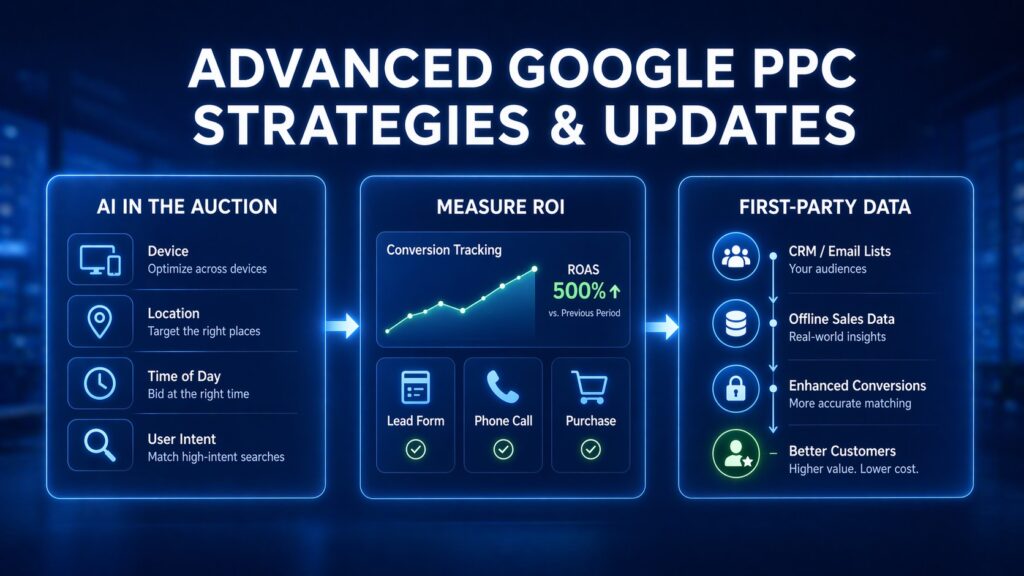
The Google Ads auction has evolved far beyond a simple manual bidding war. Today, Artificial Intelligence (AI) plays a foundational role in determining your Ad Rank and how your budget is spent. While manual bidding gives you strict control over your maximum Cost Per Click (CPC), Google’s automated „Smart Bidding” strategies leverage AI to analyze millions of real-time data points in milliseconds.
During the auction, Google’s AI evaluates a multitude of contextual signals that human advertisers simply cannot process manually. These AI signals include the specific device the searcher is using, their exact location, the time of day, and even their deeper user intent based on past behavior. For example, if the AI recognizes that a user searching on a mobile phone at 8:00 AM is highly likely to call your business, a Smart Bidding strategy will automatically adjust your bid upward for that specific auction to ensure you capture the high-intent lead.
Measuring & Improving ROI
Running a paid search campaign without proper conversion tracking is essentially an easy way to lose. To ensure your campaigns are profitable and to give the AI the data it needs to optimize, you must focus on accurate measurement.
- Setting Up Conversion Tracking: You must place Google Ads tracking tags (or use Google Tag Manager) on your website. This allows you to track exactly what happens after a user clicks your ad—whether they submit a lead form, click a phone number, or make a purchase. Without this data, you cannot determine which keywords are driving actual business and which are just wasting budget.
- Calculating ROAS (Return on Ad Spend): To truly measure your campaign’s success, you need to look beyond the cost per click and calculate your return. The formula for calculating ROAS is straightforward: (Revenue from Ads / Cost of Ads) x 100. If you spend $1,000 on ads and generate $5,000 in revenue, your ROAS is 500%. Tracking this metric allows you to identify your most profitable campaigns and scale them confidently.
- Leveraging First-Party Data: With upcoming cookie deprecation and tightening privacy regulations, relying on third-party tracking is becoming less effective. To maintain an edge, businesses must utilize first-party data—the information you collect directly from your customers, such as CRM email lists and offline sales data. By feeding this verified, privacy-safe data back into Google Ads through features like Enhanced Conversions, you train Google’s algorithm to find more customers that match your most valuable existing clients.
Common Google Paid Search Mistakes & How to Avoid Them
Skipping Conversion Tracking
One of the most severe beginner mistakes is launching a campaign without proper conversion tracking in place. Running ads without tracking your leads is a fast way to lose. You might see that you are getting clicks and spending money, but you won’t know which specific keywords or ads actually resulted in a phone call, form submission, or sale.
How to avoid it: Before you spend a single dollar, ensure Google Tag Manager or Google Ads tracking codes are properly installed to track your specific goals. You must give the system data on what a successful conversion looks like so it can optimize for more of them.
Sending Traffic to the Home Page
When a user clicks an ad for a specific service like „custom patio installation,” they expect to see a page about custom patios—not a generic homepage that forces them to hunt for the right information. Sending paid traffic to the home page creates friction, hurts your conversion rates, and lowers your Quality Score.
How to avoid it: Advise using dedicated landing pages that perfectly match the intent of your ad. If you advertise a specific service, the user should land on a highly relevant page dedicated entirely to that service, complete with a clear call-to-action.
Overusing Broad Match & Ignoring Negative Keywords
Relying too heavily on broad match keywords without a safety net is a guaranteed way to waste your budget. If you use broad match indiscriminately, Google will show your ads for loosely related, irrelevant searches (like DIY videos or cheap alternatives), draining your daily budget before your actual potential clients even start searching.
How to avoid it: Start your campaigns with phrase or exact match types to maintain tight control over the search terms triggering your ads. Most importantly, build an extensive list of negative keywords before you launch to actively block irrelevant clicks from the start.
Not Testing New Ads
Many business owners write one set of ads, turn the campaign on, and never look at the ad copy again. By doing this, you are failing to refine your messaging and missing out on finding out what truly resonates with your audience.
How to avoid it: Encourage iterative A/B testing of your headlines, descriptions, and landing pages. Constantly test new variations of your Unique Selling Proposition (USP)—like a new warranty offer versus a speed-of-service claim—to see which messaging yields the highest click-through and conversion rates.
Budget Mismanagement
Setting an unrealistic budget is a quick way to fail, especially in competitive local markets. For example, trying to run a campaign on a $5/day budget when your industry’s average cost per click is highly competitive means your ad will barely participate in the auction. You will also waste your limited funds if you are overspending on irrelevant clicks.
How to avoid it: Do your keyword research to understand the average Cost Per Click for your area and services. Set a realistic daily budget that allows for enough clicks per day so the system can actually learn and optimize. Regularly review your search terms report to ensure your money is only going toward high-intent searches.
FAQ: How does google paid search work
How does google paid search work?
It works through a Pay-Per-Click (PPC) system where advertisers bid on specific keywords related to their business. An invisible auction takes place in milliseconds to determine which ads are most relevant, and you only pay a fee when a user actually clicks your ad.
How do Google search ads operate compared to organic SEO?
Google search ads guarantee immediate visibility at the top of the search results the moment your campaign goes live, but you pay for every click. In contrast, organic SEO provides „free” and sustainable traffic, but it requires significant effort and can take months or years to reach the first page.
What is the process of Google PPC when a user makes a search?
The moment a user types a query into the search bar, Google instantly scans its database to see whose targeted keywords match the search. If an advertiser has a matching keyword, they enter a lightning-fast auction to determine who gets the limited ad slots.
How does the Google Ads search auction function to rank ads?
Google uses a formula called Ad Rank to determine the winner, rather than simply giving the top spot to the highest bidder. Ad Rank is calculated by multiplying your Max Bid by your Quality Score (which grades your ad relevance, expected click-through rate, and landing page experience).
How does google paid search work for service businesses looking for leads?
It captures high-intent traffic by targeting users at the exact moment they are looking for an immediate solution. When someone searches for a phrase like „emergency roofer near me,” they have a high intent to purchase, making paid search highly cost-effective.
How do Google text ads work when it comes to budgeting and costs?
Advertisers tell Google the absolute maximum amount of money they are willing to pay for a single click. However, the winning advertiser only pays a penny more than what is required to beat the Ad Rank of the competitor immediately below them.
How does google paid search work with automated Performance Max campaigns?
For a brand-new account, you should start with a manually controlled search campaign rather than Performance Max. You should only open up budget for Performance Max testing after your targeted search campaigns are consistently producing leads at your target CPA.
How does Google pay-per-click work with broad match keywords?
Broad match gives Google permission to show your ad for loosely related searches. Because this casts a wide net, you must build a massive negative keyword list before using it so you do not waste your budget on irrelevant clicks.
How do Google paid listings operate with artificial intelligence?
AI evaluates millions of real-time contextual signals during the auction, such as the searcher’s device type, exact location, and time of day. Using this data, Google’s automated „Smart Bidding” automatically adjusts your bids to help capture high-intent leads.
To ensure success, how does google paid search work with landing pages?
To maximize success, paid search requires sending traffic to a dedicated, custom landing page that perfectly matches the intent of the ad. Sending traffic to a generic homepage creates friction, hurts conversion rates, and negatively impacts your Quality Score.

Daniel Ostrzyzek
Hi, I’m Daniel Ostrzyzek, a passionate Google Ads specialist with over 8 years of experience. I work with small to medium-sized businesses to help them attract leads, achieve their growth goals, and maximize ROI through Google Ads campaigns. After discovering my passion for digital marketing, I dove deep into Google Ads. Over the years, I’ve gained valuable experience working with businesses across various industries. I specialize in Google Ads Search and lead generation campaigns, helping my clients maximize the results of their online advertising.
Let's Talk!
I’m here to help you grow your business with the power of Google Ads. If you’re ready to take your campaigns to the next level – Schedule My Free Consultation