
Google Ads for Landscapers
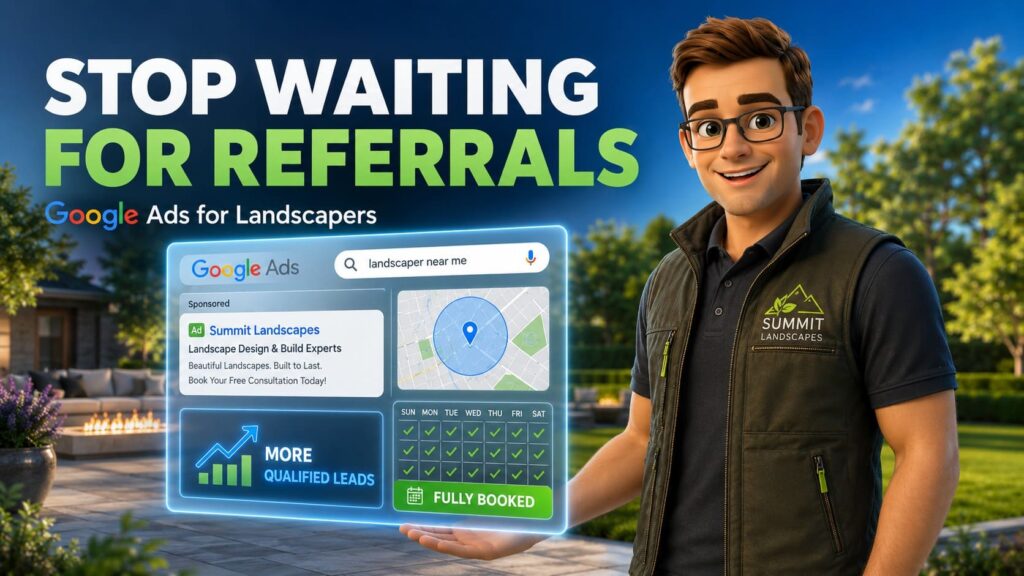
Stop relying on unpredictable word-of-mouth. It is time to turn Google Ads for landscapers into a predictable machine that books high-ticket landscaping jobs on demand.
TL;DR: The 30-Second Strategy
- Skip „Smart Campaigns”: Google’s default settings drain your budget on irrelevant clicks.
- Target Buyers, Not Browsers: Focus exclusively on high-intent phrases (like „paver patio installation”) and block „DIY” or „cheap” searches.
- Ditch the Homepage: Sending expensive paid traffic to a generic homepage is burning money. Use dedicated service pages designed to convert.
The Reality of the Landscaping Grind
You already work long hours dealing with unpredictable weather, broken equipment, and crew management. You shouldn’t have to stress about where your next client is coming from.
Referrals are great, but they create a „word-of-mouth ceiling”. You cannot confidently scale your crew or buy new trucks if your schedule is a guessing game.
The „Burned Budget” Trauma
Many landscapers have tried Google Ads, turned on the default „Smart Campaigns,” blew through $500 in a weekend, and got zero phone calls. Or worse, they paid for clicks from people searching for „DIY mulch installation” or „cheap lawn care near me”.
Here is the truth: Google Ads isn’t broken; your setup is.
When engineered correctly, it is a predictable, high-quality lead generation machine. It is the most reliable way to generate high-ticket leads—like custom hardscaping and commercial contracts—on demand.
Stop guessing. Here is exactly how to build google ads for landscapers a lead-generation machine that actually works.
Contents
- 1. Google Ads for Landscapers
- 1.1. Google Ads for Landscapers
- 1.2. The Reality of the Landscaping Grind
- 1.3. The „Burned Budget” Trauma
- 1.4. Understanding Google Ads and LSAs for Landscaping Businesses
- 1.5. Benefits of Google Ads in Landscaping
- 1.6. Keyword Research and Account Structure in Google Ads For Landscapers
- 1.7. Let's Talk!
- 1.8. Setting Budgets and Bidding Strategies for Google Ads Landscaping
- 1.9. Crafting Effective Ads and Extensions - Google Ads For Landscapers
- 1.10. Designing High-Converting Landing Pages in Google Ads Landscaping
- 1.11. Tracking, Analytics and Optimisation - Google Ads Landscape Business
- 1.12. Seasonal & Niche Campaign Ideas - PPC Landscaping
- 1.13. The Hidden Cost of Google's Constant Updates
- 1.14. FAQ: Google Ads For Landscapers
- 1.14.1. 1. What are Google Ads and how do they work for landscapers?
- 1.14.2. 2. How much should I spend on Google Ads per month for my landscaping business?
- 1.14.3. 3. What is the average cost per click (CPC) and cost per lead (CPL) for landscaping Google Ads?
- 1.14.4. 4. Which keywords are most effective for landscaping advertising?
- 1.14.5. 5. What negative keywords should landscapers add to avoid wasting their ad budget?
- 1.14.6. 6. How do Local Service Ads (LSAs) differ from traditional Google Search Ads for landscapers?
- 1.14.7. 7. How does seasonality affect Google Ads campaigns for lawn care and landscaping?
- 1.14.8. 8. Should I hire an expert to manage my landscaping Google Ads or run them myself?
- 1.14.9. 9. How do I prevent click fraud and protect my landscaping advertising budget?
- 1.14.10. 10. Why is a dedicated landing page so important for lawn care PPC and landscaping ads?
- 1.14.11. Daniel Ostrzyzek
- 1.15. Let's Talk!
Understanding Google Ads and LSAs for Landscaping Businesses
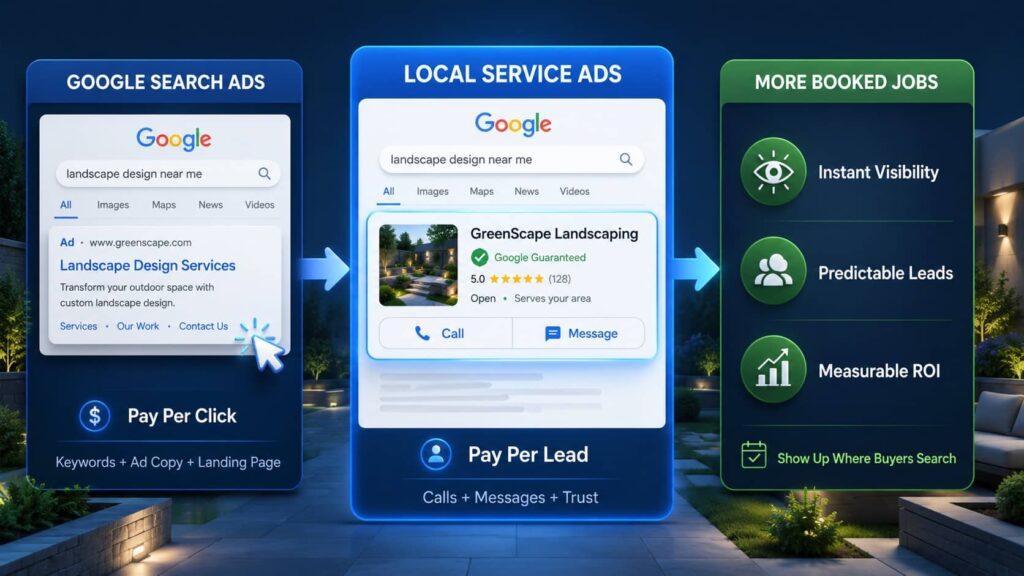
To stop wasting money and start booking jobs, you need to understand the tools at your disposal. The Google ecosystem offers two primary ways for service businesses to dominate the top of the search results, and you need to know exactly when to use each. Let’s demystify how these platforms actually work.
What Are Google Search Ads vs. Local Service Ads?
Many contractors ignore the nuances between traditional Search Ads and Local Service Ads (LSAs). Here is the difference:
- Google Search Ads: These are the traditional text ads you see at the top of the search results. They operate on a pay-per-click (PPC) model, meaning you bid on specific, relevant keywords (like „landscape design [city]”) and pay when someone clicks your ad. You have total control over the ad copy, the keywords you target, and the dedicated landing page the user is sent to.
- Local Service Ads (LSAs): These ads appear at the very top of the search page—even above traditional Search Ads. Instead of paying for clicks, you pay per lead (when a customer calls or messages you directly through the ad). LSAs require you to pass a background check to earn a „Google Guaranteed” badge, which builds instant trust with homeowners. In fact, Google’s own AI overviews heavily recommend LSAs for capturing high-intent local queries.
How Google Ads Work for Landscapers
When homeowners or facility managers need landscaping services today, they rarely flip through a phone book. Instead, they open Google and type in phrases like „Lawn care near me” or „retaining wall contractors”.
If your business doesn’t appear at the top of those results, you miss out on high-intent customers who are ready to buy right now. Google Ads allows you to bypass the wait and appear instantly before these active searchers. You choose exactly which geographic areas you want to target, set a daily budget, and tell Google exactly which search phrases should trigger your ads.
Why Google Ads Matter for Landscapers and Lawn‑Care Providers
If you want to stop guessing about your revenue, Google Ads is the answer. Here is why it matters:
- Predictable Growth: When optimized correctly, Google Ads functions as a predictable, high-quality lead generation machine. It is the single best way to start, grow, and scale your landscape business.
- Instant Visibility: While Search Engine Optimization (SEO) is important, it can take months or years to rank organically. Google Ads provides much faster results, putting you at the top of the page on day one.
- Total Financial Control: You get complete budget flexibility and measurable ROI. You can track exactly which ads, keywords, and landing pages are actually generating phone calls and booked estimates.
Benefits of Google Ads in Landscaping
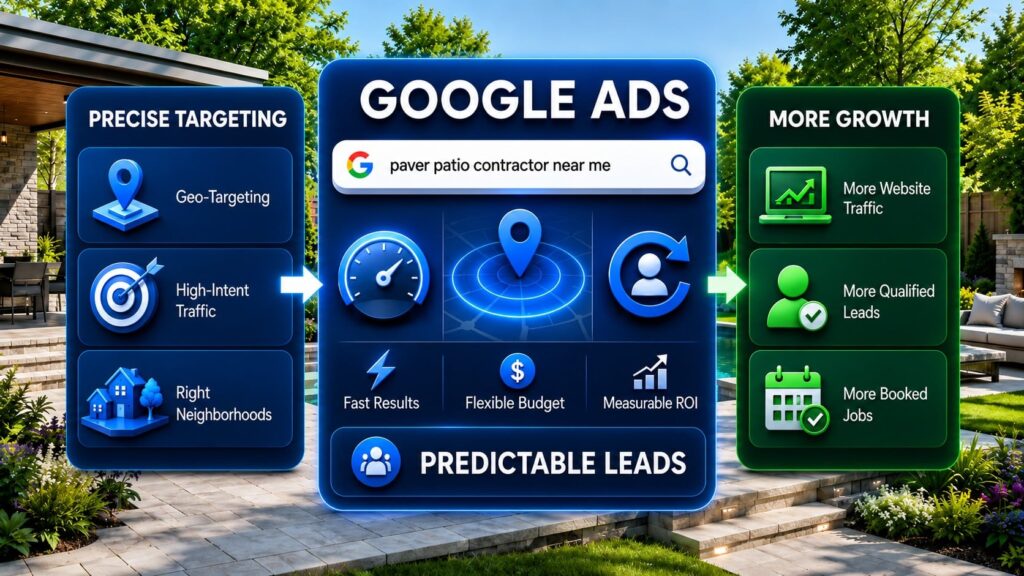
There is a reason why Google Ads is the absolute best way to start, grow, and scale your landscape business. When engineered correctly, it stops being a gamble and transforms into a predictable, high-quality lead generation machine. Here is exactly how it directly benefits your bottom line.
Increased Website Traffic and Precise Geo‑Targeting
The goal is not just to get more general website traffic; it is to capture the right traffic. One of the biggest advantages of Google Ads is precise geo-targeting. You no longer have to waste gas and time driving an hour across town for an unqualified estimate. You can literally draw a digital boundary around the specific, high-income neighborhoods, zip codes, or commercial districts where you actually want to work. This ensures your budget is only spent on high-intent customers exactly where your crews operate.
Faster Results Compared to SEO
Search Engine Optimization (SEO) is a vital long-term strategy, but climbing the organic rankings takes months or even years. As a landscaping business owner, you have payroll to meet and you need to secure a fully booked calendar for your crews right now. Google Ads delivers much faster results compared to SEO. By bidding on relevant keywords, you bypass the line and appear instantly before searchers the moment you flip the switch.
Budget Flexibility, Measurable ROI and Remarketing Opportunities
Unlike traditional advertising like billboards, radio, or mailers, Google Ads offers total budget flexibility and measurable ROI. You are never left guessing what is working. You can track exactly how many dollars you spent and directly tie it to the phone calls and form fills it generated.
Additionally, the platform allows you to use powerful retargeting campaigns. If a homeowner visits your $15,000 paver patio landing page but gets distracted and leaves without requesting a quote, remarketing opportunities allow you to stay in front of them. Your display ads can „follow” them across other websites they visit, keeping your landscaping company top-of-mind until they are ready to pull the trigger.
Keyword Research and Account Structure in Google Ads For Landscapers
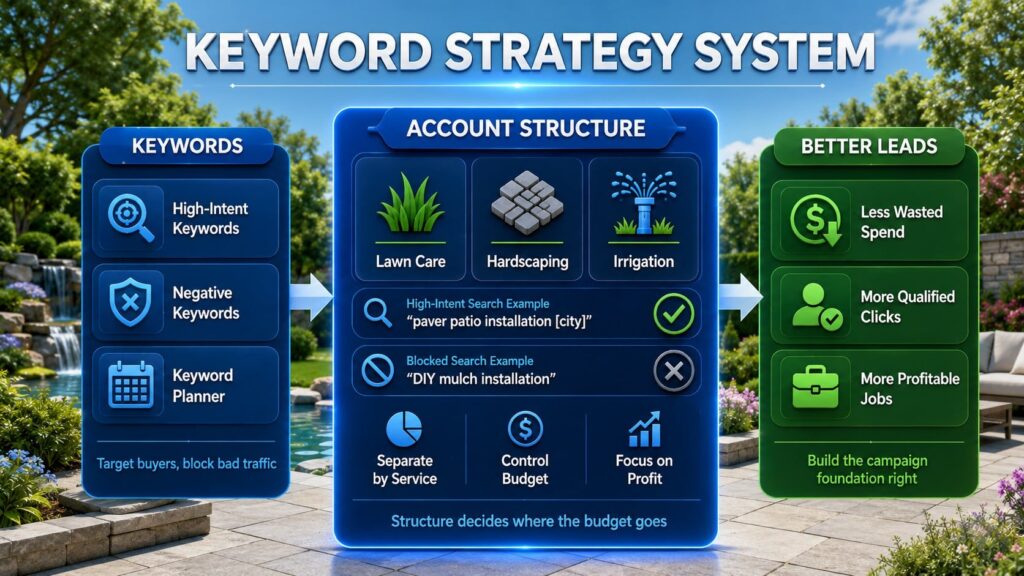
This is where most landscapers get it wrong. Selecting the right keywords and structuring your account properly is the difference between a campaign that drains your bank account and a predictable high-quality lead generation machine. Here is how we build the foundation.
High‑Intent Keywords vs. Informational Searches
There is nothing more frustrating than paying for clicks from people searching for „landscaping jobs,” „DIY mulch installation,” or „cheap lawn care near me”. These are informational or low-intent searches from people who are never going to hire you.
Instead, you must target high-intent keywords—phrases used by people who have their credit card in hand and are actively looking to hire a professional. For example, instead of targeting „patios,” you target „paver patio installation [City]” or „retaining wall contractors”.
Using Google Keyword Planner
To find these high-intent phrases, you shouldn’t just guess. Using tools like Google Keyword Planner allows you to see exactly how many times people in your specific service area are searching for „landscape design” versus „lawn maintenance” each month.
Negative Keywords to Avoid Wasting Spend
Knowing what searches to block is just as important as knowing what to target. A robust negative keyword list is your ultimate defense against wasted ad spend.
If you do not block the wrong terms, Google will happily spend your money on them. For example, if you run a hardscaping campaign, you must exclude phrases like „how to build”, „materials”, and „cost calculator”. If you offer lawn maintenance, you must block „cheap”, „mower repair”, and „DIY”. Having these exact negative keyword lists ready from day one prevents you from paying the expensive „tuition” of learning Google Ads through trial and error.
Structuring Campaigns and Ad Groups by Service (e.g., lawn care, hardscaping)
A very common mistake is putting all of your services into one single campaign. If you throw lawn mowing, tree removal, and custom patios into the same bucket, Google will often spend your entire daily budget on the cheapest, highest-volume searches (like mowing) before the high-ticket clients even wake up.
You must separate your campaigns by service. Why? Because a $50 lawn mowing lead requires a very different budget and bidding strategy than a $15,000 paver patio lead. Structuring your campaigns by specific services (e.g., dedicated ad groups for lawn care, hardscaping, and irrigation) ensures you have total control over exactly how much money goes toward acquiring your most profitable, high-ticket jobs.

Let's Talk!
I’m here to help you grow your business with the power of Google Ads. If you’re ready to take your campaigns to the next level – Schedule My Free Consultation
Setting Budgets and Bidding Strategies for Google Ads Landscaping
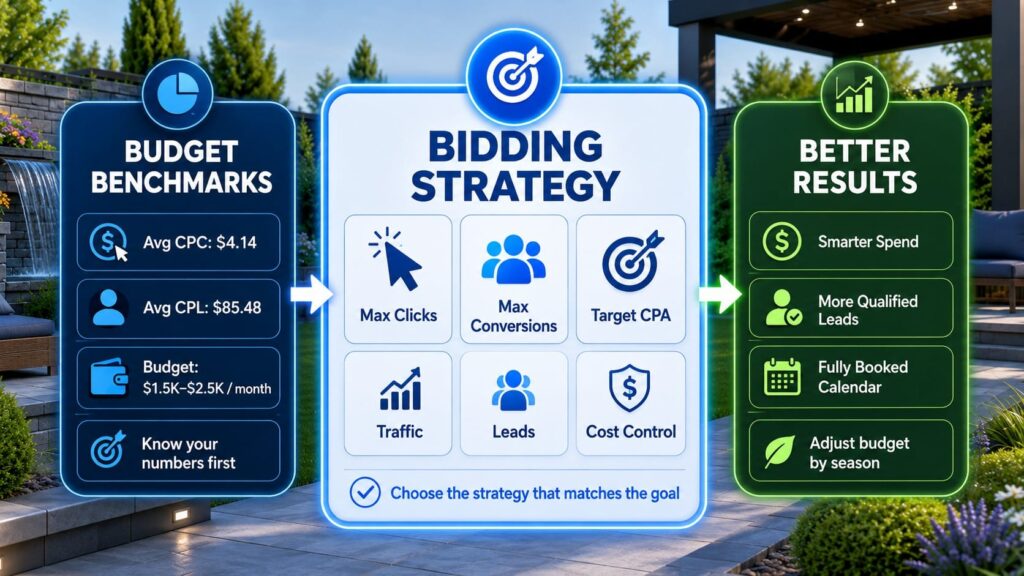
Throwing money at Google without a mathematical plan is exactly how you experience the „burned budget” trauma. To build a predictable lead generation machine, you need to understand the numbers, set realistic expectations, and utilize the right bidding strategies to maximize your return on investment.
Typical CPC and CPL Benchmarks for Landscaping Services
You shouldn’t be guessing what a lead should cost. Based on recent green industry benchmark reports for landscaping and lawn care, we have hard data on what you should expect. The average click-through rate (CTR) is 4.56%. The average cost per click (CPC) sits around $4.14, while the average cost per lead (CPL) is approximately $85.48.
Keep in mind, these are averages. A $50 lawn mowing lead will have a lower CPL, while a $15,000 paver patio lead will cost more to acquire. The goal isn’t just the cheapest clicks; it is paying the right price to acquire high-ticket jobs profitably.
How Much Should Landscapers Spend on Google Ads? (Budget Worksheet)
Many landscapers blow through $500 in a weekend and give up. To be competitive and give Google’s algorithm enough data to find high-intent buyers, the recommended starting budget is $1,500 to $2,500 per month.
You have to look at this as an investment, not an expense. If spending $1,500 generates three $15,000 hardscaping jobs, the return on ad spend is massive. We always recommend using a dedicated budget worksheet to calculate exactly how many leads you need to keep your crews fully booked and setting your daily budget accordingly.
Bid Strategies: Max Clicks, Max Conversions, Target CPA
Google offers several ways to bid on your ads, and picking the wrong one can drain your budget.
- Max Clicks: Good for driving a lot of traffic, but it doesn’t guarantee those people will actually call you.
- Max Conversions: Tells Google to find people most likely to fill out a form or call, but it requires historical data to work well.
- Target CPA (Cost Per Acquisition): This is the holy grail, where you tell Google exactly what you are willing to pay for a lead.
But ask yourself: do you really want to spend your Friday nights analyzing Search Term Reports and adjusting Maximize Conversions bidding strategies? This is why hiring an expert with more than 8 years of experience saves you money—we manage the optimization so you can focus on closing estimates.
Seasonal Budgeting (Spring Lawn Care vs. Winter Snow Removal)
Landscaping is not a static, year-round business. Your Google Ads budget must be dynamic. You cannot run the exact same campaigns and budgets in November that you run in April.
A proper strategy accounts for seasonal budgeting. You must seamlessly pivot your ad spend from spring lawn care and summer irrigation to fall leaf removal and winter snow removal. By shifting your budgets ahead of the seasonal demand curves, you ensure your calendar—and your crews—stay fully booked all year long.
Crafting Effective Ads and Extensions - Google Ads For Landscapers
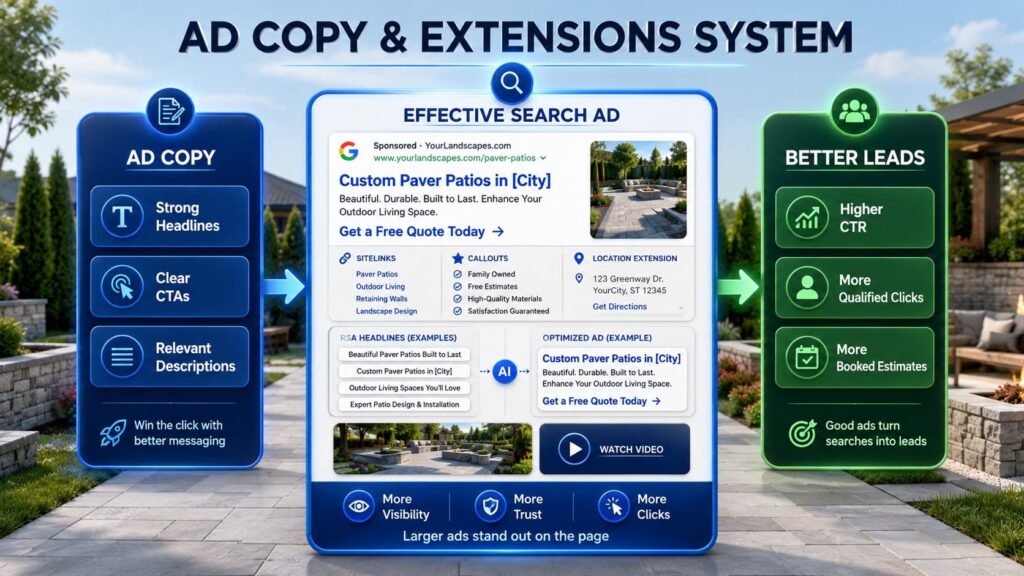
Getting your ad to show up on the first page is only half the battle. If your ad doesn’t stand out from the five other local guys bidding on the same job, you are leaving money on the table. Crafting high-converting ad copy and utilizing the right extensions is how you win the click and capture the high-ticket lead.
Writing Compelling Headlines and Descriptions (Include CTAs)
Your headlines need to instantly address the searcher’s intent. If a homeowner is searching for a high-ticket project, your headline shouldn’t just say „Bob’s Landscaping Services.” It needs to speak directly to their need, like „Custom Paver Patios in [City] | Get a Free Quote Today.”
You must include strong Calls to Action (CTAs) in your descriptions that tell the homeowner exactly what to do next. Writing compelling copy takes time and testing, but working with an expert speeds up the process. With over 8 years of experience, I already have the exact ad copy templates that are proven to work specifically in the landscaping industry.
Using Sitelinks, Callouts and Location Extensions
Ad extensions are non-negotiable. They make your ad physically larger on the search results page, taking up more real estate and pushing your competitors further down.
- Sitelinks: Use these to direct users to specific service pages, like your hardscaping portfolio or your customer reviews page.
- Callouts: Highlight your unique selling points, such as „Fully Licensed & Insured” or „Free Estimates.”
- Location Extensions: Prove that you are a local, legitimate business operating right in their community, which builds immediate trust with nearby homeowners.
Responsive Search Ads (RSAs)
To maximize your results, you need to understand Responsive Search Ads (RSAs). With RSAs, you provide Google with multiple headlines and descriptions. Google’s algorithm then constantly mixes and matches these assets, A/B testing different combinations to see which version gets the highest click-through rate. However, feeding the algorithm the right variations requires deep expertise—if you put in weak copy, the system will just test bad combinations.
Incorporating Images and Video in Google Ads
Landscaping and google ads for hardscaping are highly visual industries. Homeowners want to see the quality of your previous work before they decide to hire you.
By adding high-quality image assets of your best landscape designs directly to your Search ads and utilizing video in your Video campaigns, you instantly build a connection. Visuals help bridge the gap between a simple text search and a booked estimate, showcasing your craftsmanship before the homeowner even clicks on your ad.
Designing High-Converting Landing Pages in Google Ads Landscaping
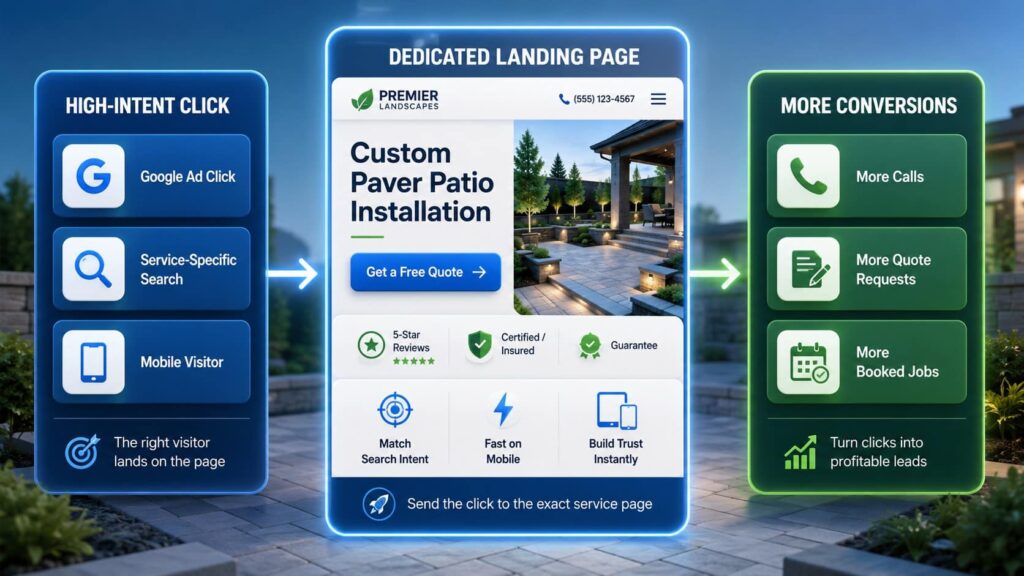
Getting a homeowner to click your ad is only half the battle. If they land on a confusing, slow, or generic website, they will leave immediately—and you still have to pay Google for that click. Designing high-converting landing pages is exactly how you turn expensive traffic into highly profitable booked jobs.
Matching Search Intent and Service Pages
One of the biggest mistakes you can make is sending your paid traffic to a generic homepage. Doing this is literally burning money. When a homeowner clicks an ad for a high-ticket project, they do not want to hunt through your website’s menus to see if you actually offer that service.
Matching search intent with dedicated service pages is critical. A hardscaping ad must go directly to a dedicated hardscaping landing page. By giving the user exactly what they searched for the second they land on the page, you drastically increase the chances that they will pick up the phone.
Mobile Optimisation and Fast Load Times
The vast majority of homeowners searching for „landscaping near me” are doing it from their smartphones while standing in their yard or sitting on their couch. Because of this, mobile optimization and extremely fast load times are non-negotiable. If your landing page takes more than three seconds to load on a cell network, or if they have to pinch and zoom to read your text, that expensive lead will bounce back to Google and call your competitor instead.
Trust Signals: Reviews, Certifications and Guarantees
You have to build trust the second a prospect lands on your page. Your dedicated landing pages must feature strong trust signals, including industry certifications, guarantees, and authentic customer reviews. You need to show them a portfolio of your past work and include a massive, unmissable „Get a Free Quote” button.
This is an area where DIY campaigns almost always fail. I specialize in conversion rate optimization, running rigorous A/B tests for both ads and landing pages. I systematically create the highest converting landing pages and continually optimize them to drive better results and secure fully booked calendars for my clients.
Tracking, Analytics and Optimisation - Google Ads Landscape Business
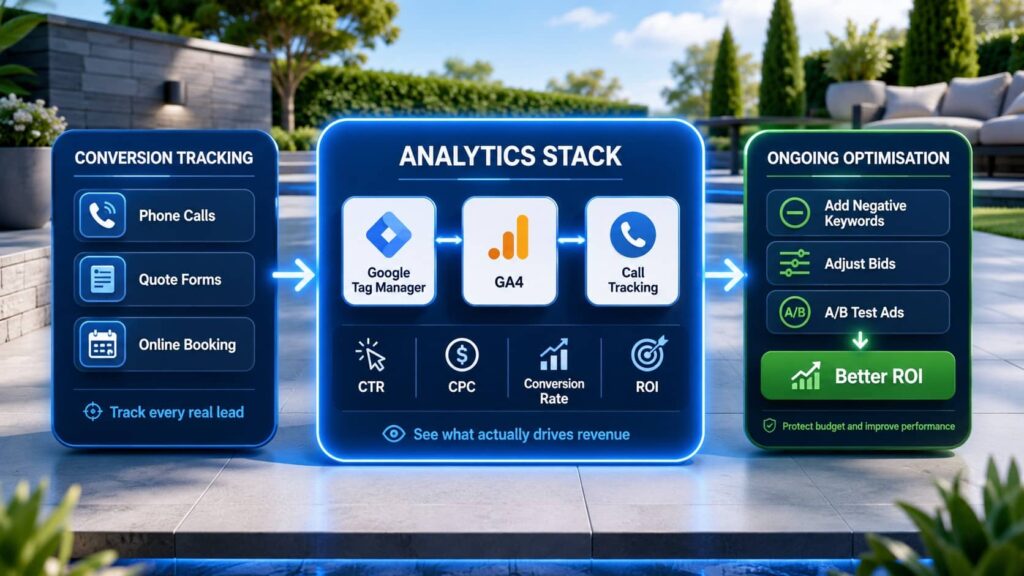
Running a campaign without tracking the results is like quoting a massive paver patio project without ever measuring the yard. If you cannot definitively prove which clicks are turning into paying customers, you can quickly lose. Proper tracking and continuous optimization are what separate amateur campaigns from highly profitable lead generation machines.
Setting Up Conversion Tracking (Calls, Forms, Online Booking)
A „click” does not pay your crew’s payroll; a booked job does. That is why setting up conversion tracking is the single most important technical step in your account. You must be able to track every time a prospect calls your phone number, fills out a quote form on your landing page, or completes an online booking. Without this data, Google’s algorithm has no idea what a successful lead looks like, and it will keep spending your budget on the wrong people.
Using Google Tag Manager, Google Analytics 4 and Call Tracking Tools
To accurately track these conversions, you need a robust technical stack. This involves using Google Tag Manager to deploy tracking codes, linking your account to Google Analytics 4 (GA4) to understand user behavior, and implementing third-party call tracking tools. Call tracking is especially vital for landscapers because it allows you to trace a specific phone call back to the exact keyword the user searched for.
However, setting up tags, triggers, and tracking pixels is incredibly technical. As a busy landscaping owner, your time is better spent closing estimates, not troubleshooting GA4 tracking errors.
Monitoring Key Metrics: CTR, CPC, Conversion Rate and ROI
Once your tracking is dialed in, you must monitor the metrics that actually impact your bottom line.
- Click-Through Rate (CTR): Are your ads compelling enough to get clicked?
- Cost Per Click (CPC): Are you paying a fair price for your traffic?
- Conversion Rate: Out of 100 visitors, how many are actually requesting a quote?
- Return on Investment (ROI): The ultimate metric. If you spend $1,000, how much revenue are you bringing in?
Ongoing Optimisation: Adding Negative Keywords, Adjusting Bids, A/B Testing Ads
Google Ads is never a „set it and forget it” platform. The market changes, competitors adjust their budgets, and search trends shift. Your campaigns require ongoing optimization to stay profitable. This means meticulously reviewing search term reports to add new negative keywords, adjusting your bids to maximize efficiency, and continuously A/B testing your ads to improve performance.
I specialize in conversion rate optimization, running systematic A/B tests for both the ads and the dedicated landing pages. I know that landscaping owners are incredibly busy and simply do not have the time to manage this level of technical detail. By doing this daily optimization work for them, I ensure their budgets are protected and secure a fully booked calendar for their crews.
Seasonal & Niche Campaign Ideas - PPC Landscaping
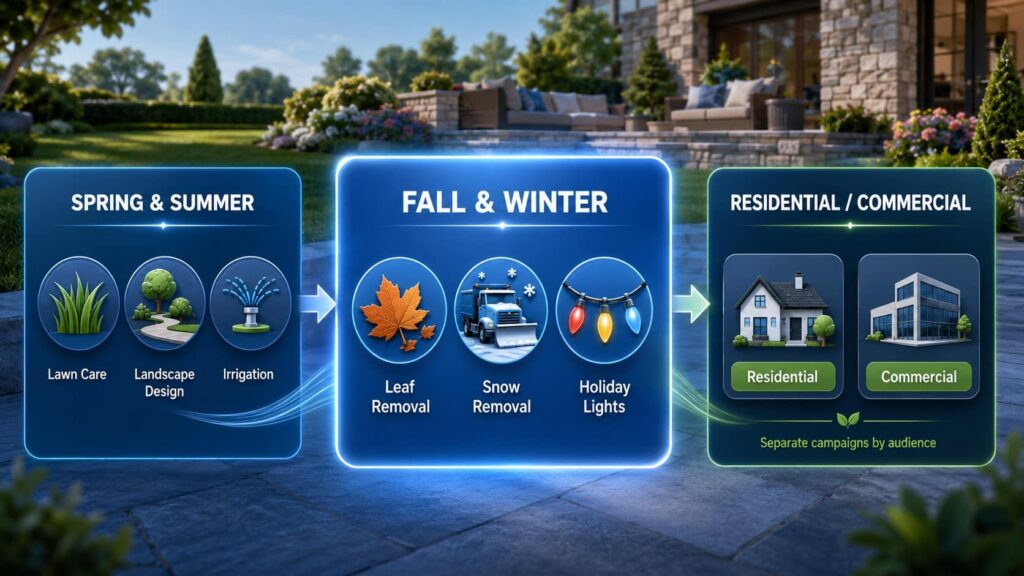
Landscaping is not a static, one-size-fits-all business. Your services change with the weather, and your Google Ads strategy needs to pivot right alongside it. Running a highly profitable account means knowing exactly when to launch seasonal campaigns and how to separate your target audiences.
Spring & Summer: Lawn Care, Landscaping and Irrigation
Spring and summer are the peak seasons for the green industry. During these months, your campaigns should aggressively target homeowners actively looking for seasonal solutions. However, remember the golden rule: never mix these services into one campaign.
You should have dedicated campaigns for ongoing lawn care maintenance, custom landscape design, and high-ticket summer projects like irrigation system installations. By keeping them separate, you ensure that high-volume, lower-ticket searches (like mowing) don’t eat up the budget you need to acquire a massive summer hardscaping project.
Fall & Winter: Leaf Removal, Snow Removal and Holiday Lights
When the grass stops growing, your lead generation shouldn’t stop. A major advantage of Google Ads is the ability to instantly pivot your budget to address seasonality, such as shifting from spring lawn care to winter snow removal.
As the seasons change, you can pause your summer ads and activate targeted campaigns for fall leaf removal, winter snow plowing, and even holiday light installation. The key to winter profitability is being proactive. By launching your snow removal campaigns before the first major blizzard hits, you can secure lucrative, season-long contracts while your competitors are still scrambling.
Residential vs. Commercial Campaigns
Treating a homeowner the same as a commercial property manager is a quick way to waste your ad spend. A homeowner looking for a backyard paver patio is a completely different buyer than a facility manager looking for a multi-year HOA maintenance contract.
The B2B procurement cycles for commercial landscaping differ significantly from residential decision-making. Because of this, you must build distinct residential and commercial campaigns. This means utilizing entirely different keyword sets—targeting phrases like „commercial lawn maintenance” instead of „lawn care near me” —and sending that traffic to specialized landing pages designed specifically to convert facility managers and business owners.
Knowing how to perfectly time these seasonal shifts and separate these complex niches takes years to master. I handle these seasonal transitions for my clients automatically, ensuring their crews have a predictable pipeline of work regardless of the weather or the target audience.
The Hidden Cost of Google's Constant Updates
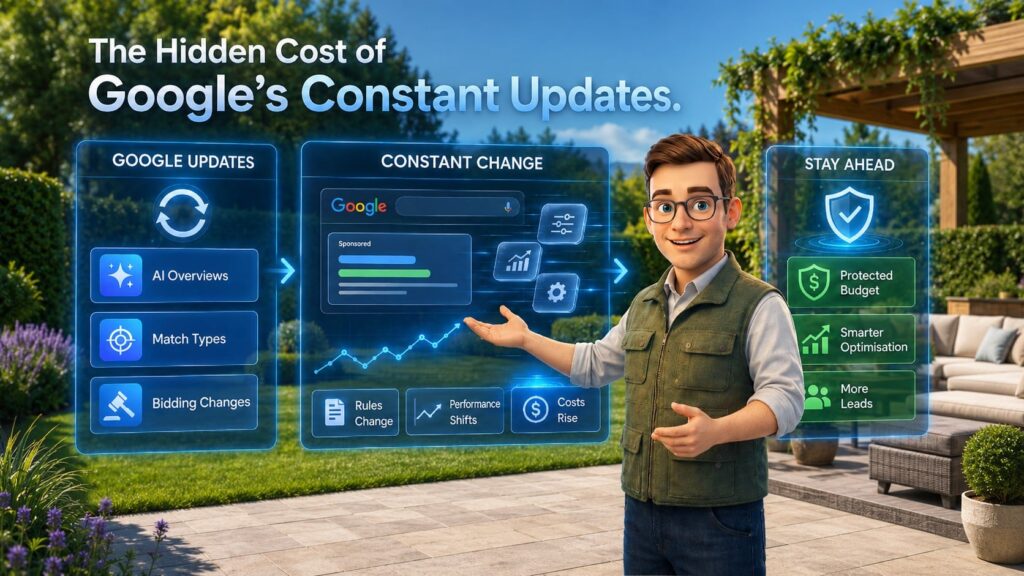
Many landscapers treat Google Ads like a billboard: they put it up and expect it to generate leads for the next five years without touching it. But Google Ads is not a static platform—it is a constantly evolving ecosystem, and falling behind means losing money.
The Algorithm Never Sleeps
Google changes its rules, algorithms, and ad formats constantly. In just the last year alone, they have rolled out new AI Overviews, altered how keyword match types behave, and continuously updated their automated bidding strategies. If you build a campaign and do not actively manage it, your performance will slowly degrade, and your cost per lead will inevitably skyrocket while your competitors steal your market share.
Staying Ahead of the Curve So You Don’t Have To
You run a landscaping business. You simply do not have the hours in your week to read through Google’s complex release notes, attend marketing webinars, or test the newest beta features on your own dime.
That is exactly why you need a dedicated specialist. I don’t just build your campaigns and walk away; I make it my priority to teach, test, and stay completely up-to-date with every single change Google makes to its platform. Because I am constantly learning and adapting to the latest industry standards, I can immediately apply the newest, most profitable strategies directly to your account. While you are out in the field managing your crews and closing estimates, I am in the trenches protecting your budget and ensuring you always stay one step ahead of your local competitors.
FAQ: Google Ads For Landscapers
1. What are Google Ads and how do they work for landscapers?
Google Ads provide a pay-per-click channel that lets landscapers bid on relevant keywords and appear instantly before searchers. When set up correctly, it is the most predictable way to generate high-ticket leads on demand.
2. How much should I spend on Google Ads per month for my landscaping business?
Industry data recommend a starting budget of $1,500 to $2,500 per month. This budget is good for beginning and allows you to capture high-intent keywords and gives the algorithm enough data to properly optimize your campaigns. While scaling campaigns it’s often more than $10,000 per month.
3. What is the average cost per click (CPC) and cost per lead (CPL) for landscaping Google Ads?
According to recent green industry benchmark reports, the average cost per click (CPC) is $4.14, and the average cost per lead (CPL) is $85.48. The average click-through rate (CTR) for these campaigns is 4.56%.
4. Which keywords are most effective for landscaping advertising?
The most profitable campaigns focus on high-intent keywords rather than informational searches. For example, targeting exact phrases like „paver patio installation [City]” or „emergency tree removal” secures leads that are ready to buy.
5. What negative keywords should landscapers add to avoid wasting their ad budget?
To avoid the frustration of paying for the wrong kind of leads, you must add negative keywords to block unqualified traffic. Essential negative keywords to exclude are „cheap,” „DIY,” „how to build,” and „mower repair”.
6. How do Local Service Ads (LSAs) differ from traditional Google Search Ads for landscapers?
While traditional Search Ads charge per click (PPC), Local Service Ads charge per lead (when a customer directly calls or messages you). LSAs also highlight a „Google Guaranteed” status once your business is verified, building instant trust with local homeowners.
7. How does seasonality affect Google Ads campaigns for lawn care and landscaping?
Seasonality requires you to be dynamic with your budgeting. You must shift your campaigns and budgets based on the weather, transitioning seamlessly from spring lawn care and summer irrigation to fall leaf removal and winter snow removal.
8. Should I hire an expert to manage my landscaping Google Ads or run them myself?
Learning Google Ads through trial and error is incredibly expensive. Many landscapers blow through their budgets on default campaigns. Hiring a specialist with over 8 years of experience saves you the „tuition” of learning the platform and ensures your time remains focused on closing estimates and managing crews.
9. How do I prevent click fraud and protect my landscaping advertising budget?
Handling click fraud and ensuring compliance is a key part of continuous monitoring. A professional will set up strict geographic targeting and monitor your traffic to ensure your budget is spent on real homeowners, not invalid clicks.
10. Why is a dedicated landing page so important for lawn care PPC and landscaping ads?
Sending paid traffic to a generic homepage is burning money. High-converting landing pages match the specific search intent of the user. For instance, a hardscaping ad must direct the user to a dedicated page featuring a portfolio, customer reviews, and a clear call-to-action to maximize your return on investment.

Daniel Ostrzyzek
Hi, I’m Daniel Ostrzyzek, a passionate Google Ads specialist with over 8 years of experience. I work with small to medium-sized businesses to help them attract leads, achieve their growth goals, and maximize ROI through Google Ads campaigns. After discovering my passion for digital marketing, I dove deep into Google Ads. Over the years, I’ve gained valuable experience working with businesses across various industries. I specialize in Google Ads Search and lead generation campaigns, helping my clients maximize the results of their online advertising.
Let's Talk!
I’m here to help you grow your business with the power of Google Ads. If you’re ready to take your campaigns to the next level – Schedule My Free Consultation