
Google Ads for Hardscaping
Why Paid Search Matters for Hardscape Contractors
Let’s cut the marketing fluff: running Google Ads for hardscaping is the single most ruthless way to step in front of high-intent buyers the exact second they search for patios and retaining walls. But let’s get one thing straight: I don’t care about making your phone ring more. The only thing that matters is making it ring strictly with homeowners who actually have the budget to build.
Hardscaping vs. Landscaping: Unique Challenges
A client came to me completely exhausted. His phone rang constantly, but he was busy being broke on $200 lawn-mowing jobs. I pitched a radical pivot: stop bidding on cheap lawn care and aggressively target high-ticket hardscaping.
Yes, hardscaping leads cost more—averaging $153.27 per lead—but the math works. In our first month, we spent $4,500 on ads and signed three projects at $25,000 each. Here is exactly how to stop wasting money and start booking premium projects.
Contents
- 1. Google Ads for Hardscaping
- 1.1. Google Ads for Hardscaping
- 1.2. Understanding Google Ads Hardscaping Basics
- 1.3. Budgeting & Cost Benchmarks
- 1.3.1. Cost-Per-Click (CPC) and Cost-Per-Lead (CPL) Benchmarks
- 1.3.2. Recommended Monthly Budgets
- 1.3.3. ROI Expectations & Break-Even Analysis
- 1.3.4. Building Your Google Ads for Hardscaping Campaign
- 1.3.5. Account & Campaign Setup
- 1.3.6. Advanced Geo-Targeting for High-Ticket Builds
- 1.3.7. Ad Group & Keyword Organization
- 1.3.8. Writing Compelling Ads
- 1.3.9. Landing Page Optimization
- 1.4. Advanced Strategies for Hardscaping PPC
- 1.5. Let's Talk!
- 1.6. Common Google Ads Hardscaping Mistakes & How to Avoid Them
- 1.7. The „Stop Bleeding Money” Audit (Highly Recommended)
- 1.8. FAQ: Google Ads For Hardscaping
- 1.8.1. 1. How much should a hardscaping company spend on Google Ads?
- 1.8.2. 2. How long before I see results from hardscape PPC?
- 1.8.3. 3. Which match types and keywords are best for capturing high-ticket projects?
- 1.8.4. 4. Should I manage my own Google Ads for hardscaping campaigns or hire an agency?
- 1.8.5. 5. How do I track leads and ROI for my hardscaping ads?
- 1.8.6. Daniel Ostrzyzek
- 1.9. Let's Talk!
Understanding Google Ads Hardscaping Basics
How Google Ads Works
Think of Google Ads as a lightning-fast, invisible auction that happens the millisecond a homeowner hits ’search’ for a hardscape PPC keyword. But here is the kicker: the guy with the biggest wallet doesn’t automatically win. Google uses a metric called a Quality Score, which basically grades how relevant your ad and landing page are to the person searching. If your page is highly relevant and built specifically for the service they want, you can actually pay less per click than a competitor with a terrible, generic website.
You also use „match types” to control how strictly a search must match your keyword. You have Broad match (where Google guesses what the searcher meant—usually in the beginning it can drain your budget), Phrase match (the search must include your phrase or a close variation), and Exact match (the search must be exactly your keyword).
Types of Ads for Hardscape Services
There are four main formats we can use to dominate the local market:
- Search Ads: This is your bread and butter. You use this for active intent when someone is literally typing „patio builders near me” into their phone.
- Local Services Ads (LSAs): Ideal for pure lead generation. These sit at the very top of the page with a shiny „Google Guaranteed” badge, and you pay per lead instead of per click.
- Display Ads: These are visual banner ads. They are perfect for remarketing, meaning we show photos of your stunning past projects to people who already visited your website but haven’t called you yet.
- Video Ads: Useful for showcasing your crew in action and building local brand awareness.
PPC Hardscaping Keywords & Match Types
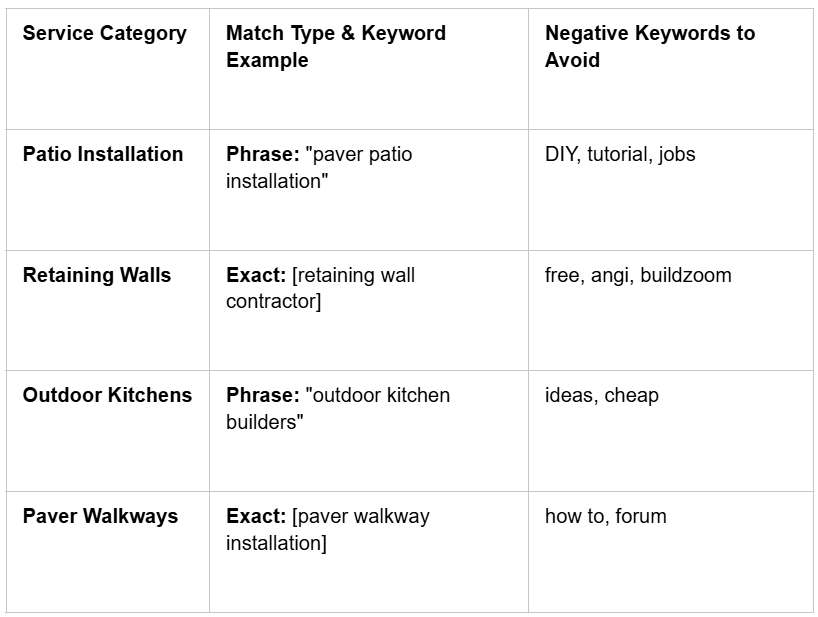
If you want high-intent leads, you must cluster your keywords tightly by the specific services you offer. If someone searches for a retaining wall, they should only see an ad about retaining walls.
Here is exactly how I organize these clusters:
Budgeting & Cost Benchmarks
Cost-Per-Click (CPC) and Cost-Per-Lead (CPL) Benchmarks
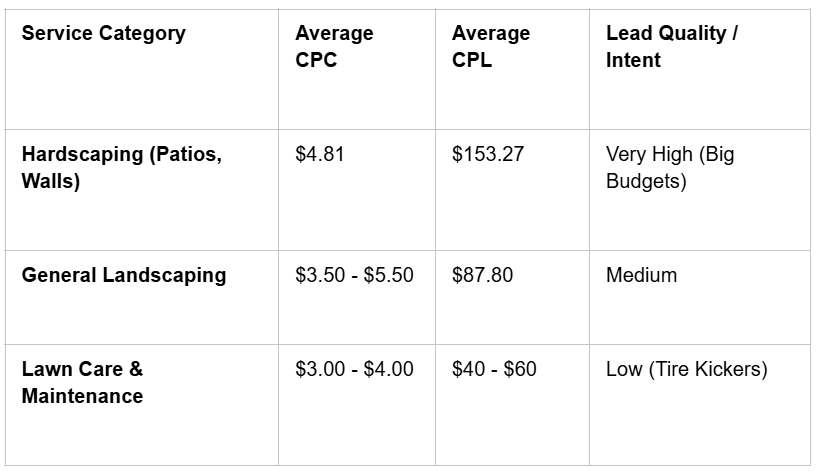
Let’s talk about real numbers. According to recent data from Evergrow and BuiltRight, the typical cost-per-click (CPC) in the landscaping space ranges from $3 to $12, and the average cost-per-lead (CPL) sits between $40 and $120.
But remember, we are filtering out the cheap lawn-mowing noise. Because we are targeting high-ticket projects, premium hardscaping leads average exactly $153.27 per lead.
Here is how the costs roughly break down when you compare the generic stuff to the big-ticket builds:
Recommended Monthly Budgets
You cannot bring a knife to a gunfight. If you want to actually win the Google Ads hardscaping auction and give Google’s algorithm enough data to optimize, you need to fund your campaigns properly. I always advise bumping up standard budget recommendations so you aren’t starved for traffic.
Here is where your budget needs to be:
- Small Contractors: $1,500–$2,000/month
- Growing Businesses: $2,500–$3,500/month
- Established Firms: $4,000+/month
Your exact spend will swing based on three major factors: how vicious your local competition is, your specific service mix (e.g., sticking strictly to outdoor kitchens vs. general pavers), and the seasonality of your market.
ROI Expectations & Break-Even Analysis
Do not let a $153 cost-per-lead terrify you. Let’s do the math on a highly conservative $5,000 patio job.
If your sales skills are average and it takes you 5 leads to close one deal (a 20% conversion rate), you just spent $765 on ads to acquire a $5,000 contract. If your average project is actually $25,000, that exact same $765 ad spend just yielded a massive return on investment.
Building Your Google Ads for Hardscaping Campaign
Account & Campaign Setup
When you first start building your Google Ads account, the platform is going to try to hold your hand. It will ask you to select your basic campaign goals, which is fine, but you need to immediately switch over to „Expert Mode”. If you let Google run your account on autopilot, it will gladly spend your budget on the easiest, cheapest, and most useless clicks it can find. Take the wheel from day one.
Advanced Geo-Targeting for High-Ticket Builds
Dallas ZIP Code Targeting for High-Ticket Hardscaping
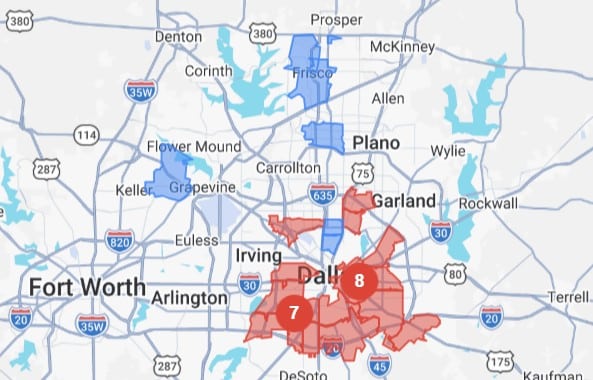
Most guys will just set up a campaign, choose a radius around their shop, and let it run. But for high-ticket hardscaping, you cannot target all of Dallas equally. You must prioritize ZIP codes with expensive homes, larger lots, and strong outdoor living potential.
Instead of lazily targeting a 20-mile radius, on May 18th, I went into the location settings and manually excluded 20 specific zip codes (like 75216 and 75217) where recent home-value data showed a weaker fit for $30,000+ hardscaping projects. I then aggressively focused our budget on five of the highest-value zip codes in the area—targeting ultra-high-net-worth pockets like Highland Park (75205) and Southlake (76092).
By using these strict exclusions, layering in household income data, and tracking our conversion quality, we dramatically reduced wasted spend on poor-fit leads. In a high-ticket hardscaping campaign, this kind of ZIP-code filtering can be the difference between getting $9,500 repair requests and $24,000+ outdoor living project inquiries.
One more PPC note: Make sure your Google Ads location options are strictly set to „Presence: People in or regularly in your targeted locations.” Never use the broader default setting of „Presence or interest.” Google confirms the default can trigger your ads for people who are merely researching or interested in the area from a thousand miles away, wasting your budget on clicks that will never turn into local projects.
Ad Group & Keyword Organization
If you throw all of your keywords into one giant bucket, your hardscape PPC ads will be a mess. But do not just separate your services into different ad groups—you need to build completely separate campaigns for each type of project. Your patio builds need their own campaign with their own dedicated budget, and your retaining walls need a separate campaign with its own budget. This gives you absolute control over where your money actually goes.
Within those specific campaigns, keep your ad groups incredibly lean. Stay far away from broad match keywords at the beginning; they will just bleed your budget dry on unqualified, generic searches. Instead, I stick strictly to phrase matches. Focus on a maximum of 10 highly specific phrase match keywords per ad group. This guarantees that your budget is only spent on hyper-relevant searches and that the homeowner sees an ad perfectly matched to what is in their head.
Writing Compelling Ads
To write an ad that actually pulls high-ticket leads, you have to spell out the exact value to the homeowner, demand they take action, and stack your ad with sitelinks and callouts to physically monopolize the search results.
But here is where I take a hard line. Most hardscaping contractors are terrified of scaring people away, so they use weak ad copy like 'Call for a Free Estimate’. I completely disagree with this approach. I believe you must put your minimum project costs—like 'Custom Patios Starting at $15k’—directly in the ad headline. I refuse to write Google Ads for hardscaping that hide the price. I will happily cut our click-through rate in half if it means I can guarantee my client never has to drive 45 minutes to quote a job for a homeowner with an $800 budget.
Landing Page Optimization
If your ad is a promise, your landing page is the proof. You need to nail the basics: use clear service descriptions, embed a simple contact form, and aggressively show off your testimonials and before-and-after photos.
But here is a hard truth. Conventional marketing wisdom says you need to build trust by putting a big 'About Our Family Business’ section right at the top of your landing page. After watching how PPC hardscaping traffic actually behaves on websites, I realized this kills your momentum. Homeowners ready to spend $30,000 on a backyard don’t actually care what year your grandfather started the company—they only care if you can build what is in their head.
When I ripped out the long 'About Us’ story on a client’s page and replaced it with a simple gallery of high-end local projects and a button that said 'Get This Look,’ the difference was immediate. We went from getting a slow trickle of generic inquiries to booking serious, high-ticket design consultations almost overnight.
Advanced Strategies for Hardscaping PPC
Negative Keywords & Traffic Filters
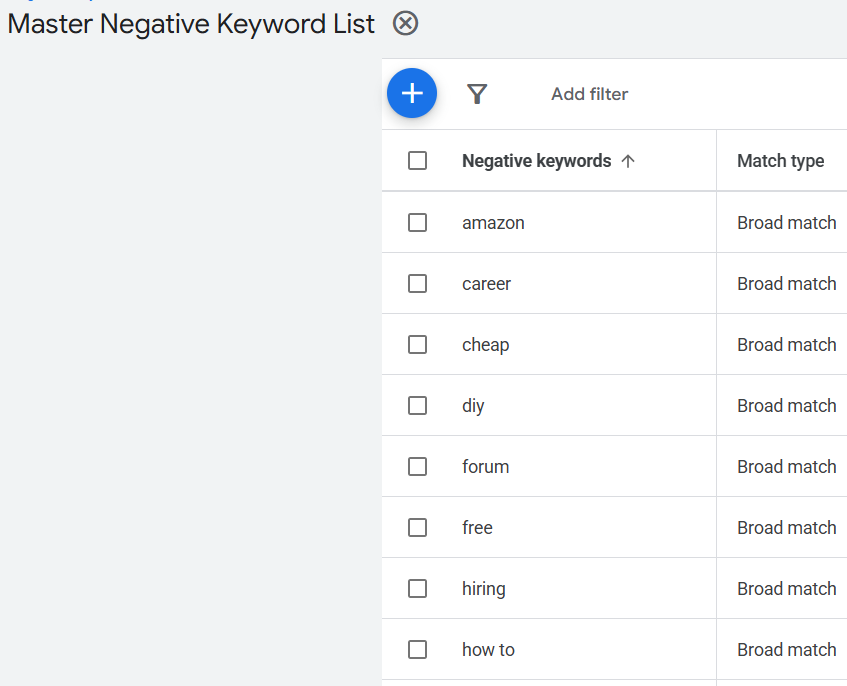
Adding negative keywords—terms like „DIY,” „tutorial,” „free,” and „jobs”—is how you prevent Google from showing your ads to people who have zero intention of hiring you.
On day one of taking over a new account, I went straight into the Search Terms report to see what the client was actually paying for. It was a bloodbath. They were buying clicks for completely unqualified phrases like „free patio ideas,” „paver diy,” and „fake grass amazon.” In the last 30 days alone, those irrelevant DIY searches had silently drained exactly $1,055 from their budget. I immediately built a massive negative keyword list to plug the leak. With that single, day-one fix, I saved the client thousands of dollars in future wasted ad spend before I even touched a single piece of ad copy.
Conversion Tracking & Analytics
If you do not set up strict conversion goals, you are just handing your money to Google with no clue what’s working and what’s not. You have to use Google Tag Manager (GTM) and Google Analytics 4 (GA4) to track exactly what happens after the click. We measure your click-through rate (CTR) and cost-per-click (CPC), sure, but the only conversions that actually matter are phone calls, submitted contact forms, and ultimately, qualified leads that turn into signed clients. I do not care how cheap your clicks are; if we cannot trace those clicks back to a booked consultation and a signed contract, the campaign is failing.
Remarketing & Display Campaigns
Homeowners rarely drop $30,000 on a backyard the very first time they click an ad. They need time to think. That is where remarketing comes in. We use display campaigns to showcase stunning portfolio images of your past projects to people who have already visited your website. Essentially, your beautiful outdoor kitchens and paver patios will „follow” them around the internet, keeping your brand in their head while they make a final decision.
Local Services Ads & Google Guaranteed
I treat Google Local Services Ads (GLSAs) like the little brother to traditional Google Ads. Let’s be clear: they are nowhere near as powerful, and they give you much less control and optimization space compared to a standard search campaign. But instead of paying for clicks, you only pay per lead. To run them, you have to pass a rigorous background and insurance check to earn a green „Google Guaranteed” badge.
Earning that badge builds instant, undeniable trust with the homeowner before they even click your profile. While GLSAs lack the heavy customization of standard Google Ads, the two work together flawlessly to help you completely dominate the top of the search results.
A/B Testing & Optimization
There is no such thing as „set it and forget it” in paid search. You must ruthlessly and continuously optimize the account. This means adjusting your bids based on what is actually converting, testing new aggressive ad copy against your old winners, and constantly refining your keyword lists.
But where the real money is made is in granular split-testing, especially on your landing pages. We do not just guess what works; we test every single element. We run strict A/B tests on button colors, specific Call-To-Action (CTA) phrasing, and different hero images of your hardscaping projects to see exactly what makes homeowners pick up the phone.
This level of testing is incredibly powerful. Let’s look at the math: if a series of simple landing page tweaks increases your conversion rate from 5% to 10%, you just doubled your lead volume. Let that sink in. You get twice as many highly qualified leads using the exact same ad budget, simply by finding the winning combination on your page. If you aren’t tweaking the machine down to this level of detail, you are leaving serious money on the table and your competitors will quickly outbid you.

Let's Talk!
I’m here to help you grow your business with the power of Google Ads. If you’re ready to take your campaigns to the next level – Schedule My Free Consultation
Common Google Ads Hardscaping Mistakes & How to Avoid Them
Overly Broad Keywords & Budget Drain
The absolute fastest way to set your budget on fire from day one is defaulting to broad match keywords. I see this mistake constantly when auditing accounts: contractors set up misaligned campaigns that cast way too wide a net, paying for generic, irrelevant searches that have absolutely nothing to do with high-ticket Google Ads hardscaping campaigns.
Don’t get me wrong—you can use broad match keywords, but absolutely not at the beginning. You have to earn the right to use them. You should never turn on broad match until your account is consistently hitting at least 30 conversions in the last 30 days strictly from your highly controlled phrase match keywords. Even then, you must have a giant negative keyword list already in place. If you unleash broad match without that massive list to block the junk traffic, Google will exhaust your daily ad spend on useless clicks before the right prospects even get a chance to see your ad.
Poor Landing Pages & Conversion Drop-Offs
Sending paid traffic to your generic website homepage is a massive mistake. If a homeowner clicks an ad promising custom retaining walls and lands on a page talking about your general lawn care services, they will immediately hit the back button. This mismatched landing page experience doesn’t just kill your conversion rate; it actively destroys your Google Ads Quality Score. A poor Quality Score signals to Google’s algorithm that your page is not relevant, which actively drives up your cost-per-click and forces you to pay a premium for worse results.
Ignoring Seasonality & Local Competition
You have to adjust your budgets based on local competition and seasonality, but most contractors get the timeline completely backward.
Standard marketing strategy says you should pause your ad spend in November and save your budget for the „spring rush.” Based on my internal tracking, this is completely wrong. The largest, most expensive patio projects are actually acquired in January and February when the ground is completely frozen. Because your competitors get scared and pause their ads during the winter, the auction clears out and our CPC drops by a massive 45%. We aggressively buy that cheap winter traffic, and by the time April rolls around, my clients already have their entire spring schedule booked solid with premium hardscaping jobs.
The „Stop Bleeding Money” Audit (Highly Recommended)
Ready to Stop Paying the „Stupid Tax” to Google? You can spend the next six months trying to figure this out on your own while Google drains your budget on cheap lawn-care clicks, or you can let me fix it. I build ruthless Google Ads for hardscaping campaigns designed to do one thing: put you in front of homeowners ready to drop $30,000+ on a premium outdoor living space.
CONTACT ME NOW and let’s start building your campaigns the right way
FAQ: Google Ads For Hardscaping
1. How much should a hardscaping company spend on Google Ads?
You cannot bring a knife to a gunfight. If you want to dominate Google ads for hardscaping, your budget must align with your local competition. Small contractors should commit $1,500–$2,000/month, growing businesses need $2,500–$3,500/month, and established firms should aggressively deploy $4,000+ per month. Trying to run campaigns on a microscopic $15 or $20 a day budget just starves the algorithm and guarantees you lose the auction to competitors willing to pay for premium patio and retaining wall leads.
2. How long before I see results from hardscape PPC?
If your paid search campaign is built correctly, the phone can literally ring on day one. However, the system typically requires a 2 to 4-week „learning phase” where the algorithm figures out which users are most likely to convert into actual signed contracts. Months two and three are where we refine the data, ruthlessly cut wasted spend, and watch your cost-per-acquisition drop while profitability for your hardscape business spikes.
3. Which match types and keywords are best for capturing high-ticket projects?
Start strictly with phrase matches to keep your targeting incredibly lean—no more than 10 highly targeted keywords per ad group. Only graduate to broad match once your account is consistently pulling in at least 30 conversions over a 30-day period. More importantly, negative keywords are non-negotiable. I have saved clients thousands on day one just by looking at their Search Terms report and blocking useless junk traffic like „paver diy,” „free patio ideas,” and „fake grass amazon.”
4. Should I manage my own Google Ads for hardscaping campaigns or hire an agency?
Managing it yourself saves you an agency fee upfront, but you will inevitably pay the „stupid tax” to Google in the form of wasted ad spend on generic keywords. Hiring a specialized agency costs money, but they bring proprietary data, instantly stop the bleeding, and know exactly how to structure campaigns for $30,000 outdoor kitchen builds instead of cheap $200 lawn cleanups.
5. How do I track leads and ROI for my hardscaping ads?
Do not just look at vanity metrics like clicks and impressions. You must use Google Tag Manager (GTM) and Google Analytics 4 (GA4) to track the metrics that actually pay the bills: phone calls and submitted contact forms. The ultimate goal is to tie those digital conversions directly into your CRM so you can track exactly which specific Google search resulted in a signed $50,000 contract.

Daniel Ostrzyzek
Hi, I’m Daniel Ostrzyzek, a passionate Google Ads specialist with over 8 years of experience. I work with small to medium-sized businesses to help them attract leads, achieve their growth goals, and maximize ROI through Google Ads campaigns. After discovering my passion for digital marketing, I dove deep into Google Ads. Over the years, I’ve gained valuable experience working with businesses across various industries. I specialize in Google Ads Search and lead generation campaigns, helping my clients maximize the results of their online advertising.
Let's Talk!
I’m here to help you grow your business with the power of Google Ads. If you’re ready to take your campaigns to the next level – Schedule My Free Consultation