
How to Improve Google Ad Strength
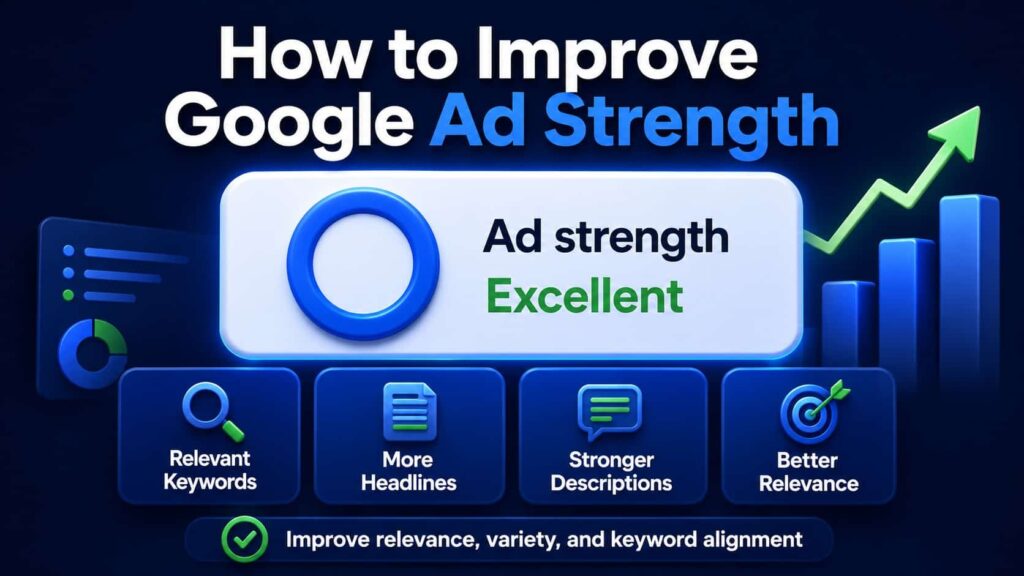
To improve Google Ad Strength, you must maximise asset variety, avoid pinning, and incorporate keywords using all 15 headlines and 4 descriptions. But if your dial is stuck at „Average” and you feel a wave of panic, take a breath. It feels like Google is grading your marketing homework, but let’s talk about what’s really happening.
To understand this, let me share what I saw. In February 2021, Google made RSAs the default ad format for standard search campaigns. Then, on June 30, 2022, Google stopped allowing the creation and editing of Expanded Text Ads (ETAs), leaving RSAs as the sole standard search ad format.
I remember my thoughts that this was the next major step to automation. Google was officially taking the wheel. Ad Strength is just their way to ensure we feed their algorithm enough puzzle pieces. But does an „excellent” score actually matter? Let’s dive in.
Contents
- 1. How to Improve Google Ad Strength
- 1.1. How to Improve Google Ad Strength
- 1.2. What Is Google Ads Ad Strength?
- 1.2.1. Definition & Rating Scale (Incomplete → Excellent)
- 1.2.2. How It Differs from Quality Score & Optimization Score
- 1.2.3. Does Ad Strength Really Matter?
- 1.2.4. Benefits of Using the Indicator
- 1.2.5. Limitations & Criticisms
- 1.2.6. When to Ignore Ad Strength
- 1.2.7. Preparing to Optimize: Audience & Goals
- 1.2.8. Define Your Audience & Pain Points
- 1.2.9. Align With Business Goals & KPIs
- 1.2.10. Audit Existing RSAs
- 1.2.11. Core Strategies to Improve Ad Strength
- 1.2.12. Use All 15 Headlines & 4 Descriptions
- 1.2.13. Diversify Headline Types
- 1.2.14. Integrate Keywords Naturally
- 1.2.15. Highlight Unique Selling Points & Benefits
- 1.2.16. Avoid Over-Pinning & Encourage Variety
- 1.2.17. Refresh & Save Ads Regularly
- 1.3. Advanced Techniques & Tools
- 1.4. Let's Talk!
- 1.5. Case Studies & Data
- 1.6. Ad Strength Myths
- 1.7. FAQ: How to Improve Google Ad Strength
- 1.7.1. 1. How to improve Google ad strength quickly?
- 1.7.2. 2. How to increase Google Ads strength from "Poor" to "Excellent"?
- 1.7.3. 3. Is Google Ads Ad Strength a ranking factor?
- 1.7.4. 4. How to improve ad strength in competitor campaigns?
- 1.7.5. 5. Does ad strength matter for actual CTR or conversions?
- 1.7.6. 6. Does pinning assets reduce Google Ads ad strength?
- 1.7.7. 7. What does dynamic keyword insertion do for ad strength?
- 1.7.8. 8. Does ad strength matter for Performance Max (PMax) campaigns?
- 1.7.9. 9. Is $20 or $100 a day enough budget to test ad strength combinations?
- 1.7.10. 10. Should I pause or delete ads that only have an "Average" or "Good" ad strength?
- 1.7.11. Daniel Ostrzyzek
- 1.8. Let's Talk!
What Is Google Ads Ad Strength?
Definition & Rating Scale (Incomplete → Excellent)
Let’s break down what this metric actually is. Ad Strength is a real-time feedback tool. As you type in your new responsive search ad, Google grades your work on a scale ranging from „Incomplete” all the way up to „Excellent”.
What is it actually grading? The system evaluates your asset variety, uniqueness, keyword relevance, and whether you are using minimal pinning. In plain English, Google wants to know if you are handing its algorithm enough distinct headlines, keywords, and descriptions so it has the freedom to mix and match them as it pleases.
How It Differs from Quality Score & Optimization Score
This is where I see a lot of people panic unnecessarily. You absolutely must understand that Ad Strength is not a ranking factor.
It is a completely different beast from your Quality Score. The Quality Score actually impacts your cost per click and where your ad physically shows up on the search results page. Ad Strength, on the other hand, is simply a diagnostic tool that rewards variety, relevance, and experimentation. Think of it this way: if Quality Score is your actual financial credit score, Ad Strength is just your accountant suggesting you should probably diversify your portfolio.
Does Ad Strength Really Matter?
Benefits of Using the Indicator
Let’s be fair for a second—the indicator isn’t completely useless. It provides real-time feedback while you are physically building your ad , which is incredibly helpful if you are a beginner just learning the ropes. It also forces you to brainstorm a wide variety of headlines instead of being lazy and just submitting the first three that come to mind.
Limitations & Criticisms
But here is where the cracks start to show. If you only chase that „excellent” score and leave all your assets unpinned to keep Google happy, you often end up with awkward, robotic headline combinations that don’t make sense to a human reader. On top of that, the data shows that „excellent” ads can actually underperform, just like „average” ones do in certain cases. Having that „excellent” label does not magically guarantee your ad will perform better.
When to Ignore Ad Strength
If you want to win, you have to look past the vanity score. I disagree that only the ad with the excellent ad strength converts the best. It’s very easy to drop this score to good or average, while pinning the headlines or testing new descriptions without popular keywords, like they suggest.
It’s all about your business and I have a lot of tests while the good score beats the excellent score in the most important case which is the higher conversion rate and lower cost per conversion. At the end of the day, relevance, your click-through rate, and actual conversions matter infinitely more than a green circle.
I believe that if you are sacrificing your ad’s readability and real-world performance just to appease Google’s algorithm with an „excellent” badge, you are actively throwing your budget away.
Preparing to Optimize: Audience & Goals
Before we start throwing a bunch of new headlines at the wall to see what sticks, we need to take a step back. You wouldn’t build a house without a blueprint, and you shouldn’t build an ad without knowing exactly who you are talking to and what you want them to do.
Define Your Audience & Pain Points
Most people jump straight into keyword stuffing, but remember: you are writing for humans, not just the Google algorithm. I always tell people to start by defining customer personas to truly understand your audience’s motivations.
What keeps your customer up at night? What is their specific problem that your business solves? You have to understand your customer’s pain points and craft compelling content around their desires. If your ad promises a solution to that pain point, you must make sure your landing page aligns perfectly with that ad promise. Otherwise, you are just paying for them to click and immediately bounce.
Align With Business Goals & KPIs
Next, ask yourself what success actually looks like for this campaign. You need to decide upfront when to prioritize hard conversions over simple brand awareness—and definitely when to prioritize those conversions over your Ad Strength score.
Set concrete benchmarks for your Click-Through Rate (CTR), Cost Per Click (CPC), and Cost Per Acquisition (CPA). Having these numbers written down means you won’t be flying without the plan. You will know if tweaking your ads is actually improving your bottom line or just making the Google dial turn green.
Audit Existing RSAs
Now, let’s open up your account and look at the damage. Before writing anything new, audit your existing RSAs. You need to check your current number of assets, evaluate their variety, and review their actual performance data.
Look closely for duplicate headlines. If you have three variations of „Call Us Today,” you aren’t really giving the system anything unique to test. Also, identify any pinned elements. You might find that you’ve accidentally handcuffed the algorithm by pinning too many redundant phrases, which is a quick way to tank both your Ad Strength and your performance.
Core Strategies to Improve Ad Strength
Alright, let’s get our hands dirty. If you really want to play Google’s game and push that dial toward „Excellent,” here are the core tactics you need to deploy.
Use All 15 Headlines & 4 Descriptions

First things first: do not leave blank spaces. You need to provide at least 15 unique headlines and four descriptions. Let me explain the math behind why Google wants this so badly. If you only give the system 5 headlines and 2 descriptions, there are roughly 200 possible ad combinations. But if you max it out with 15 headlines and 4 descriptions, that number skyrockets to over 32,000 potential combinations. Having more assets allows Google to test exponentially more combinations to find what works.
Diversify Headline Types
You can’t just write „Buy My Stuff” 15 different ways and expect a good score. Google wants distinct categories. You need to include keyword-rich headlines that match your ad group, along with your brand messaging, clear value propositions, specific offers like discounts or trials, and solid authority claims.
Integrate Keywords Naturally
It goes without saying that you should use your high-performing keywords in your headlines. However, resist the urge to keyword stuff just to trick the meter. A great way to handle this smoothly is to incorporate dynamic keyword insertion. This automatically updates your ad with the exact keyword the user searched for, keeping relevance high without sounding spammy.
Highlight Unique Selling Points & Benefits
Why should someone click your ad over the guy below you? You need to showcase your actual features, benefits, and problem-solving aspects. Don’t assume they know what to do next—always include strong calls to action and create a sense of urgency.
Avoid Over-Pinning & Encourage Variety
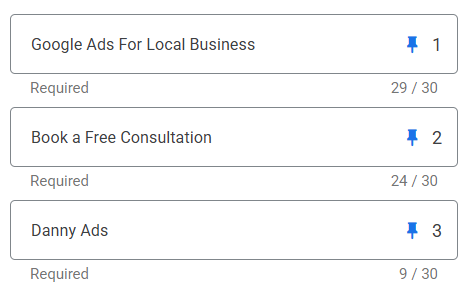
This is where things get controversial, and it is where I draw a hard line. Google will explicitly tell you to pin only essential elements, warning that excessive pinning can reduce Ad Strength and even lead to higher CPCs. They argue that unpinned combos allow more testing, but they also admit that these combinations must still read coherently.
I disagree that only the ad with the excellent ad strength converts the best. It’s very easy to drop this score to good or average, while pinning the headlines or testing new descriptions without popular keywords, like they suggest. I won’t sacrifice the coherence of my messaging just to get a perfect score. If pinning my golden keywords makes the ad readable for a human, I will gladly accept an „Average” badge over an „Excellent” robot-generated mess.
Refresh & Save Ads Regularly
Finally, don’t just set it and forget it. You need to go back in and edit your underperforming headlines, unpin any unnecessary ones, and re-save the ad. Doing this will actively prompt Google to re-evaluate your ad and update your score on the spot.
Advanced Techniques & Tools
Once you’ve got the basics down, it’s time to level up. Here are the advanced moves I use to keep my accounts sharp and my campaigns actually making money.
Use AI for Headline Generation
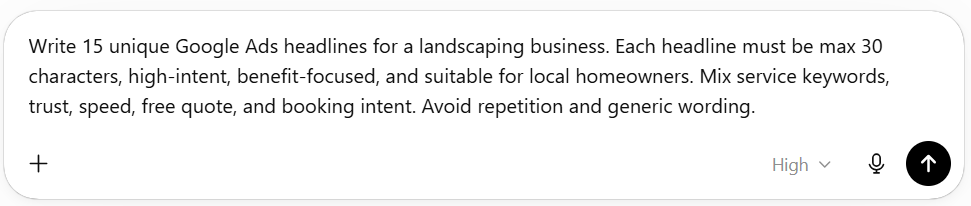
Let’s be honest: writing 15 unique headlines from scratch for every single ad group is mentally exhausting. Don’t be afraid to use AI tools like Claude or ChatGPT to do the heavy lifting. You can feed them a prompt to generate diverse headlines that cover specific categories like urgency, benefits, features, social proof, and authority. Just try using an example prompt like: „Act as a Google Ads expert and write 15 distinct headlines for my business, mixing urgency with social proof”.

Let's Talk!
I’m here to help you grow your business with the power of Google Ads. If you’re ready to take your campaigns to the next level – Schedule My Free Consultation
Analyse Asset Performance Reports
You can’t just set your ads live and hope for the best. You need to pull up the asset details in Google Ads to see exactly what is working. This report is your best friend because it explicitly shows you which headlines are getting high impressions and which ones are completely ignored by the algorithm. Stop guessing. If an asset is dragging you down, cut it and write a new one.
Test & Iterate
Good marketing is just systematic testing. You should be running A/B tests, rotating your ads every few weeks, and continually using negative keywords to tightly refine your targeting. Don’t let your accounts get stale.
Landing-Page Alignment
I see this mistake all the time. Your ad does the hard work of getting the click, but your landing page completely drops the ball. Your landing page absolutely must fulfill the promise you made in the ad. If your ad says „20% Off Today,” that exact offer needs to be the first thing they see when they click through. You also need to ensure your landing page includes those relevant keywords, features fast loading times, and has strong calls to action.
Consider Profit-Focused Metrics
Finally, we need to look past the standard, surface-level Google Ads dashboard metrics. If you are generating leads, you need to ruthlessly track your Target CPA (Cost Per Acquisition) and your actual cost per signed case. At the end of the day, knowing exactly how much it costs to get a real signature on the dotted line is the metric that should dictate your budget allocation—not a vanity ad strength score.
Case Studies & Data
Let’s look at the actual numbers. It is one thing to talk about theory, but it is another to see how this plays out in real, spending accounts.
Example: Improving from Poor to Good
First, let’s look at a local business scenario. If you have an ad sitting at a „Poor” rating because you only wrote three headlines and didn’t include any of your main keywords, fixing it is a no-brainer. When you take an ad from „Poor” to „Good” by adding more assets, unique headlines, and naturally inserting keywords, you usually see an immediate jump in your Click-Through Rate (CTR) and conversions. Why? Because you took an incomplete ad and gave the system enough pieces to actually build something readable.
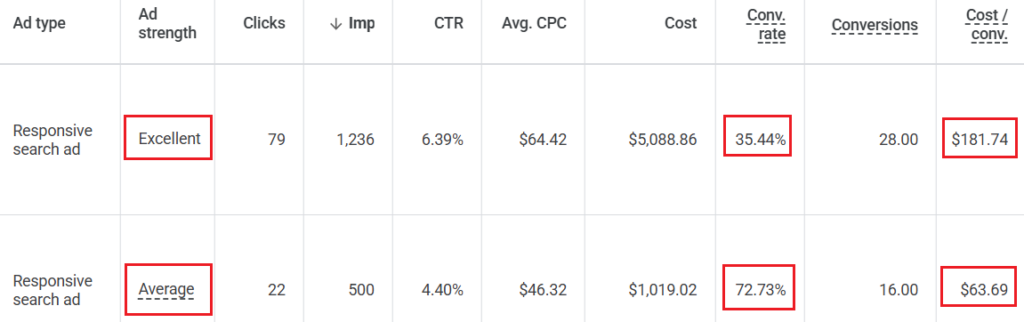
Example: Excellent vs Average
In summer of 2023 I’ve started testing a lot of new RSA’s and until this day they are still with us. I didn’t just run a weekend experiment; I ran these tests relentlessly to see what actually moves the needle for my clients.
It’s all about your business and I have a lot of tests while the average score beats the excellent score in the most important case which is the higher conversion rate and lower cost per conversion. When I pinned my golden keywords—which instantly caused Google to downgrade my score from „Excellent” to „Average”—my ads finally made sense to humans. I disagree that only the ad with the excellent ad strength converts the best. I will gladly take a „Average” or “Good” rating if it means my cost per signed case goes down and my actual profitability goes up.
Interpreting Google’s 12% Conversion Lift
You will hear Google constantly quote their internal data showing that advertisers see up to a 12% lift in conversions when moving an ad from „Poor” to „Excellent”. But you have to look at the context and the limitations of that claim. If your ad is „Poor,” it means it is broken. Fixing a broken ad will obviously give you a lift. However, going from „Good” to „Excellent” often requires you to unpin everything and stuff keywords just to satisfy the algorithm, which can actually hurt your readability and your conversion rate. I believe you should focus on writing highly persuasive, structured copy for humans instead of contorting your messaging just to hit Google’s 12% benchmark.
Ad Strength Myths
Let’s clear the air and bust some of the biggest lies circulating in the PPC world right now. When you spend enough time managing accounts, you quickly realize that what Google suggests and what actually works are often two completely different things.
Myth 1 – High Ad Strength = High Conversions
Just because you have an „Excellent” rating does not mean your phone is going to ring off the hook. A high score absolutely does not guarantee conversions. Ad Strength merely measures if you gave Google enough raw ingredients to mix and match; it doesn’t measure if the final message is actually persuasive to a human being.
Myth 2 – Ad Strength Is the Only Metric That Matters
Do not get tunnel vision staring at that one little dial. You need to focus on the metrics that actually impact your business. You should always be tracking your Click-Through Rate (CTR), your Quality Score, and most importantly, your conversion rate and real clients from the campaigns. Ad Strength is just a basic guideline, not your campaign’s ultimate KPI.
Myth 3 – „Excellent” Ads Always Perform Better
This is the trap most beginners fall into. There is plenty of data and independent studies out there showing that „Average” or „Good” ads can—and frequently do—outperform „Excellent” ones. As I mentioned earlier, when you unpin everything to chase that „Excellent” badge, you risk creating awkward, disjointed combinations. A logically structured, pinned „Good” ad will often beat a chaotic „Excellent” ad in real-world performance.
Myth 4 – More Headlines Always Improve Ads
Google will practically beg you to keep adding headlines until you hit the maximum of 15. But throwing in too many random headlines just to fill the quota can actually make your ads unreadable. If you are just adding fluff to hit a number, you are falling right into the unreadable ad trap. Write what makes sense for your customer, not what satisfies the algorithm.
FAQ: How to Improve Google Ad Strength
1. How to improve Google ad strength quickly?
To improve Google ad strength, you need to provide the algorithm with a wide variety of assets to test. Fill out all 15 headlines and 4 descriptions, naturally incorporate your target keywords, and avoid pinning every single line.
2. How to increase Google Ads strength from "Poor" to "Excellent"?
If you are stuck at „Poor,” you likely haven’t provided enough unique headlines or you forgot to include your main keywords. You can increase Google Ads strength by adding distinct value propositions, using dynamic keyword insertion, and unpinning assets so the system can mix and match them freely.
3. Is Google Ads Ad Strength a ranking factor?
No, it is absolutely not a ranking factor. It is simply a real-time guidance tool designed to encourage you to write diverse ad copy. Your Quality Score and bid dictate your actual ad rank—not this metric.
4. How to improve ad strength in competitor campaigns?
This is a tricky scenario due to strict trademark restrictions. You often cannot use a competitor’s exact brand name in your headline. Instead, to improve Google Ads ad strength here, you must focus heavily on relevance by highlighting your unique value propositions and using compelling headlines that tell the searcher exactly why you are the better choice.
5. Does ad strength matter for actual CTR or conversions?
Not in the way the platform wants you to think. While moving a broken „Poor” ad to „Good” will generally improve performance, just chasing an „Excellent” ad strength Google Ads score does not guarantee high conversions. In my personal experience, a logically pinned „Good” ad often drives a better conversion rate and lower cost per signed case.
6. Does pinning assets reduce Google Ads ad strength?
Yes, excessive pinning will directly reduce your ad strength. Google’s AI wants total freedom. When you pin a headline to position 1, you limit their testing capabilities, and the system penalizes your score for it.
7. What does dynamic keyword insertion do for ad strength?
Dynamic Keyword Insertion (DKI) automatically swaps a default word in your ad with the exact keyword the user searched for. Because the ad strength indicator heavily weighs keyword relevance, using DKI is a highly effective way to improve Google Ads ad strength while keeping your messaging highly tailored.
8. Does ad strength matter for Performance Max (PMax) campaigns?
Yes, the concept of ad strength isn’t exclusively for standard Responsive Search Ads (RSAs); it also directly applies to your Performance Max (PMax) asset groups. You still need a robust mix of text headlines, descriptions, images, and videos.
9. Is $20 or $100 a day enough budget to test ad strength combinations?
Whether your daily budget is adequate depends entirely on your specific industry’s average CPC and your overall goals. However, keep in mind that your budgets must allow for enough clicks for the algorithm to actually test the thousands of ad combinations you just provided.
10. Should I pause or delete ads that only have an "Average" or "Good" ad strength?
Absolutely not. As I’ve stated, I have plenty of tests where the „Good” score beats the „Excellent” score when you look at the metrics that actually matter—like target CPA and cost per signed case. If your ad is highly profitable and resonating with human readers, keep it running.

Daniel Ostrzyzek
Hi, I’m Daniel Ostrzyzek, a passionate Google Ads specialist with over 8 years of experience. I work with small to medium-sized businesses to help them attract leads, achieve their growth goals, and maximize ROI through Google Ads campaigns. After discovering my passion for digital marketing, I dove deep into Google Ads. Over the years, I’ve gained valuable experience working with businesses across various industries. I specialize in Google Ads Search and lead generation campaigns, helping my clients maximize the results of their online advertising.
Let's Talk!
I’m here to help you grow your business with the power of Google Ads. If you’re ready to take your campaigns to the next level – Schedule My Free Consultation