
Google Ads Advantages and Disadvantages
- Published:2026-06-08
- Updated: 2026-06-08
Google Ads Advantages and Disadvantages
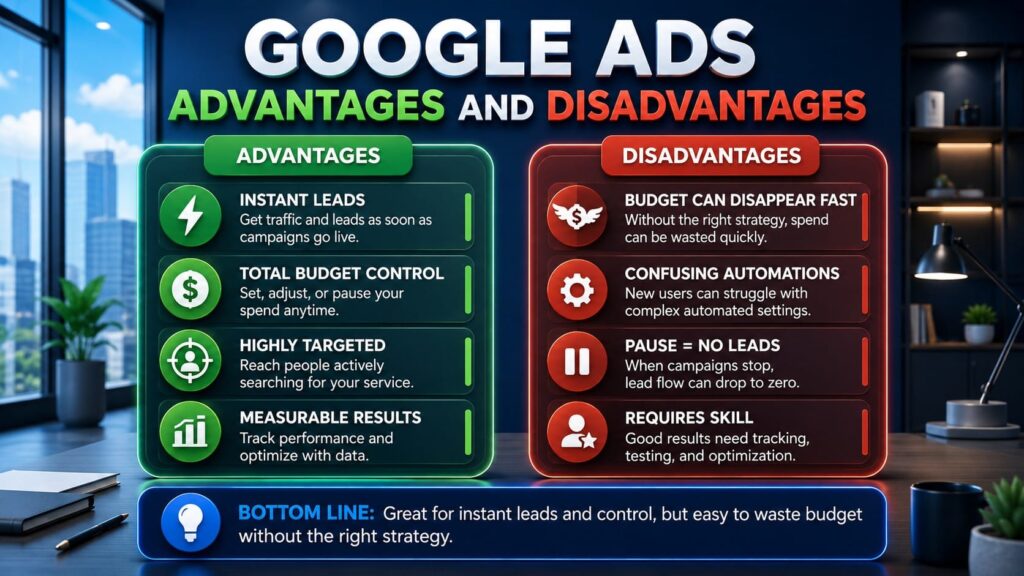
When evaluating Google ads advantages and disadvantages, the quick answer is simple: the primary advantage is getting instant leads with total budget control, while the main disadvantage is burning your budget fast on confusing automations. Plus, the moment you pause campaigns, your leads drop to zero.
I remember kicking off my Google Ads journey in 2017 and feeling completely in over my head. Honestly, with the flood of new automations and constant updates, it’s a much harder game to play today. But while beginners struggle, it’s a walk in the park for me now because I know exactly what I’m doing. I can’t tell you how many accounts I’ve audited where clients tried to run the ads themselves, burned out after a few months, and eventually just handed the reins to me.
I’m writing this to you like a letter to a friend to share the absolute reality of the platform. We’ll cover the real Google ads pros and cons and the ugly truths—including the exact hidden data in your account that no one else is talking about.
Contents
- 1. Google Ads Advantages and Disadvantages
- 1.1. Google Ads Advantages and Disadvantages
- 1.2. 7 Major Advantages of Google Ads
- 1.3. 7. Free Credits to Start
- 1.4. Let's Talk!
- 1.5. 7. Disadvantages of Google Ads (And the Ugly Truths)
- 1.6. 5. Time Intensive
- 1.7. 6. The Hidden Search Terms Report (Proprietary Insight)
- 1.8. 7. Strict Privacy Policies and Healthcare Restrictions
- 1.9. Google Ads Advantages and Disadvantages vs. SEO & Facebook Ads
- 1.10. Budgeting Reality Check: Is $20 a Day Good for Google Ads?
- 1.11. My Hard Stance on AI and Campaign Strategy
- 1.12. The DIY Trap: Why Running Your Own Ads Actually Costs You More
- 1.13. FAQ: Google Ads advantages and disadvantages
- 1.13.1. 1. What are the main Google Ads advantages and disadvantages?
- 1.13.2. 2. Is $20 a day good for Google Ads?
- 1.13.3. 3. What are the hidden disadvantages of Google Ads?
- 1.13.4. 4. Is Google Ads worth it for small businesses?
- 1.13.5. 5. How do the Google Ads pros and cons compare to Facebook Ads?
- 1.13.6. 6. Google Ads vs SEO: Which is better?
- 1.13.7. 7. How long does it take to see the advantages of Google Ads?
- 1.13.8. 8. Can Google Ads improve my organic ranking?
- 1.13.9. 9. Should I use AI Max or PMax for a brand new account?
- 1.13.10. 10. Why is it so easy to burn the budget on Google Ads?
- 1.13.11. Daniel Ostrzyzek
- 1.14. Let's Talk!
7 Major Advantages of Google Ads
1. Total Budget Control and Speed
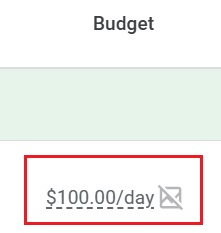
Let’s start with the good stuff. When looking at the advantages of Google Ads, the absolute best thing about this platform is that you have full control of the budget. You tell Google exactly what you are willing to spend each day, and it won’t force you past your limits. If you want to test the waters with $30 a day, we can do that. If your calendar is suddenly too full, we can literally push a button and pause the spend immediately. But the real magic is the speed. Unlike organic SEO, which can take six to twelve months to show real movement, I can build a campaign, start the ads in 24 hours, and immediately start getting leads. You aren’t waiting around hoping the phone will ring; it is a very fast way to grow and scale a business right from day one.
2. Pinpoint Location Targeting
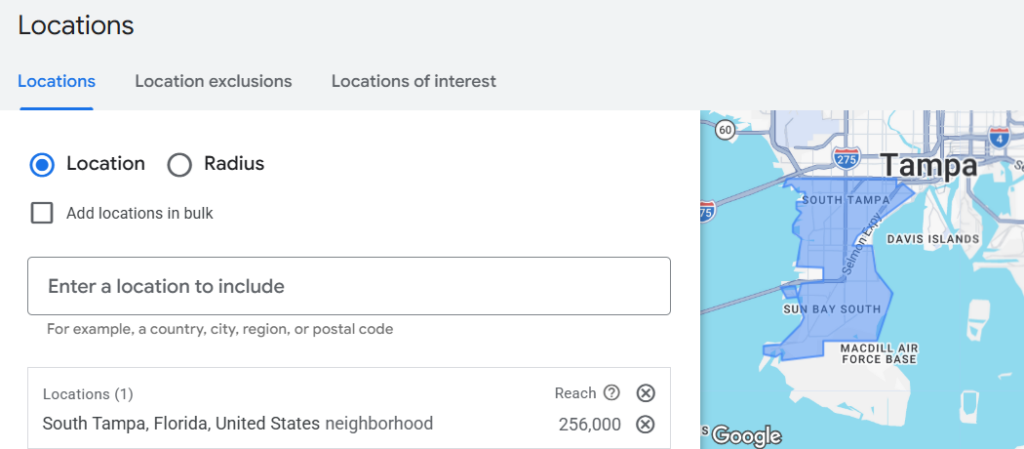
If you run a local service business—like a plumbing company or a cleaning service—paying for clicks from people from other state is a complete waste of money. I love that we have full control of the location where we want to serve the ads. I can target a specific city, a tight cluster of zip codes, or even drop a one-mile radius right around your shop to make sure your budget is only spent on people you can actually drive to. If you only want to work in high-income neighborhoods, we just draw a digital fence around them and ignore the rest.
3. Bottom-of-Funnel Keyword Control
This is where Google absolutely crushes social media advertising. On Facebook, you are interrupting people who are looking at photos of their friends. On Google, I get complete control of the keywords that we can advertise on, meaning I am putting your ads directly in front of people at the bottom of the funnel who are actively searching and ready to buy your service or product. There is a massive difference between hoping someone needs a plumber and bidding on the exact phrase „emergency plumber near me open now.” They already have the problem; we just show up at the exact second they need the solution.
4. Hyper-Detailed Measurement
I am obsessed with tracking data, and Google Ads lets us measure every single piece of the campaign in a very detailed way. I never have to guess what marketing strategy is working. I can track the exact cost per click, the cost per lead, and ultimately measure how much money we make from specific campaigns. I can look at an account and say, „This exact keyword cost you $150 this month, but it generated $4,000 in closed sales.” If a different keyword is just burning cash without generating a return, I kill it immediately. Simple as that.
5. A/B Testing Capabilities
You never truly know what message will click with a customer until you put it out there in the wild. The platform gives us the ability to easily run A/B tests for the ads and landing pages. I constantly test different headlines against each other—for example, does „Award-Winning Plumbers” get cheaper clicks than „$50 Off Your First Service call”? I test different offers and elements in the landing pages to see which one brings in the highest conversion rates and qualified leads. We let the data tell us what your customers actually respond to, rather than just guessing.
6. A Variety of Campaign Types
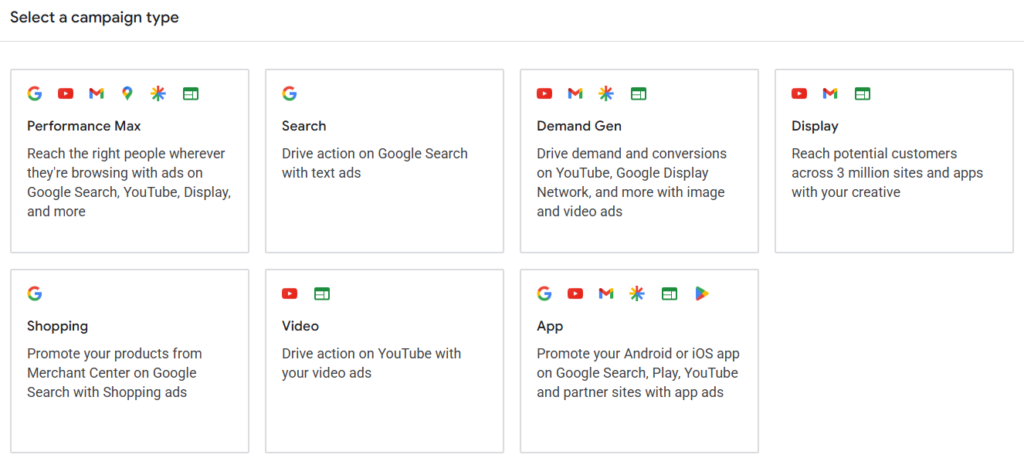
Once you conquer the basics, the ceiling for growth is huge because we have a lot of different campaigns to test. While standard search ads are usually the absolute best starting point for a service business to get fast leads, the ecosystem is massive. We have display ads to chase people around the internet, video campaigns for YouTube, Performance Max (PMax), and Demand Gen. All of these are worth testing and represent a great opportunity to grow the business further once your initial search foundation is profitable and solid.
7. Free Credits to Start
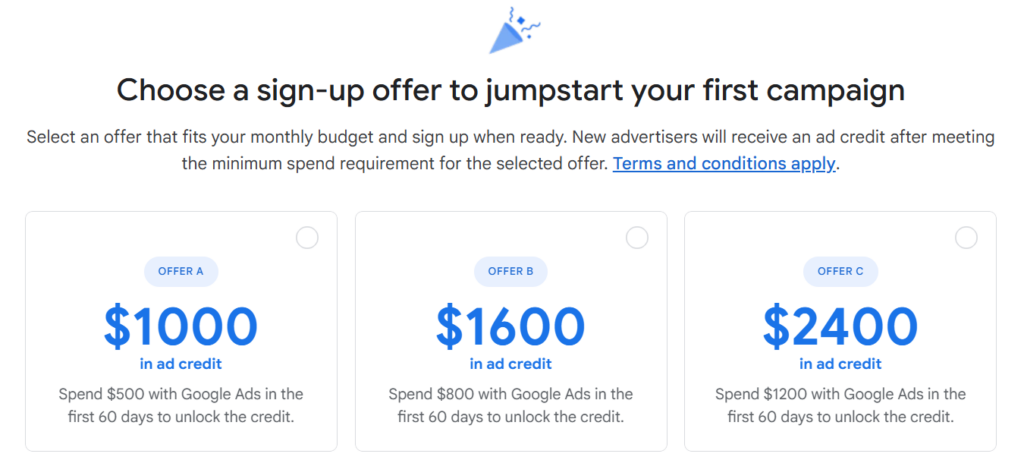
When you open a brand new account, Google actually hands you free money to get started. They typically offer promotional credits—like matching your first $1000 in ad spend—when you launch your first campaigns (the amount changes and depends on the country). I love this because it gives you a crucial financial buffer. You get to test your initial keywords, gather your first batch of data, and figure out what actually converts using Google’s money instead of burning purely through your own cash.

Let's Talk!
I’m here to help you grow your business with the power of Google Ads. If you’re ready to take your campaigns to the next level – Schedule My Free Consultation
7. Disadvantages of Google Ads (And the Ugly Truths)
1. Paused Ads Equal Zero Leads
Let’s be brutally honest about how this platform operates and the main disadvantages of Google Ads. The platform is essentially a faucet you rent from Google. The absolute reality is that when the ads are paused, we do not have the leads. Unlike organic SEO, where a well-ranking page can bring in traffic for years, Google Ads is a strict pay-to-play system. The second you stop spending money, your phone instantly stops ringing.
2. High Costs in Competitive Markets
If you are an insurance agent, or a plumber in a major city, you are going to experience some serious sticker shock. In a competitive market the costs are high. You might look at the cost-per-click and wonder how anyone makes a profit. But here is the truth: if you know how to do it you can still grow. You just have to be vastly smarter than your competitors by optimizing your landing pages and hunting for high-intent, long-tail keywords instead of just throwing money at the most obvious, expensive terms.
3. The Dangers of New Automations

Google loves to push „smart” and automated campaigns to make the platform seem effortless, but this is a massive trap. There are a lot of new automations from Google, and if you are not aware about the impact of it and how to deal with it, you can lose money fast. Google’s automated systems want to spend your budget, and if you just accept their default recommendations without knowing how to put guardrails in place, it will funnel your money right into low-quality clicks that never convert.
4. Constant Changes & Budget Burn
The Google Ads interface you are looking at today will not be the exact same one you see in the near future. There are a lot of different small and from time to time bigger changes. You need to have a hand on it constantly to not lose the important ones. If you have no experience you can burn the budget fast. I’ve audited so many accounts where a business owner missed a single, subtle setting change and accidentally blew thousands of dollars on irrelevant traffic.
5. Time Intensive
You cannot just set a campaign up on a Sunday afternoon, ignore it for a month, and expect to get rich. You really need to have the experience if you want to grow the business using Google Ads. And it’s completely overwhelming if you’re starting; if you have a business to run it’s very difficult to have time to learn and get experience. To win, you need to be actively analyzing data, adding negative keywords, and adjusting bids, do A/B tests —and most service business owners simply do not have the hours in the day for that.
6. The Hidden Search Terms Report (Proprietary Insight)

This is my biggest grievance with the platform, and it is a massive no entry spot. In the search terms report, you can have the view sometimes to the half of the keywords you spent money on. Google hides the rest under an „other search terms” category, claiming privacy reasons. Not a lot of people are talking about it. When I sit down with clients, I literally pull up my screen with the budget of the clicks we can find in this report and the ones we can not—and their jaws drop. I believe it is fundamentally unfair to pay for traffic when Google refuses to tell you exactly what those people typed into the search bar, making expert management even more critical to prevent wasted spend.
7. Strict Privacy Policies and Healthcare Restrictions
If you are in a regulated industry—especially the medical field—Google Ads can be an absolute nightmare to navigate. They have incredibly strict privacy policies and healthcare restrictions. For example, if you run a medical clinic or deal with sensitive health issues, Google’s „Health in Personalized Advertising” policy strictly forbids you from using remarketing. You absolutely cannot track potential patients and show them ads across the internet later because Google considers it a violation of user privacy.
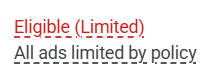
On top of that, if you use certain restricted medical terms, or offer specialized treatments like weight loss or addiction services, your ads will constantly get flagged, marked as „Eligible (Limited)”, or flat-out disapproved by their automated systems. You often have to jump through massive hoops to get expensive third-party certifications (like LegitScript) just to be allowed to run your ads. It is incredibly frustrating for legitimate medical business owners who just want to advertise their services but have to constantly fight with Google’s policy bots to keep their campaigns online.
Google Ads Advantages and Disadvantages vs. SEO & Facebook Ads
I constantly get asked by business owners if they should just run Facebook Ads because the clicks seem cheaper, or if they should abandon paid ads altogether and focus purely on SEO. Here is my honest take: you cannot treat these platforms like they do the same job.
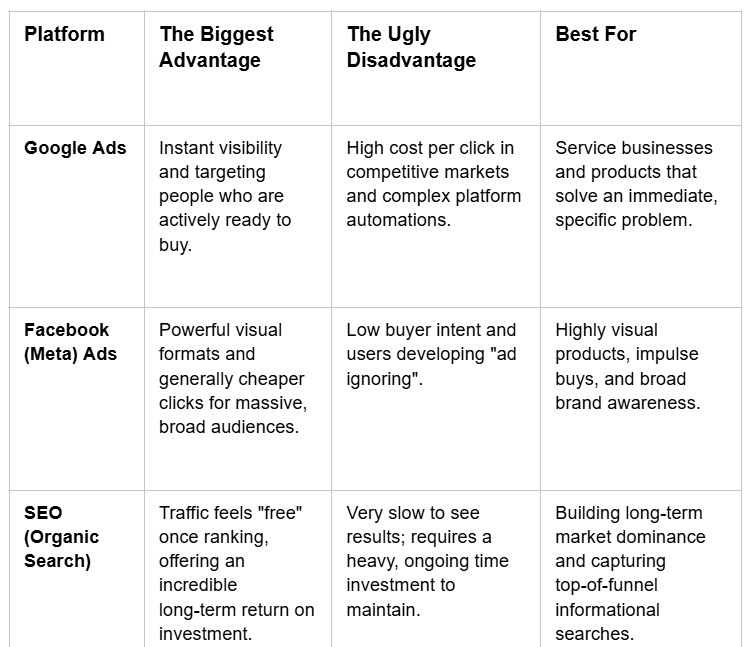
Facebook (Meta) Ads are interruption marketing. You are essentially putting a digital billboard in front of someone while they are scrolling through photos of their friends. It can be great for brand awareness or impulse purchases, but the user intent to buy right then and there is very low, and users frequently develop ad ignoring.
Google Ads captures high buyer intent because you are targeting users who are actively searching for what you offer. They already have a problem; they just need your solution.
SEO is fantastic, but it is strictly a long-term strategy. It can take six months to a year to actually rank a new page. If you need the phone to ring tomorrow to keep the lights on, SEO is not going to save you. Google Ads is your lever for fast results , while SEO should be built in the background as your long-term foundation.
Here is a quick, structured breakdown to help you evaluate the best fit for your business right now:
Budgeting Reality Check: Is $20 a Day Good for Google Ads?
I see this question popping up in Google’s own search results and forums all the time: „Is $20 a day good for Google Ads?”. Business owners also constantly ask me if $100 a day is what they really need to see results.
Here is my direct, honest answer: For most local service businesses today, $20 a day is simply not enough to move the needle. If you are a plumber, an electrician, or dentist in a competitive market, a single high-intent click can easily cost $15 to $30. At $20 a day, you are buying one or maybe two clicks. That is nowhere near enough traffic to figure out what keywords actually convert. You are just dripping money into a bucket with a hole in it. If you want to give Google Ads a fair test and gather enough data to actually optimize your account, $100 a day is a much more realistic starting point.
You also need to understand how Google actually spends your money. When you set a daily budget, you are really setting an average. Google calculates your spending limit based on a monthly cap. If you set a $50 daily limit, Google might spend $100 on a Tuesday when search demand for your service is exploding, and only $10 on a slow Sunday.
This is why setting expectations based on your specific industry is so critical. In highly competitive markets, the cost per click is naturally high. If you enter a fierce, expensive market with a tiny budget, your money will be eaten alive before you can even survive the learning phase. You must set a budget that allows for enough daily clicks to actually evaluate performance, or you are just gambling.
My Hard Stance on AI and Campaign Strategy
Google released AI MAX for search in May 2025, adding yet another automated campaign type to the mix. You will probably hear recommendations from others telling you to go all-in and put all your cards on these new AI-driven campaigns, but it is not the time for that. For service businesses, this campaign type simply is not performing well right now.
Here is a proprietary insight that standard tutorials will not tell you: if you have an ad group set up strictly for standard search and you decide to open AI Max for Search within it, you will find that 90% of your budget is suddenly going only to AI MAX. It completely cannibalizes your traffic, leaving standard search with almost nothing.
Because of this aggressive budget drain, I have a very firm rule. I don’t recommend and disagree that starting campaigns with PMAX or AI Max for search is a good idea for a brand new account. It is the exact opposite. First, gain conversions and leads from standard search at a cost your business can accept. Only after you have that profitable, predictable baseline should you test campaigns like PMAX or AI Max for search, and strictly with just 10% of your overall budget.
The DIY Trap: Why Running Your Own Ads Actually Costs You More
I see this happen all the time. A business owner decides to save a few bucks by managing their Google Ads themselves instead of hiring an expert. I’ve audited a lot of accounts where clients tried to run the ads by themselves, but after a few months, they give up, swallow their pride, and hand the mess over to me.
Here is the absolute reality: if you have a business to run, it is virtually impossible to find the time to learn this platform properly. You are busy dealing with your staff, your customers, and your daily operations. Meanwhile, Google is rolling out small, sneaky changes—and sometimes massive overhauls—that require you to have your hands constantly on the keyboard so you do not lose the important ones.
Ultimately, understanding Google ads advantages and disadvantages means knowing your limits. When you DIY your account, you are not saving the management fee. You are simply paying that fee directly to Google in the form of wasted clicks, hidden search terms, and blown budgets. You really need to have the experience if you want to grow the business using Google Ads without burning your cash.
If you are currently stuck in this DIY trap and watching your budget drain away, let’s talk. Reach out to me for an account audit, and I will show you exactly where your money is bleeding and how we can stop it.
FAQ: Google Ads advantages and disadvantages
1. What are the main Google Ads advantages and disadvantages?
The biggest advantage of Google Ads is the speed and total budget control—you can get high-intent leads within 24-48 hours. The main disadvantage is that it is strictly pay-to-play; the moment you pause your campaigns, the leads stop instantly. Plus, navigating the confusing automated settings can drain your budget if you aren’t careful.
2. Is $20 a day good for Google Ads?
Honestly, no. In competitive service markets, $20 a day might only buy you one or two clicks. To actually test keywords and figure out your true Google Ads ROI, I always tell clients that $100 a day is a much more realistic starting point to gather enough data.
3. What are the hidden disadvantages of Google Ads?
One of the ugliest disadvantages of Google Ads is the hidden search terms report. Often, you are only allowed to see about half of the exact keywords you actually spent money on. Google hides the rest, making it incredibly hard to optimize your budget without expert experience.
4. Is Google Ads worth it for small businesses?
Absolutely. Even with the high Google ads cost per click in some competitive markets, if you target bottom-of-funnel keywords, control your location targeting and optimize campaigns, there is a huge opportunity to grow your service business from day one.
5. How do the Google Ads pros and cons compare to Facebook Ads?
The biggest advantage of Google Ads over Facebook is buyer intent. On Google, people are actively searching for your exact solution. On Facebook, you are interrupting their scrolling. Facebook might have cheaper clicks, but Google brings you people who are actively ready to buy right now.
6. Google Ads vs SEO: Which is better?
They serve entirely different purposes. The advantage of Google Ads is speed—you get leads immediately. The disadvantage is that you pay for every single click. SEO gives you an incredible long-term return, but it can take months to work. I recommend using ads for instant cash flow while building your organic SEO in the background.
7. How long does it take to see the advantages of Google Ads?
You can build a campaign and start seeing traffic and leads within 24 hours. That speed is why I love the platform. However, truly dialing in your conversion rates and hitting your target Google Ads ROI usually takes to three months of active testing and A/B optimization.
8. Can Google Ads improve my organic ranking?
No, running paid ads does not directly boost your organic SEO rankings. This is a common myth. However, the data we gather from ads—like knowing exactly which keywords generate actual revenue—can be a massive advantage when planning your long-term organic SEO strategy.
9. Should I use AI Max or PMax for a brand new account?
I strongly disagree with doing this. If you mix standard search with AI Max for search, you will find that 90% of your budget drains directly into AI Max. First, master standard search to get profitable leads, then test those automated campaigns with only 10% of your budget.
10. Why is it so easy to burn the budget on Google Ads?
Because beginners don’t know how to navigate the constant platform changes and default automations. A major disadvantage of Google Ads is that if you don’t have the hands-on experience to monitor the hidden data and adjust bids daily, Google’s systems may spend your money on low-quality traffic.

Daniel Ostrzyzek
Hi, I’m Daniel Ostrzyzek, a passionate Google Ads specialist with over 8 years of experience. I work with small to medium-sized businesses to help them attract leads, achieve their growth goals, and maximize ROI through Google Ads campaigns. After discovering my passion for digital marketing, I dove deep into Google Ads. Over the years, I’ve gained valuable experience working with businesses across various industries. I specialize in Google Ads Search and lead generation campaigns, helping my clients maximize the results of their online advertising.
Let's Talk!
I’m here to help you grow your business with the power of Google Ads. If you’re ready to take your campaigns to the next level – Schedule My Free Consultation