
Google Local Services Ads vs Google Ads
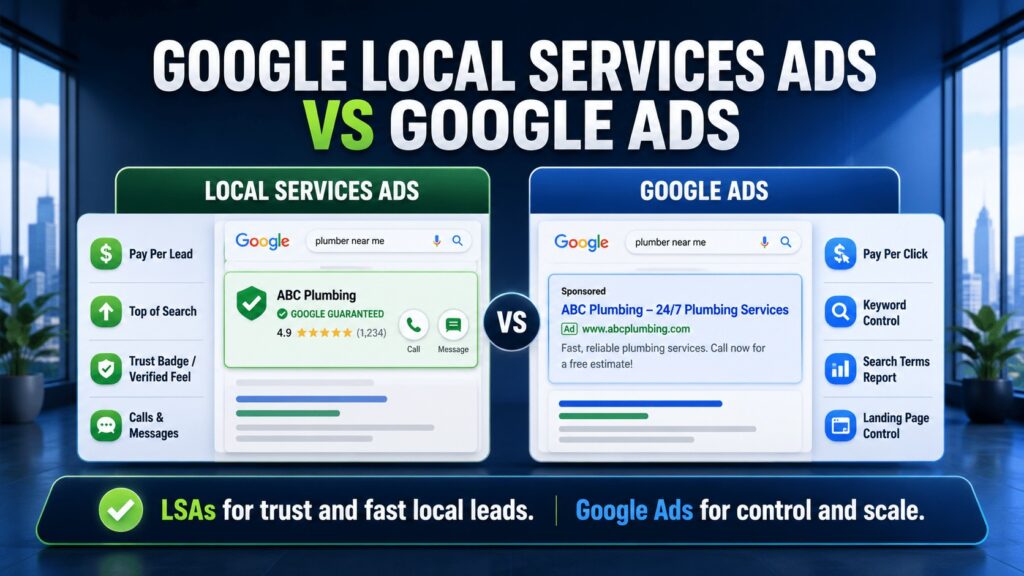
The Short Answer: Google Local Services Ads (LSAs) are pay-per-lead ads appearing at the absolute top of local search results with trust badges like „Google Guaranteed”. Traditional Google Ads use a pay-per-click (PPC) model, offering total control over search terms. LSAs drive immediate trust, while traditional Ads provide granular optimization to block junk traffic. When evaluating Google Local Services Ads vs Google Ads, it ultimately comes down to instant trust versus maximum control.
Let’s be real. When someone types „plumber near me,” a battle starts on the search results page. You see two different ads trying to steal that click: LSAs sitting at the very top, and traditional Google Ads fighting for attention with specific text. I’ve spent years inside these dashboards. Today, we will explore costs, setup tips, and why treating these two platforms as strict competitors in the GLSA vs Google Ads matchup is a massive mistake.
Contents
- 1. Google Local Services Ads vs Google Ads
- 1.1. Google Local Services Ads vs Google Ads
- 1.2. What Are Google Local Services Ads?
- 1.3. What Are Google Ads?
- 1.4. Proprietary Evidence: The $8,000 Conversion Rule Breakthrough
- 1.5. Eligibility and Setup for Local Service Ads
- 1.6. Let's Talk!
- 1.7. Managing and Optimising Local Service Ads
- 1.8. When to Use Google Local Services Ads and Google Ads (and When to Combine Them)
- 1.9. Conclusion & Next Steps
- 1.10. FAQ: Google Local Services Ads vs Google Ads
- 1.10.1. 1. What is the main difference in Google Local Services Ads vs Google Ads?
- 1.10.2. 2. Is GLSA cheaper than a traditional Google Ads campaign?
- 1.10.3. 3. In the GLSA vs Google Ads debate, which should I choose?
- 1.10.4. 4. Can I dispute bad leads and get my money back with Local Services Ads?
- 1.10.5. 5. How do I get the "Google Guaranteed" badge for my business?
- 1.10.6. Daniel Ostrzyzek
- 1.11. Let's Talk!
What Are Google Local Services Ads?
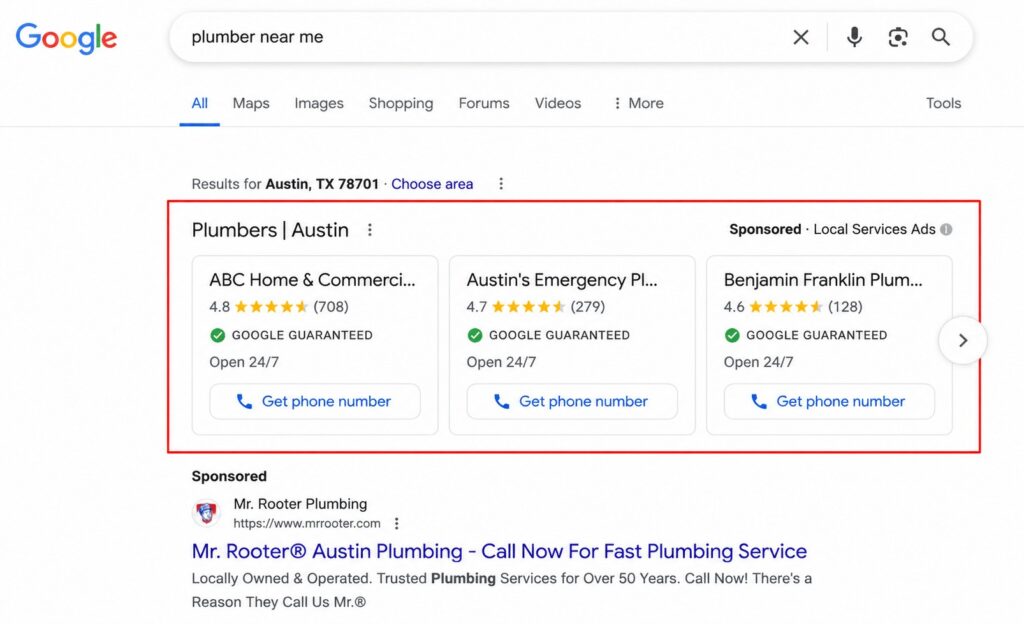
Google Local Service Ads are those hyper-local blocks that dynamically appear above absolutely everything else—above the standard paid text ads, above the map pack, and above the regular organic results. They are almost impossible to miss because they proudly feature your star rating, real-time Google reviews, and a direct button for the customer to call or message you immediately. I believe Google Local Services Ads (GLSAs) are just the little brother to traditional Google Ads. Let me be blunt: they don’t pack the same punch, and they strip away a massive amount of the control and optimization you get with a standard search campaign. You are trading power for simplicity, meaning you are completely handing the wheel over to a black-box algorithm.
What Are Google Ads?
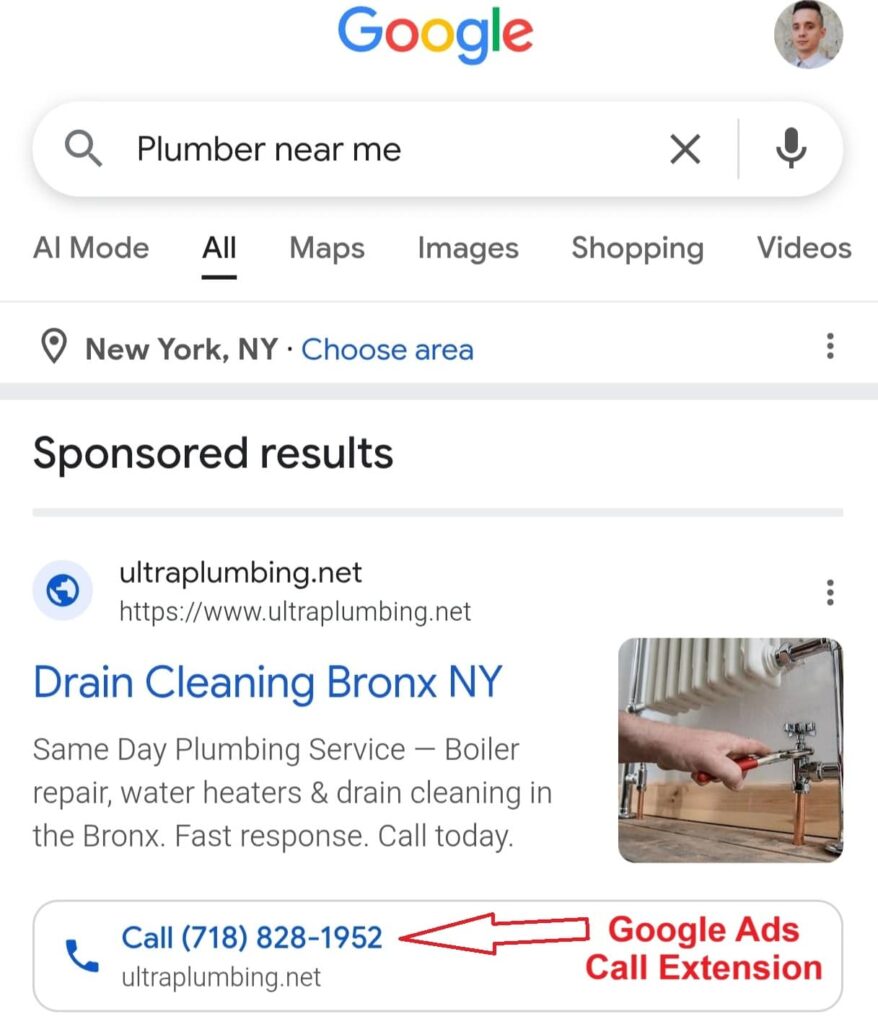
Traditional Google Ads operate on a classic Pay-Per-Click (PPC) framework. Instead of a rigid templated profile, you write custom text and drive traffic to your own landing pages across Search, Display, YouTube, and Maps. You can also use call assets (formerly call extensions) to display your phone number right in the ad, giving mobile users a one-click button to call you directly. While these ads give you total control over your exact keywords, the catch is that you pay for every single click—whether it becomes a paying customer or an immediate bounce. You can set your daily budget to know how much Google Ads cost monthly.
Key Differences: Google Local Services Ads vs Google Ads
Pricing Models – Pay-Per-Lead vs Pay-Per-Click
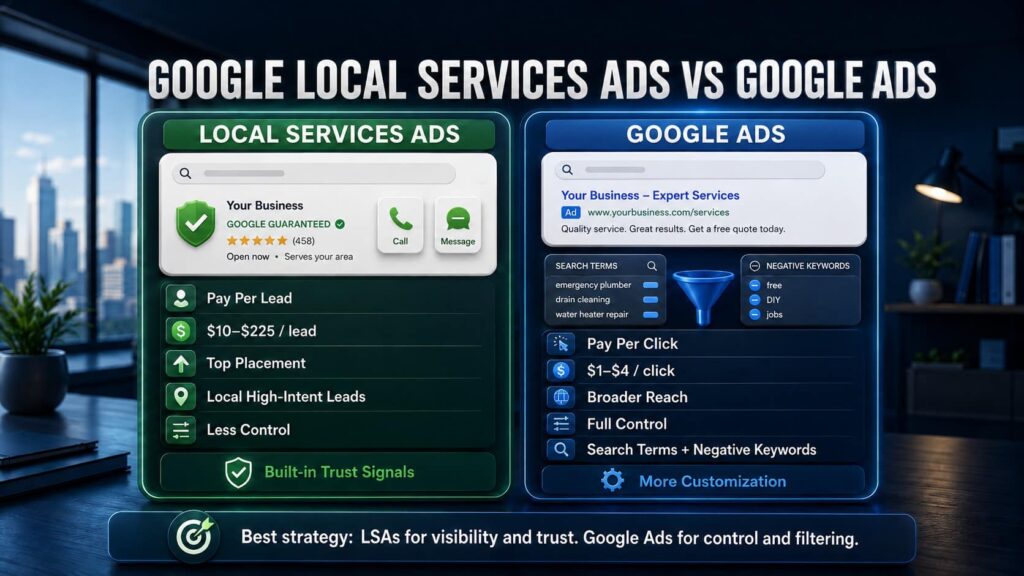
The financial mechanics between these two platforms in the GLSA vs Google Ads ecosystem are fundamentally different. With traditional Google Ads, you pay per click, which usually averages between $1 and $4 per click for standard search campaigns. With Google Local Services Ads, you pay per lead, and the 2026 data shows those costs can range anywhere from $10 to $225 per lead depending on your market. In the GLSA system, you only get charged for a lead if the call lasts over 30 seconds, and you do have the ability to dispute invalid leads.
But here is where I take a hard stand. Read any generic marketing blog or ask a standard AI, and they will tell you that Google’s algorithm has become so advanced that you should just trust it to find your customers. They claim GLSA is perfect because you simply select your service category, and Google’s „smart” AI handles all the targeting. I completely disagree. Trusting a black-box algorithm to decide what a „relevant” customer looks like is financial suicide.
Here is the truth standard AI won’t tell you: Google hides the actual search terms in GLSA for a reason. If you could see what people were actually typing into the search bar before they clicked your GLSA profile and cost you $80, you would be furious. Google’s algorithm may match the broad searches like „DIY fixes” or „parts store near me” just to spend your budget.
My counter-intuitive secret is that traditional Google Ads is vastly superior because it gives you the Search Terms Report—the unfiltered lie detector of exactly what the user typed. While GLSA keeps you completely with no idea about search terms, traditional Google Ads lets me see the exact phrase, identify the junk Google is trying to sell me, and use Negative Keywords to permanently block it. The industry says to trust the algorithm; my data proves you need the Search Terms report to protect yourself from it. This doesn’t mean you should abandon GLSAs—their top-of-page placement and trust badges are too valuable to ignore—but it means relying on them as your only strategy is a massive mistake.
Ad Placement & Visibility
When comparing visibility in Google Local Services Ads vs Google Ads, placement is everything. LSAs sit directly above paid search ads, the local map pack, and organic search results. They completely dominate the top of the screen. In contrast, traditional Google Ads can appear above, beside, or below organic results, but they also give you placement options across the Display network, Google Shopping, YouTube, and Maps.
Audience & Reach
Another critical factor in the GLSA vs Google Ads comparison is how they handle audience reach. LSAs are built for local, high-intent service searches where the customer is ready to call, message, or book with a nearby provider. That local intent is powerful: Google data shows that 76% of people who search on their smartphone for something nearby visit a business within a day. The key distinction is that LSAs are not a general retail ad format. They are available only for eligible local service categories, such as chiropractors, dentists, contractors, landscapers, lawyers, and other approved service-area or storefront service businesses.
Traditional Google Ads, by contrast, provide a significantly broader reach and flexibility. If you need to scale outside a tight geographic boundary, educate an audience, or target highly complex problems that a broad service category cannot catch, traditional ads give you that necessary scale.
Control & Customisation
LSAs are simpler to manage because Google matches your ads to searches based largely on your selected service categories, job types, and service areas. That simplicity comes with a tradeoff: you have far less control over the exact keywords, ad messaging, and landing page experience. Google Ads, on the other hand, gives you much deeper control over your keyword strategy, ad copy, landing pages, and daily budgets.
Let me show you why this matters. When I took over a B2C service client’s account, I didn’t just tell them they needed a bigger budget. I personally dug into their traditional Google Ads dashboard and saw exactly where their cash was bleeding. I noticed they were paying for clicks during weird hours that only resulted in 20-second, useless phone calls. So, I went in and built a custom schedule to completely cut off our ads during those specific times. Then, I went line-by-line through their data and manually blocked all the junk search terms that were draining their daily spend. I literally watched the quality of their incoming phone calls transform.
You just can’t do this with a GLSA account. With GLSA, you are forced to sit on the sidelines and take whatever calls Google hands you. With traditional Google Ads, I actually got my hands dirty, cut the waste myself, and forced the system to only bring us real buyers.
Trust & Verification Signals
Traditional Google Ads can include trust elements like ratings, assets, and advertiser disclosures, but they do not carry the same built-in verification weight as Local Services Ads. LSAs are different because eligible advertisers must go through Google’s screening and verification process before earning the Google Verified badge.
That badge can be a major advantage in competitive local service markets. For homeowners comparing contractors, dentists, chiropractors, or other local providers, seeing that a business has passed Google’s verification process can create instant credibility before the customer even clicks, calls, or sends a message. The key point is simple: Google Ads let you build trust through your landing page, reviews, offer, and brand. LSAs place part of that trust directly inside the ad itself.
Proprietary Evidence: The $8,000 Conversion Rule Breakthrough
I recently worked with a mid-sized B2C service client that was spending about $8,000 per month to generate inbound phone calls. On paper, the campaign looked active. In reality, many of the calls were low-quality: quick hang-ups, unqualified tire-kickers, and people asking questions that had no chance of turning into revenue.
This is exactly where the difference between Google Local Services Ads vs Google Ads becomes very real.
If that entire budget had been running through Local Services Ads, we would have had far fewer optimization levers. LSAs can generate calls and messages, and Google may offer lead feedback or credits for certain poor-quality leads, but you cannot build a custom bidding signal around your own definition of a qualified phone call.
With traditional Google Ads, we could.
I went into the account and set a strict rule: a phone call only counted as a conversion if it lasted longer than 120 seconds. That one change forced the campaign to stop treating quick hang-ups and low-intent calls as success. Instead, the algorithm started optimizing toward deeper, more meaningful conversations—the kind of calls that actually had a chance to become customers.
The result: qualified inbound phone calls increased by 29% in just 30 days, while the monthly budget stayed the same.
That is the advantage Google Ads. You are not just buying leads. You are controlling what Google learns from. And when you feed the system better conversion data, you give it a much better chance of finding real buyers instead of wasting your budget on bad-fit calls.
Eligibility and Setup for Local Service Ads
Industry Eligibility and Geographic Availability
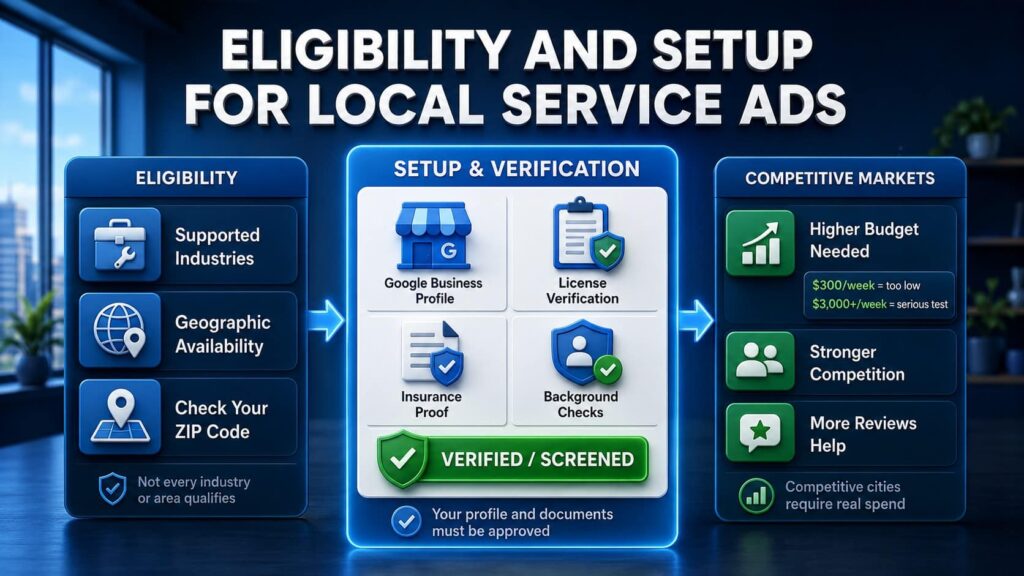
Before you get excited about launching a campaign, you need to find out if Google even allows your business into the club. The Local Services Ads program is heavily gatekept and varies drastically based on your geographic location and state regulations. Currently, the program extensively covers core home services like HVAC, plumbing, electrical, and roofing, but it has also been steadily expanding into professional and white-collar niches like financial planning, and healthcare practices including dentists, chiropractors, and doctors. However, don’t assume your trade is automatically safe; many specialized professions or e-commerce models are entirely excluded from the platform. You have to check Google’s official regional eligibility list first, because if your industry isn’t explicitly supported in your zip code, the door is completely shut.
Google Business Profile and Verification
If you pass the eligibility test, the real work begins with your Google Business Profile, which serves as the literal foundation for your entire LSA presence. You must have a fully claimed, accurate, and completely optimized profile because Google syncs your reviews and business data directly into your LSA dashboard. From there, Google puts you through a grueling verification process that stops most business owners dead in their tracks. To secure that coveted green Google Verified or Google Screened badge, you have to submit current trade licenses, proof of corporate general liability insurance, and force your entire field staff to pass rigorous third-party background checks. This isn’t a quick upload-and-go scenario; it is a strict audit designed to weed out shady operators, but surviving it is pure gold because that badge builds immediate, rock-solid trust with property owners before they even click your name.
The Brutal Cost of Admission in Competitive Markets
Look, if you are trying to break into a brutal, highly competitive niche like insurance or health—and God forbid you are trying to do it in a massive city like New York—you have to be ready to spend real money. I can’t tell you how many times I’ve seen local business owners set up an account with an average weekly budget of exactly $300, and then scratch their heads wondering why their phone isn’t ringing. I’ve literally looked at those dashboards myself. Let’s be real: in a hyper-competitive market, $300 a week is pocket change to Google. You need to multiply that number by at least 10 times—meaning you need a baseline of $3,000 a week minimum—just to get a seat at the table and think seriously about making GLSAs work. If you try to skimp on the buy-in, Google’s algorithm will simply ignore your profile and feed all the live leads to the big players who are properly funded.

Let's Talk!
I’m here to help you grow your business with the power of Google Ads. If you’re ready to take your campaigns to the next level – Schedule My Free Consultation
Managing and Optimising Local Service Ads
Here is a tough truth Google won’t tell you: you can set your account up perfectly, pass the grueling background checks, get that shiny green badge, and still sit there for weeks with your phone completely silent. Unlike regular Google Ads, you don’t just flip a switch and get calls the very next morning. When things go quiet, it is super frustrating to figure out why, but I’ve found it almost always comes down to you trying to do too much.
If you make your service area too big, click on way too many job types, or stretch a small budget across too many options, Google will actually stop showing your ads. You might think checking every single box makes you more visible, but it actually dilutes your budget and tells the algorithm that you lack a hyper-local specialty. And honestly, the system itself is just unpredictable. You could be getting great phone calls every single day for months, and then wake up one morning to find your leads cut in half—or totally at zero—for absolutely no reason at all. This is exactly why relying entirely on a black-box system without a backup plan is a massive risk.
When to Use Google Local Services Ads and Google Ads (and When to Combine Them)
The Monopolization Strategy
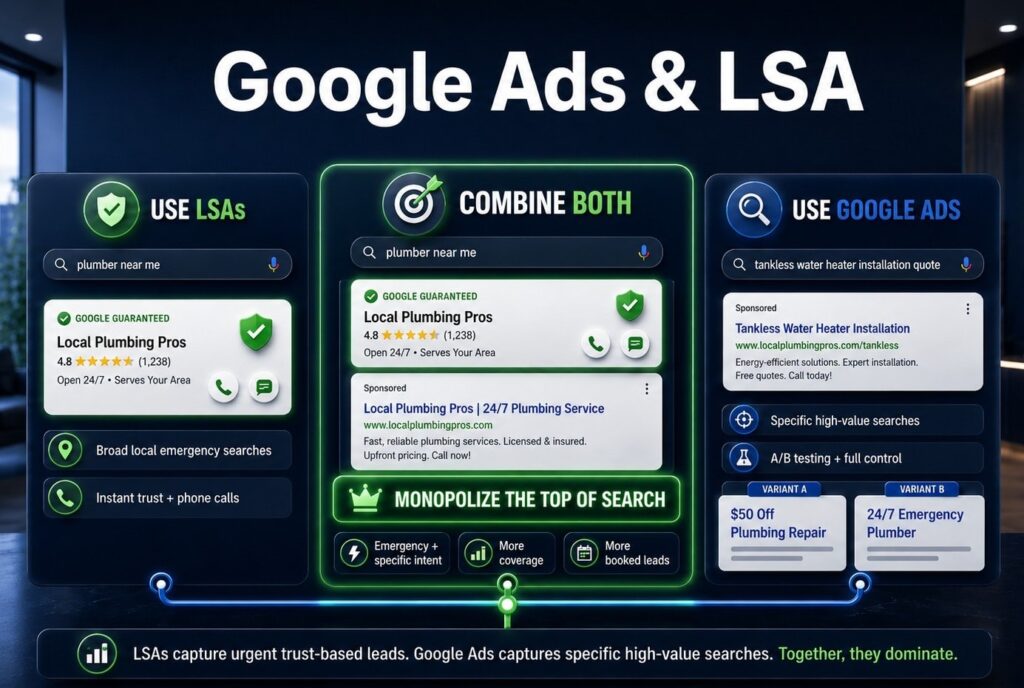
Most industry advice forces you to choose a side, arguing whether you should put your budget into pay-per-lead or pay-per-click in the GLSA vs Google Ads war. I completely disagree with marketers who treat these platforms as competitors. While GLSAs might lack the granular tweaking and absolute control of standard search ads, pairing the two platforms creates an unstoppable combo that lets you absolutely monopolize the top of the search results.
Think about how a real customer searches. When someone has an immediate, high-stress local emergency—like a burst pipe or a broken air conditioner—they type a broad term like „plumber near me.” In that exact moment, your LSA profile swoops in at the absolute top of the page, leveraging that green Google Guaranteed badge to establish immediate, rock-solid trust and capture the phone call.
But what about the customer searching for a highly specific problem? Say someone types „commercial circuit breaker repair and replacement” or „tankless water heater installation quote.” The broad GLSA algorithm often misses these nuanced, high-value queries. That is exactly when your traditional Google Ads step in to catch the traffic, allowing you to use specific keywords and custom ad copy to drive that user to a dedicated landing page. By running both systems simultaneously, you cover every single angle: GLSAs secure the instant-trust emergency calls, while traditional Google Ads hunt down the complex, high-ticket buyers that the automated system ignores. You don’t have to choose between them; you use them together to completely dominate your local market.
A/B Testing: The Power to Pivot
Let me give you another massive reason why traditional Google Ads is vastly superior when it comes to scaling your business: the ability to run ruthless A/B tests. In standard Google Ads, you have total, unfiltered control over your ad copy and your landing pages. If I want to test a headline that says „$50 Off Your Plumbing Repair” against one that says „24/7 Emergency Plumber,” I can run both simultaneously. I can look at the exact conversion data in Google Ads, kill the loser, and pour all of our budget into the winner. I can test different landing pages, different calls to action, and different offers to see exactly what actually prints money.
With GLSA, that level of strategic iteration is completely impossible. You get their rigid, templated profile, and that is it. There is no split-testing your layout, no A/B testing your business description, and no tweaking your core messaging to outsmart a competitor. You are entirely at the mercy of Google’s standardized format. If your GLSA profile suddenly stops converting, you can’t test your way out of the problem—you just have to sit there, completely stripped of control, and hope the black-box algorithm decides to favor you again.
Conclusion & Next Steps
At the end of the day, handing your entire marketing budget over to a black-box algorithm is financial suicide. Google Local Services Ads are a fantastic tool to secure that coveted green trust badge and get your business to the absolute top of the page, but they strip away your control and leave you completely blind to the actual search terms draining your cash. You are forced to sit on the sidelines and take whatever leads the system decides to hand you.
Traditional Google Ads give you the steering wheel back. They let you run ruthless A/B tests, use the unfiltered Search Terms Report to permanently block junk traffic, and force the system to optimize for real buyers—just like I did when I implemented that strict 120-second call rule to cut out the tire-kickers.
My final advice? Stop treating these two platforms as a forced choice. You need the instant trust of GLSAs for local emergencies, and the surgical precision of traditional Google Ads to capture high-ticket, complex jobs. If you are tired of waking up to a silent dashboard, bleeding cash on 20-second phone calls, and want to build a personalized hybrid strategy that absolutely monopolizes your local search results, it is time to take back control.
Schedule a free consultation with me today, and let’s force the system to stop draining your budget and start delivering highly qualified leads.
FAQ: Google Local Services Ads vs Google Ads
1. What is the main difference in Google Local Services Ads vs Google Ads?
The difference is pricing and control. With Google Local Services Ads (GLSAs), you pay per lead but surrender all targeting control to a black-box algorithm. With traditional Google Ads, you pay per click (PPC) but retain complete, granular control over your keywords and custom ad copy.
2. Is GLSA cheaper than a traditional Google Ads campaign?
Not necessarily. While GLSAs charge per lead, the platform automates your targeting and doesn’t provide specific search term data, meaning you can sometimes capture broader inquiries outside your primary focus. Traditional Google Ads charge per click, but they give you the control to actively use negative keywords to refine your traffic, which can often lead to a highly efficient cost per qualified buyer.
3. In the GLSA vs Google Ads debate, which should I choose?
Do not choose. The best strategy is to run both simultaneously to completely monopolize the top of the search results. Use GLSAs to capture immediate, instant-trust emergency calls, and use traditional Google Ads to hunt down the complex, high-ticket jobs the automated system misses.
4. Can I dispute bad leads and get my money back with Local Services Ads?
You can dispute invalid leads, but Google’s definition is very strict. Spam, wrong numbers, and clearly irrelevant contacts may qualify for a credit, but DIY questions, price checks, and early-stage research are usually still treated as valid leads. That is why combining Local Services Ads with Google Search Ads can work so well. Search campaigns let you block unwanted terms before you pay, instead of trying to recover the cost afterward.
5. How do I get the "Google Guaranteed" badge for my business?
You must pass a strict verification process. Google requires a fully optimized Google Business Profile, active trade licenses, proof of liability insurance, and third-party background checks for your field staff. It is a grueling process, but that green badge builds immediate, rock-solid trust with customers.

Daniel Ostrzyzek
Hi, I’m Daniel Ostrzyzek, a passionate Google Ads specialist with over 8 years of experience. I work with small to medium-sized businesses to help them attract leads, achieve their growth goals, and maximize ROI through Google Ads campaigns. After discovering my passion for digital marketing, I dove deep into Google Ads. Over the years, I’ve gained valuable experience working with businesses across various industries. I specialize in Google Ads Search and lead generation campaigns, helping my clients maximize the results of their online advertising.
Let's Talk!
I’m here to help you grow your business with the power of Google Ads. If you’re ready to take your campaigns to the next level – Schedule My Free Consultation